
Microsoft Patents AI Tool That Turns Plain English Queries Into Database Answers
Biological databases speak their own language, and AI models generally can't read it. Microsoft's new patent describes a system that acts as a translator between the two.
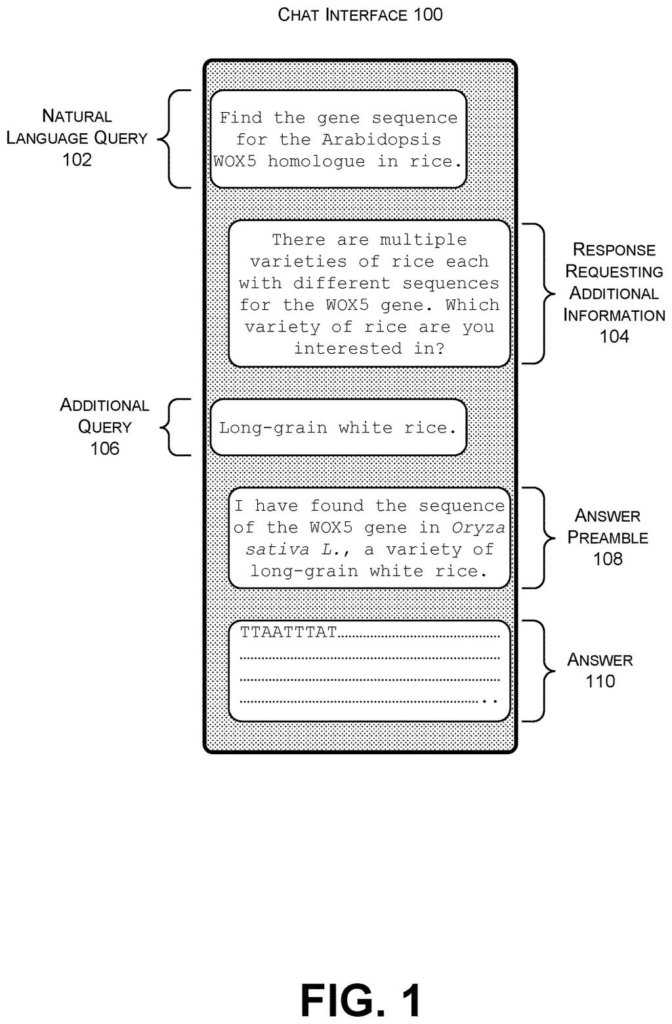
What Microsoft's gene-database AI interface actually does
Imagine asking a question like "what does the BRCA1 gene sequence look like?" to an AI assistant. Most AI models would try to answer from memory, but gene sequences and other scientific data live in specialized databases with their own strict formats. The AI has no reliable way to look things up in those databases directly.
Microsoft's patent describes a system that fixes this. When you ask a biology-related question in plain English, the system builds a special set of instructions (a "custom prompt") that tells the AI how to query a connected database tool. The database tool does the actual lookup, returns the raw data, and the AI folds it into a readable answer for you.
The first independent claim specifically focuses on biological sequences, like DNA or protein chains, suggesting Microsoft is targeting biomedical research workflows where scientists need to pull precise sequence data without writing database queries by hand.
How the custom prompt bridges plain English and database queries
The patent describes a pipeline with three main moving parts:
- A natural language query receiver that takes a plain-English question containing a reference to a biological sequence (for example, a gene name or accession number).
- A custom prompt generator that converts that question into a structured prompt telling the large language model (LLM) to use a specific "database look-up tool" rather than relying on its own internal knowledge.
- A database look-up tool that translates the LLM's request into the exact query format the database expects, retrieves a database-specific gene identifier, then uses that identifier to fetch the actual sequence data.
The two-step lookup is notable: the system first resolves a human-readable gene name into the database's internal ID, then uses that ID to pull the sequence. This mirrors how bioinformatics databases like NCBI or Ensembl actually work, where the same gene can have multiple identifiers across different systems.
The core technical problem being solved is that biological sequences are not natural language. An LLM trained on text can't reliably store or recall exact gene sequences as "embeddings" (the mathematical representations LLMs use to understand meaning). By routing lookups through a dedicated tool, the system gets precise data rather than an AI guess.
What this means for researchers using complex biological databases
For working biologists and bioinformatics researchers, querying gene databases today means learning database-specific syntax or writing code. A system like this could let a researcher ask a question in plain English and get back verified sequence data, without touching a command line. That's a real reduction in friction for a large class of scientific work.
More broadly, the patent is an example of tool-augmented AI, where LLMs are paired with external data sources rather than expected to know everything. Microsoft has been investing heavily in this pattern (it shows up throughout Microsoft Copilot), and extending it to scientific databases signals an interest in winning over research and healthcare customers who need accuracy, not just fluency.
This is a focused, pragmatic patent rather than a flashy one. The biological sequence angle is specific enough to suggest Microsoft has real use cases in mind, possibly in pharmaceutical research or genomics tooling. The two-step gene-identifier lookup is the kind of detail that only shows up when engineers have actually tried to build this and hit the wall of how messy biological databases are in practice.
There are more where this came from
We read every patent application Big Tech publishes and send you the ones worth knowing. Plain English, free, every week.
The drawings
5 drawing sheets from US 2026/0220380 A1 · click any drawing to enlarge


Want this weekly breakdown for a company we don't cover? Patentlyze Pro →
Be the first to weigh in