
Adobe Patents a System That Watches You Fill Out Forms and Rewrites Them With AI
Every time someone abandons a confusing form, Adobe wants an AI to notice, figure out why, and rewrite the form before the next person sees it.
What Adobe's AI form-fixer actually does for users
Picture a form you had to fill out online, maybe a job application or an insurance claim, where one question confused you so much you just gave up. Adobe's new patent describes a system designed to stop that from happening.
The idea is that the software watches how people interact with a form in real time: where they hesitate, which fields they skip, where they quit entirely. It then feeds that behavioral data into a pair of AI systems. The first AI figures out what is wrong; the second AI actually rewrites the form to fix it.
The result is a form that can improve on its own over time, without a human designer having to step in and manually rework it. Adobe frames this as a general framework, so it could apply to any kind of fillable digital form.
How the two-agent LLM pipeline spots and fixes form problems
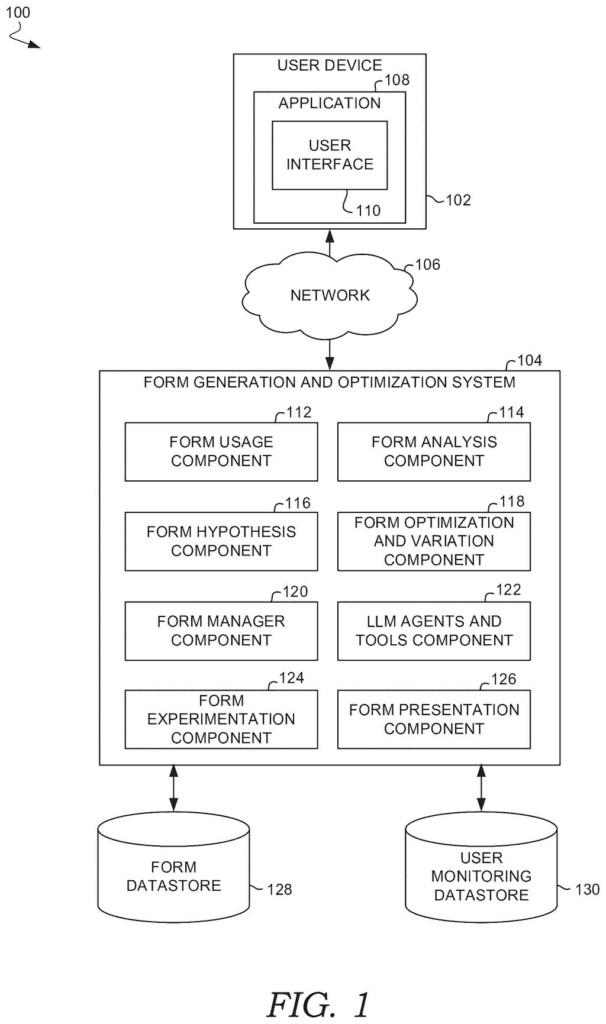
The patent describes a pipeline made up of several distinct software components working in sequence.
Step one: monitoring. A form usage component tracks how each person interacts with the form, think dwell time on a field, error messages triggered, fields left blank, and whether the user submitted or abandoned the form.
Step two: analysis. A form analysis component processes that interaction data to identify specific problems, such as a question being unclear, a field ordering that confuses users, or a required field people consistently miss.
Step three: hypothesis generation. A first set of large language model (LLM) agents (AI systems built on the same class of technology as ChatGPT) takes the identified problems and generates a "form hypothesis", essentially a theory about what change would make the form work better.
Step four: revision. A second set of LLM agents takes that hypothesis and produces an actual revised version of the form with the suggested changes applied.
The two-agent split is deliberate: one group diagnoses, one group writes. This separation keeps the diagnostic reasoning distinct from the generative rewriting, which can improve accuracy at each stage.
What this means for Acrobat and Adobe's forms business
Adobe makes tools that millions of businesses use to build and distribute digital forms, including Acrobat and Adobe Experience Manager. A system that automatically improves forms based on real usage data would be a meaningful selling point for enterprise customers who run high-stakes forms like loan applications, onboarding flows, or patient intake documents, where drop-off rates directly cost money.
For you as an end user, the practical effect is that a form you struggled with today could be cleaner for the next person. The broader pattern here is Adobe moving toward AI systems that operate in the background, closing the feedback loop between how people use a product and how that product looks the next time around.
This is a genuinely useful idea that fits neatly into what Adobe already sells. The two-agent architecture (one to diagnose, one to rewrite) is a sensible design choice, and the feedback-loop framing gives Adobe a clear story to tell enterprise buyers. Don't expect it to ship as a flashy consumer feature; expect it to appear inside Experience Manager as a conversion-rate optimization tool.
There are more where this came from
We read every patent application Big Tech publishes and send you the ones worth knowing. Plain English, free, every week.
The drawings
11 drawing sheets from US 2026/0220354 A1 · click any drawing to enlarge


Want this weekly breakdown for a company we don't cover? Patentlyze Pro →
Be the first to weigh in