
IBM Patent Describes AI That Calls Human Experts When It Needs Help
Most AI systems either answer your question or make something up. IBM is patenting a third option: admitting it doesn't know, finding a human expert who does, and then permanently learning from that exchange.
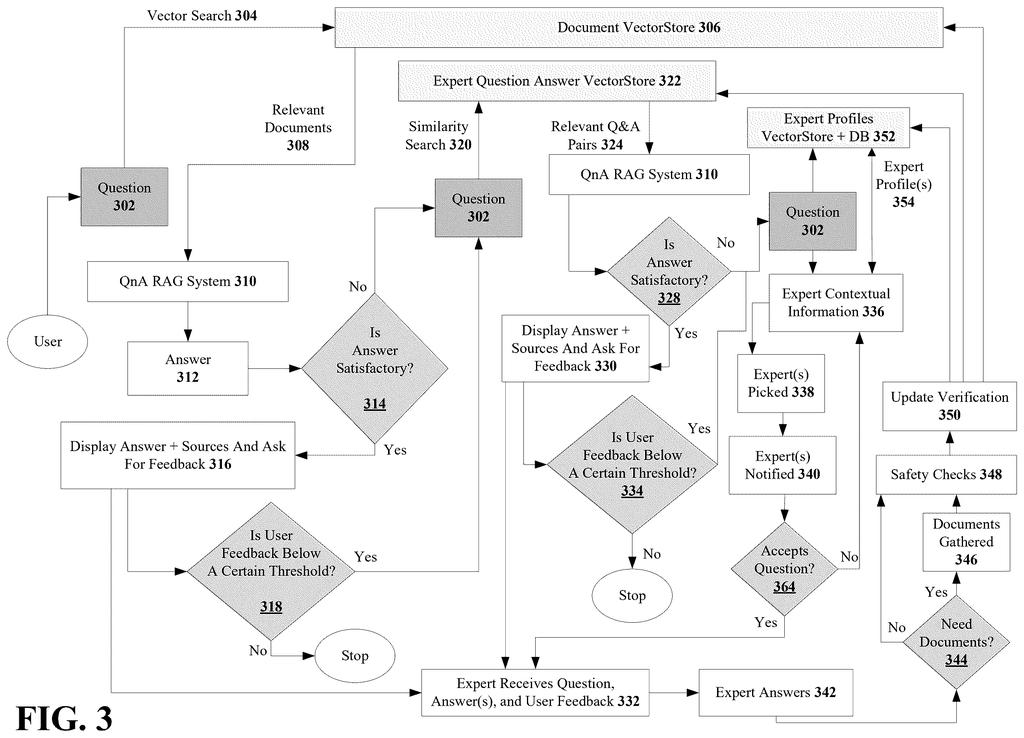
What IBM's human-in-the-loop AI system actually does
Imagine you ask your company's internal AI assistant a question about an obscure compliance rule. It searches its documents and comes up empty. Rather than guessing or giving you a generic non-answer, it escalates.
That's the core idea in this IBM patent. The system tries three things in order: search its existing documents, check a library of questions that stumped it before (along with expert answers), and finally locate a real human expert in that subject area and ask them directly. The expert can point the AI to documents it didn't have, and the AI uses those to build a response.
Here's the part that makes it more than a simple help-desk ticket: after the expert helps, their recommended documents get added to the AI's permanent knowledge base. The next person who asks a similar question gets a direct answer, no human required. The system gets better every time it gets stuck.
How the three-stage search and escalation pipeline works
The patent describes a retrieval-augmented generation (RAG) system, which is an AI architecture where a language model answers questions by first pulling relevant text from a database, rather than relying solely on what it memorized during training. IBM's twist is adding a structured fallback ladder when the standard RAG search fails.
The system maintains three separate searchable databases called vector stores (indexes where text is stored as numerical representations so the AI can find conceptually similar content, not just keyword matches):
- Document vector store: the main knowledge base of company documents
- Expert Q&A vector store: a log of past questions that the documents couldn't answer, paired with expert-provided answers
- Expert profiles vector store: profiles of human domain experts and their areas of knowledge
When a query comes in, the system works through these in sequence. If standard document search fails a confidence threshold, it checks past expert Q&A pairs. If that also fails, it identifies a relevant human expert, contacts them, and asks for recommended documents. Those documents go into a temporary staging store kept separate from the main database.
The AI then runs a contained search over only those staged documents to generate an answer. If the staged answer meets quality standards, those documents are promoted into the main knowledge base permanently, improving future responses.
What this means for enterprise AI and knowledge gaps
For large organizations, the gap between what an AI knows and what employees actually need to know is a real operational problem. Most enterprise AI tools either hallucinate an answer or give a confident non-answer. A system that can identify who inside an organization holds the missing knowledge, and then route the question accordingly, addresses that gap directly.
The self-improving loop is the more significant angle here. By promoting expert-vetted documents back into the main knowledge base, the system gradually reduces its own blind spots without a manual retraining cycle. Over time, the need to escalate to a human for the same class of questions should shrink. For IBM, which sells AI tools to enterprise clients through its watsonx platform, this kind of structured, auditable AI behavior is exactly the reliability story those customers want to hear.
This is a genuinely useful idea for enterprise AI, and IBM is in a strong position to deploy it given its deep relationships with large corporate clients. The self-healing knowledge base mechanic is the real differentiator here, not the escalation itself. Whether the patent holds up as distinct from existing human-in-the-loop RAG research is a separate question, but as a product feature, it's easy to see why this would sell.
There are more where this came from
We read every patent application Big Tech publishes and send you the ones worth knowing. Plain English, free, every week.
The drawings
8 drawing sheets from US 2026/0220131 A1 · click any drawing to enlarge


Want this weekly breakdown for a company we don't cover? Patentlyze Pro →
Be the first to weigh in