
Adobe Patents an AI System That Re-Lights Real Objects in 3D After You Photograph Them
Imagine photographing a product on your desk from a dozen angles, then sliding a virtual sun wherever you want it without touching a studio light. That's what Adobe is building.
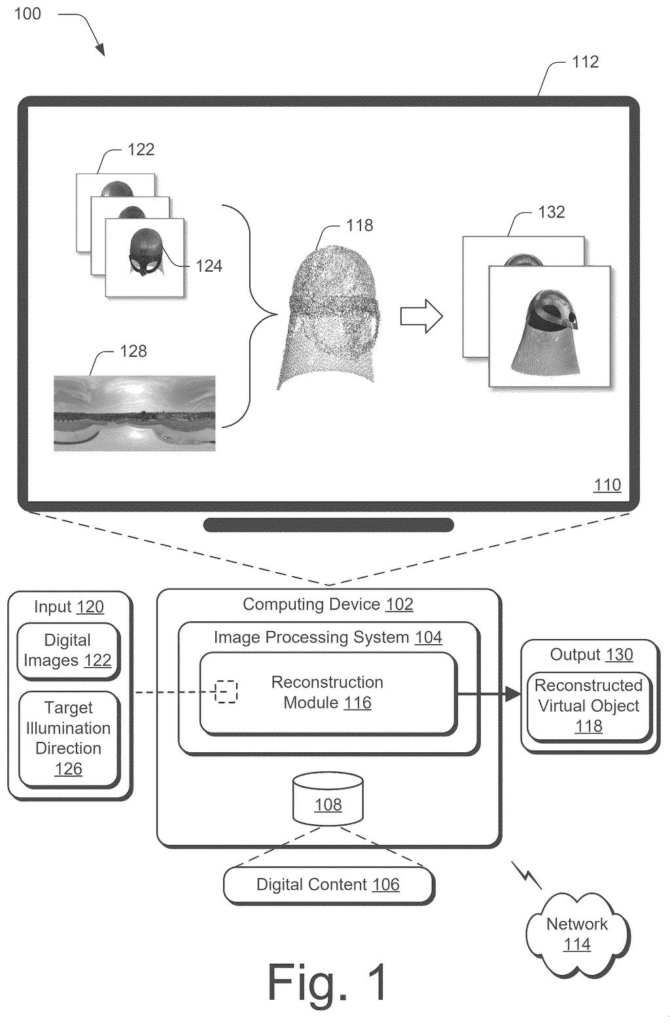
What Adobe's photo-to-3D relighting system actually does
Picture a photographer shooting a sneaker from every angle on a tabletop. Right now, if the lighting in those photos is wrong, you either reshoot or spend hours touching up each image by hand. Adobe's patent describes a system that skips all of that.
You feed the system a set of photos taken from different viewpoints. It uses AI to figure out the 3D shape of the object, then calculates exactly how light would bounce off every surface if a virtual lamp were placed wherever you choose. The result is a fully rebuilt 3D version of the object, lit the way you decided, not the way the original shoot happened to be lit.
The key idea is that the lighting isn't just pasted on top. It's calculated based on the actual geometry the AI figured out, so curved surfaces catch light the way they would in real life.
How Adobe's model reads geometry to place virtual light
The system works in three stages. First, it takes multiple photos of a real object from different angles and runs them through a machine learning model to reconstruct the object's geometry (meaning its full 3D shape, surface normals, and depth information).
Second, the user picks an illumination direction, essentially choosing where a virtual light source should sit relative to the object. The system then calculates illumination parameters, which describe how that chosen light would interact with each part of the surface given the geometry already determined. This includes things like how direct light hits a face, how shadows fall, and how curved or reflective areas behave.
Third, the system renders a reconstructed virtual object combining the geometry and the computed lighting. The output is a 3D representation that looks as if the original object had been photographed under the new lighting conditions.
- Input: multi-angle digital photos plus a user-selected light direction
- Processing: AI geometry reconstruction followed by physics-informed lighting calculation
- Output: a re-lit 3D virtual object ready for rendering or compositing
What this means for photographers and 3D designers
For product photography and e-commerce, this kind of system cuts down the need for full reshoots when a client decides the lighting mood is wrong. You capture the object once, then adjust the virtual lighting in post without new studio time. That's a real workflow improvement for teams doing high volumes of product imagery.
For 3D artists and compositors, having a way to drop a real photographed object into a scene and match its lighting to the scene's virtual lights is a long-standing challenge. Adobe's approach, tying the lighting calculation directly to the AI-derived geometry, is more principled than simple image filters and could produce more convincing results in tools like Substance or Firefly.
This is practical infrastructure for Adobe's creative tools rather than a flashy consumer moment. The patent sits squarely in the territory Adobe has been building toward with Firefly and Substance 3D: turning real-world captures into editable virtual assets. It's not the most exotic AI research, but if it ships as a real feature it solves a genuinely tedious problem for anyone doing product or commercial photography.
There are more where this came from
We read every patent application Big Tech publishes and send you the ones worth knowing. Plain English, free, every week.
The drawings
9 drawing sheets from US 2026/0220881 A1 · click any drawing to enlarge


Want this weekly breakdown for a company we don't cover? Patentlyze Pro →
Be the first to weigh in