
Samsung Patents Technology to Locate Several Nearby Devices Simultaneously With One Radio Signal
Your phone already uses ultra-wideband radio to pinpoint nearby objects with centimeter-level accuracy. Samsung's new patent wants that same radio to talk to several devices at once, instead of one at a time.
What Samsung's multi-device UWB ranging actually does
Imagine you walk into your home and your phone needs to figure out exactly where your keys, your wallet, and your TV remote are, all at the same moment. Today, most location-finding radio systems work like a conversation: your phone asks one device, waits for an answer, then asks the next one. That takes time.
Samsung's patent describes a system where one device sends a single "go" signal and several nearby devices all respond in the same moment, using a type of radio called ultra-wideband (UWB). UWB is the short-range, high-precision radio already built into Samsung Galaxy phones and tags.
The practical upside: locating three or four things at once instead of sequentially could make device-finding faster and reduce the radio traffic your phone has to manage. Think of it as switching from a phone-tree to a group text.
How the ranging round slots coordinate simultaneous replies
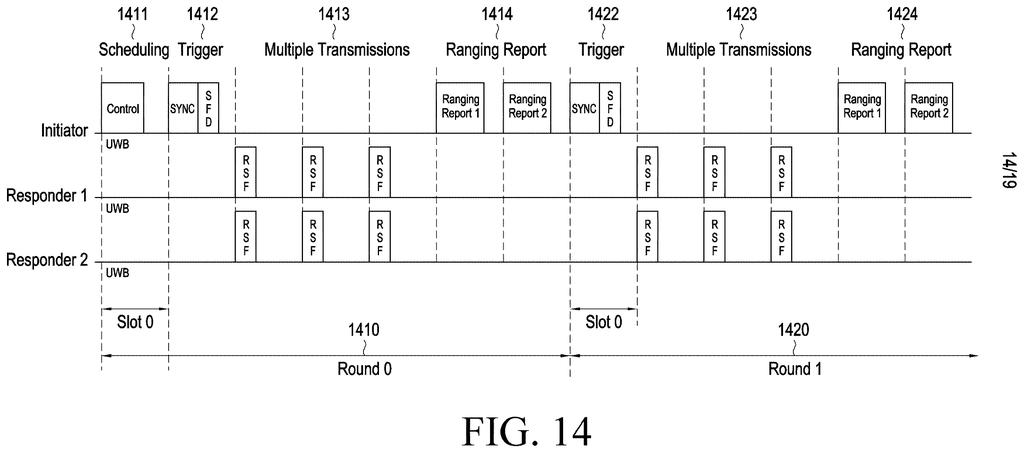
The patent describes a protocol for UWB multiplexing transmission, meaning multiple UWB devices respond to a single coordinator within the same timed window.
The system works across three ordered steps called slots inside a ranging round (a short, precisely timed measurement cycle):
- Slot 1: The controlling device broadcasts a ranging control message over either UWB or a conventional narrow-band radio (like Bluetooth or Wi-Fi). This message tells all nearby devices what to expect and when to respond.
- Slot 2: The controller sends a triggering packet, the actual start signal that tells the other devices to transmit.
- Slot 3: Two or more secondary UWB devices reply simultaneously, each sending its own packet in the same slot. The controller receives all of them at once.
The trick that makes this work is UWB's extremely wide frequency bandwidth. Unlike narrow-band radios, UWB can distinguish overlapping signals arriving at slightly different times, which allows the receiver to decode two simultaneous transmissions without them canceling each other out. The patent's independent claim establishes that the first device receives both a "first packet" and a "second packet" in the same third slot, which is the core novelty.
What this means for UWB in Samsung's device lineup
UWB chips are already inside Samsung's Galaxy S-series phones and Galaxy SmartTags. The current standard (IEEE 802.15.4z) typically handles devices in sequence, which adds latency when you need to locate several objects quickly. A multiplexed approach could mean faster location updates across a whole room full of tagged items without burning more battery on extra ranging rounds.
For Samsung, this is also a competitive move in the precision finding market where Apple's AirTag and U1/U2 chips set a well-known benchmark. Filing infrastructure patents on how UWB sessions are scheduled is exactly how companies build moats in a standards-driven technology space. Whether this specific approach lands in a shipping product depends heavily on whether it gets incorporated into future UWB standards.
This is a reasonably interesting infrastructure patent in a field that actually matters for consumer devices. UWB location is still finding its footing as a mass-market feature, and any efficiency gain at the protocol layer could help it show up in more products at lower cost. It is not a headline feature on its own, but the kind of foundational work that makes future headline features possible.
There are more where this came from
We read every patent application Big Tech publishes and send you the ones worth knowing. Plain English, free, every week.
The drawings
19 drawing sheets from US 2026/0223043 A1 · click any drawing to enlarge


Want this weekly breakdown for a company we don't cover? Patentlyze Pro →
Be the first to weigh in