
Samsung Patents Technology to Measure Distances and Scan Surroundings Simultaneously
Your phone already uses Ultra-Wideband radio to find your keys or unlock your car. Samsung's new patent describes a way to squeeze two jobs out of every UWB signal at once: figuring out how far away something is AND scanning what's around it, without sending a second transmission.
What Samsung's simultaneous UWB ranging and sensing actually does
Ever tried to do two things at once and found the tools wouldn't cooperate? UWB (Ultra-Wideband) radio is the short-range wireless technology inside many phones and smart-home devices that tells you exactly how far away something is, down to a few centimeters. But right now, distance-finding (called "ranging") and environment-scanning (called "sensing," like detecting whether someone is in a room) are treated as separate jobs that need separate signals.
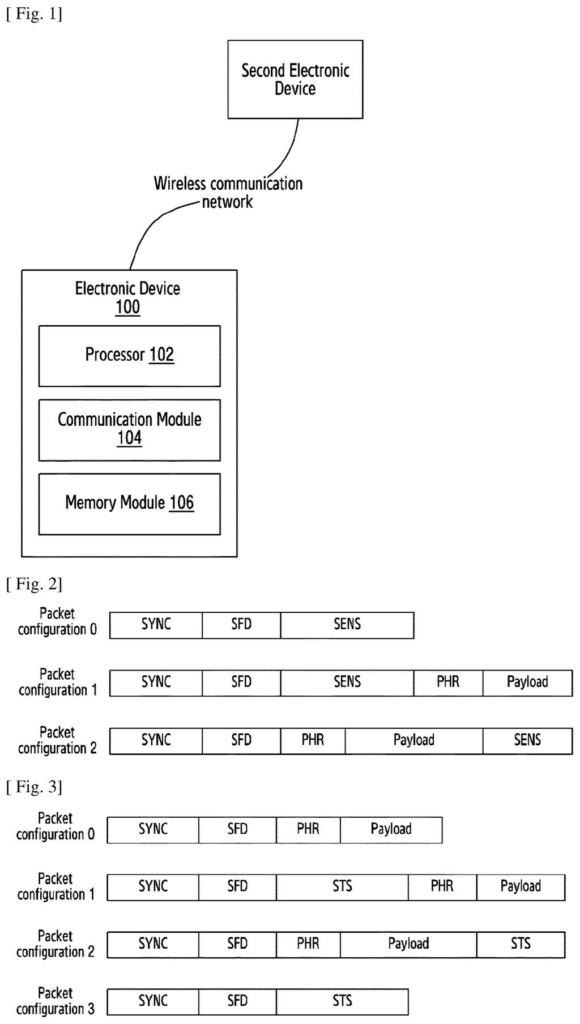
Samsung's patent describes a way to bundle both tasks into a single radio packet. You send one signal; the device on the other end extracts distance information from it, and sensing information from it, at the same time. A special control field in the message tells both devices which format is in use and coordinates their timing.
The practical payoff is less radio traffic and faster results. Whether you're tracking a device's location, detecting motion in a room, or trying to get both pieces of information together, the system doesn't make you wait for two separate rounds of communication.
How one UWB packet carries both distance and sensing data
UWB radio works by sending extremely short pulses and measuring how long they take to arrive. Ranging uses that timing to calculate distance with high precision. Sensing analyzes how the signal bounces off objects or people to detect motion, presence, or even breathing.
Today's UWB systems treat these as distinct modes. Samsung's patent proposes a unified approach where:
- A sensing packet (normally used only for environment scanning) can also carry enough information for a ranging operation.
- A ranging packet (normally used only for distance measurement) can simultaneously deliver sensing data.
- A special MMS (multi-mode signal) ranging packet can handle sensing at the same time.
The glue holding this together is a control message field: a small piece of data prepended to a transmission that tells all participating devices which packet format is being used, plus the schedule and configuration for the combined session. This lets two or more devices coordinate without extra back-and-forth negotiation.
The patent also defines the specific packet format that encodes both sets of data inside a single UWB frame. Think of it as adding a second lane to a road that already exists, rather than building a new road.
What this means for next-gen smart-home and location tech
For you as a user, this is mostly invisible infrastructure. But it affects how quickly and accurately devices like phone-based car keys, indoor location tags, or presence-detection sensors can respond. If a smart-home system needs to know both where you are and whether you moved, it currently has to ask those questions separately. Samsung's approach answers both in one exchange, which could mean faster reactions and less drain on battery-powered accessories.
Samsung's interest in UWB and next-generation device connectivity spans both consumer devices and the 5G/6G standards work this patent explicitly references. Whether this specific packet design makes it into a standard or stays proprietary remains to be seen, but it addresses a real coordination overhead that limits what current UWB hardware can do.
Samsung's 1370th filing in our Samsung coverage since May adds to a location-signal thread that includes pinpointing low-power devices and sharing 5G location signals.
A bag tag that can locate your luggage and detect if someone touched it, using a single wireless exchange instead of two separate ones, means you get the answer faster on a smaller battery that lasts longer. Fewer dead tags, fewer missed alerts.
The same idea extends to a smart lock that measures your distance and confirms your presence in one step rather than two, which is the difference between a door that opens as you reach it and one that makes you wait while it figures out what you already know.
The real payoff is that crowded places like airports and hospitals, where dozens of these devices compete for the same airwaves, become more reliable without anyone changing how they use their devices or where they carry them.
There are more where this came from
We read every patent application Big Tech publishes and send you the ones worth knowing. Plain English, free, every week.
The drawings
2 drawing sheets from US 2026/0304359 A1 · click any drawing to enlarge


Want this weekly breakdown for a company we don't cover? Patentlyze Pro →
Be the first to weigh in