
Google Patent Reveals Earbuds That Detect When They're Actually In Your Ear
Google is patenting a way for earbuds to figure out not just whether you're wearing them, but whether you're actively fiddling with the fit, all by bouncing tiny sound signals off your eardrum.
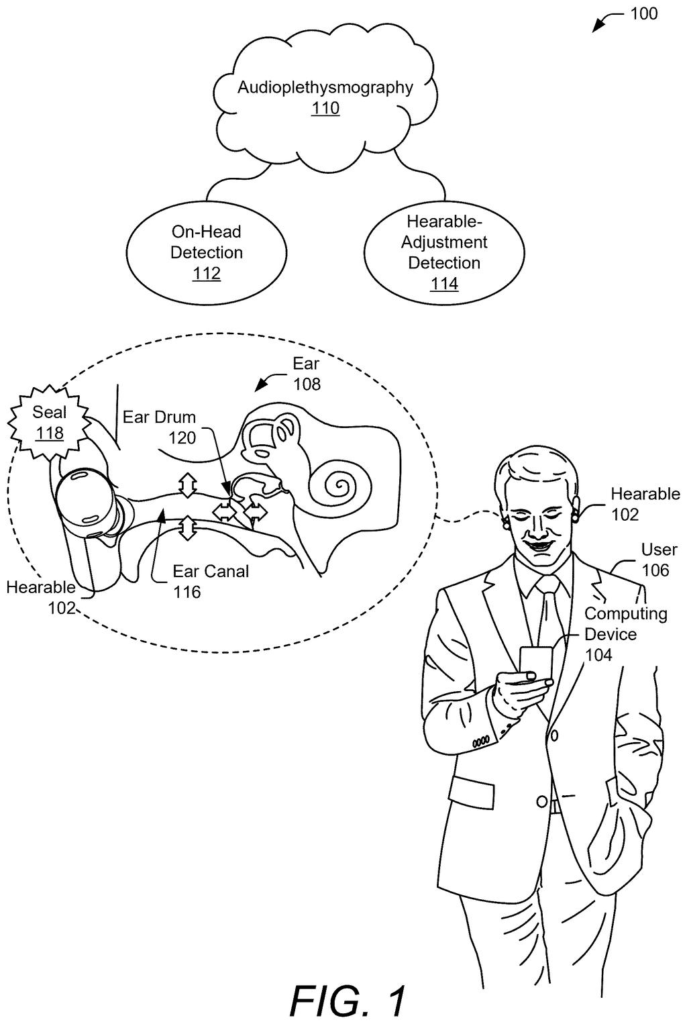
What Google's ear-canal sound trick actually does
Imagine putting in an earbud and having it instantly know you've got it seated correctly, without any buttons or app check-ins. That's the core idea here.
Google's patent describes earbuds that emit a quiet acoustic signal too subtle to notice, then listen for how that signal bounces back from your ear canal and eardrum. Because the shape of the acoustic space changes depending on how the earbud is seated (or whether it's in your ear at all), the earbud can figure out its own fit in real time.
More specifically, it can tell the difference between "in your ear and sitting right," "in your ear but you're adjusting it," and "not in your ear at all." This is called audioplethysmography, a mouthful that just means using sound to sense physical changes in your ear. The result is earbuds that respond to what's actually happening with your body, not just button presses.
How sound pulses reveal fit changes inside your ear canal
The patent describes a technique called audioplethysmography (APG), which is an active acoustic method already used in some earbuds to track heart rate and other biometrics. Here, Google applies it to a different problem: figuring out whether the earbud is worn, and whether it's being repositioned.
The earbud transmits a low-level acoustic signal into the ear canal. Because the earbud forms a partial seal at the ear, it creates what the patent calls an acoustic circuit, essentially a closed loop involving the earbud, the seal, the ear canal, and the eardrum. The earbud then listens for the return signal.
The system analyzes two properties of the returning sound:
- Amplitude, how loud the return signal is
- Phase, how much the timing of the signal has shifted
Changes in either measurement indicate a change in the acoustic environment. A stable signal means the earbud is sitting still in the ear. A shift in amplitude or phase can mean the user is pulling the earbud out, pressing it in further, or rotating it to find a better fit. The patent claims the system can distinguish between "being worn" and "being adjusted" as separate detectable states, which is a finer-grained detection than simple on/off ear sensing.
What this means for future Pixel Buds and health wearables
Most earbuds today detect whether they're worn using an infrared proximity sensor or a basic capacitive touch surface, both of which can misfire. A sound-based approach is more direct: it measures the actual acoustic environment inside your ear, which changes meaningfully only when the physical fit changes. That could mean fewer accidental pauses and more reliable auto-play behavior when you put earbuds in or take them out.
The fit detection angle is arguably more interesting. Knowing that a user is actively repositioning the earbud could let a device prompt for a quick seal check, re-run active noise cancellation calibration, or flag that audio quality may have just shifted. For health-monitoring earbuds tracking heart rate or blood oxygen via sound, knowing the fit changed is genuinely important for data accuracy.
This is a focused, practical patent aimed at a real annoyance in the earbud experience. Fit detection and wear detection that actually work reliably would be a noticeable quality-of-life improvement, and building it on top of the same APG hardware already used for health sensing is an efficient design choice. It's not flashy, but it's the kind of thing users notice every day.
There are more where this came from
We read every patent application Big Tech publishes and send you the ones worth knowing. Plain English, free, every week.
The drawings
17 drawing sheets from US 2026/0222751 A1 · click any drawing to enlarge


Want this weekly breakdown for a company we don't cover? Patentlyze Pro →
Be the first to weigh in