Sony
Sony · Wearable · Filed May 13, 2025 · USPTO published Jul 2, 2026 · Jul 2 release
Sony Patents a Light-Steering Trick to Get Cleaner Readings From Body Sensors
Getting accurate heart rate or blood oxygen readings from a wearable sensor is harder than it looks. One of the biggest enemies is your own device's light bouncing around inside and fooling the detector before it ever reaches your skin.
- Publication number
- US 2026/0182849 A1(US20260182849A1)
- Applicant
- SONY GROUP CORPORATION
- Filed · Published
- May 13, 2025 · Jul 2, 2026
- Inventors
- TOMOYA IKUTA, MAO KATSUHARA
- Status when we published
- Examiner raised objections; the company can respond
- Document
- 15 claims
- US classification
- 600/476
- Examiner
- FERNANDEZ, KATHERINE L (Art Unit 3798)
- Parent application
- National Stage Entry of PCT/JP2023/034798 (filed Sep 26, 2023)(PCTJP2023034798)
What Sony's body sensor light-control patent actually does
Imagine holding a flashlight right next to a camera and trying to photograph something in the dark. The light leaks directly into the lens before it even has a chance to bounce off anything useful. Tiny health sensors in wearables face exactly this problem: the light source and the light detector sit very close together, and stray light can skip the whole "bounce off your skin" step and go straight to the sensor, corrupting the reading.
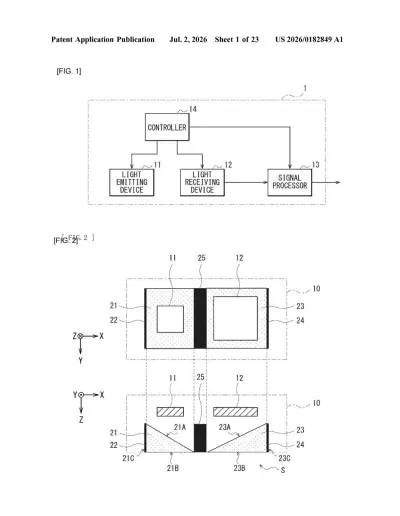
Sony's patent describes a sensor design that tackles this with two moves. A physical barrier sits between the light source and the detector to block any direct path between them. And a specially shaped optical piece guides the outgoing light away from the detector's side of the device, pushing it to spread out in the opposite direction, toward the skin area you actually want to measure.
The result is a sensor where light goes where it's supposed to go: out through the detection surface, into your tissue, and back, rather than leaking sideways and muddying the data. That means cleaner biological readings in a small, flat form factor.
How the optical member steers and blocks light paths
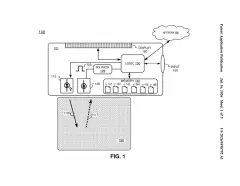
The patent describes a compact sensor assembly built around three key components arranged in a line along a flat detection surface:
- Light emitting device: the source, typically an LED, that shines light toward the skin
- First light blocking member: a physical barrier, like an opaque wall, that sits between the source and the detector to prevent direct crosstalk
- Light receiving device: the photodetector that picks up light that has reflected back from tissue
Between the light source and the detection surface sits a first optical member (think of it as a shaped lens or light guide). This piece does two things simultaneously. First, it restricts the light so it cannot travel sideways past the barrier toward the detector side. Second, it actively bends and spreads the light in the opposite direction, away from the detector.
By pushing the emitted light to fan out away from the detector rather than toward it, the design ensures that when light does return through the skin, it arrives at the detector as genuine biological signal rather than noise. The patent is focused on the geometry of how light paths are controlled inside a flat housing, which matters a lot for thin devices like smartwatches or fitness bands where the emitter and detector must sit very close together.
What this means for wearable health sensors
Optical crosstalk (stray light sneaking from emitter to detector) is one of the main reasons wearable heart rate and SpO2 sensors can give unreliable readings, especially on thin devices where everything is packed tightly. Sony's approach, using a shaped optical piece to redirect light away from the detector's side rather than just blocking it, could allow for thinner and more accurate sensors in future wearables.
For you as a consumer, more precise light management inside a sensor means fewer missed beats and fewer erratic readings during exercise or sleep monitoring. It also potentially allows manufacturers to shrink sensors further without sacrificing accuracy, which is relevant for earbuds, rings, and ultra-thin bands that are increasingly popular health-tracking devices.
Source: US 2026/0182849 A1 at the USPTO (PDF). Full patent text and figures are in the official publication.
Get our take in your Top Stories
Liked this breakdown? Add Patentlyze as a preferred source on Google, and our plain-English take shows up more often in your Top Stories the next time Sony patent news breaks.
Add Patentlyze on Google
One click.
There are more where this came from
We read the new patents from Big Tech, carmakers and more and send you the ones worth knowing. Plain English, free, every week.
More from Sony
All 722 Sony patents →
More in Hardware
All 2,375 Hardware patents →
Samsung
Samsung Patents a Smart Ring That Reads a Finger Pressed Into Its Groove
Microsoft
Wearable Tech Patent Detects How Skin Shifts Against a Sensor
Meta
Meta Patent Targets Heart Rate Monitor Accuracy in Low-Light Environments

Samsung