
Google AI Patent Teaches Assistants to Speak Any AI’s Language
Imagine asking one AI assistant to book a flight and file an expense report at the same time, without you ever switching apps. Google is patenting the plumbing that would make that possible.
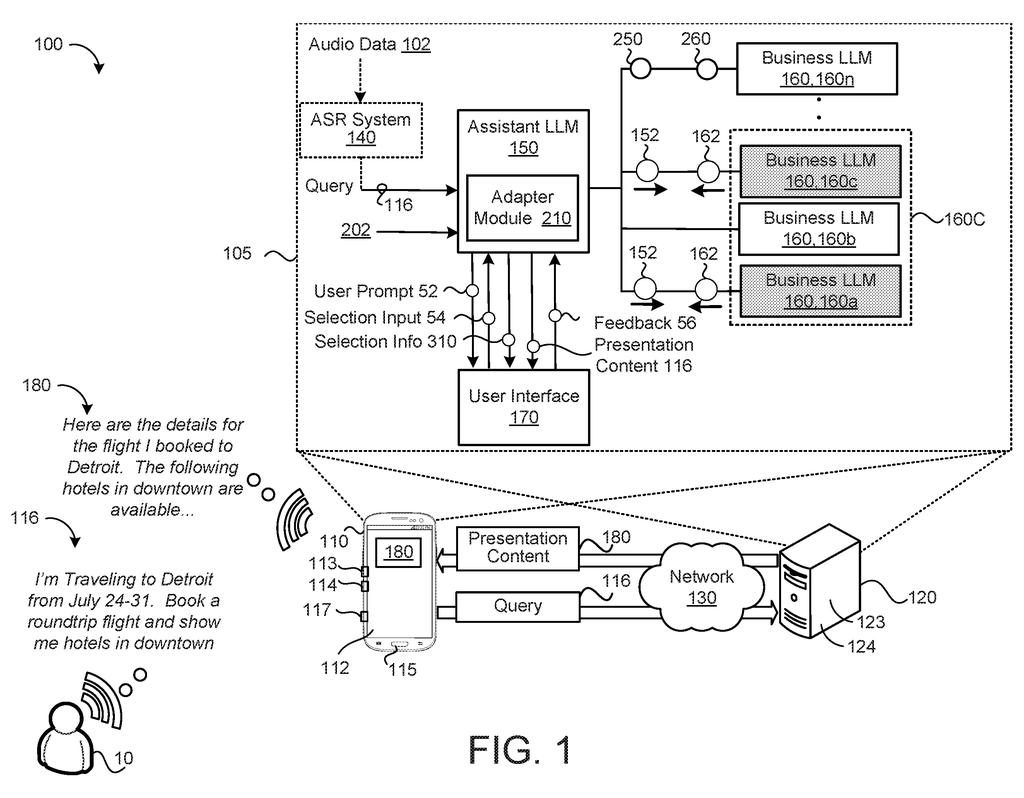
What Google's AI-to-AI translation layer actually does
Picture this: you ask your Google assistant to "schedule a meeting with the sales team and update the project tracker." Right now, that would require you to hop between Google Calendar, Slack, Jira, or whatever tools your company uses. Google's patent describes a system where its assistant acts as a go-between, automatically figuring out how to talk to each of those other AI-powered apps on your behalf.
The key insight is that different AI systems built by different companies expect questions phrased in different ways. What works for one AI chatbot won't necessarily work for another. Google's patent covers a mechanism where its assistant first asks each third-party AI how it likes to be spoken to, then stores those preferences so it can craft the right kind of message every time.
When you make a request, the assistant can split the job across multiple specialist AIs at once, each handling the piece it's best at, then stitches the results back together into a single answer for you.
How the adapter modules learn each business AI's dialect
The patent describes a two-phase system. In the first phase, Google's assistant interface sends what the patent calls an interoperability request to each third-party AI (called a "business LLM" in the filing). It essentially says: "Hey, we'd like to work with you. Show us some examples of how to phrase requests for you." Each business AI sends back a set of example prompts that reveal how it expects to be addressed.
Those examples are stored inside adapter modules, one per business AI. Think of an adapter module as a translator that has studied that particular AI's dialect. When a user later makes a request, the adapter reformats the question into the exact style that AI is trained to handle well.
When a task is complex enough to require more than one AI, the system:
- Breaks the overall task into sub-tasks
- Assigns each sub-task to the most appropriate business AI
- Issues separately formatted prompts to each AI in parallel
- Collects all the responses and compiles them into one coherent answer for the user
The patent also covers the upfront "handshake" process where Google's assistant builds its preferred list of business AIs and collects their formatting preferences before any user request ever arrives, so the actual response time stays fast.
What this means for Google Assistant's role in your apps
For everyday users, this is about reducing the friction of living across many apps. If Google ships something based on this patent, you could give one instruction to Google Assistant and have it coordinate between your HR software, your calendar, your project management tool, and your expense system without you manually switching between them or re-explaining context each time. The assistant handles the translation work invisibly.
For Google, the strategic angle is significant. This positions Google Assistant (or Gemini) as the central control layer that sits above all other business software, rather than being one tool among many. Every company whose AI gets plugged in becomes part of Google's ecosystem. That is a real platform play, and it explains why the patent carefully describes how business AIs register themselves with Google's assistant rather than the other way around.
This is one of the more strategically telling patents Google has filed in the AI era. It is not about making Google's own AI better in isolation; it is about making Google the connective tissue between all business AI tools. The "adapter module" architecture is a real engineering solution to a real problem, but the bigger story is Google trying to own the AI orchestration layer before anyone else does.
There are more where this came from
We read every patent application Big Tech publishes and send you the ones worth knowing. Plain English, free, every week.
The drawings
5 drawing sheets from US 2026/0221150 A1 · click any drawing to enlarge


Want this weekly breakdown for a company we don't cover? Patentlyze Pro →
Be the first to weigh in