
Qualcomm Patents a GPS System That Cross-Checks Satellites to Fix Its Own Errors
Your phone's GPS is only as good as the satellite signals it receives, and those signals can be distorted by buildings, atmosphere, or bad geometry. Qualcomm's new patent describes a system that spots those distortions by comparing signals against each other and against your recent location history, then corrects for them before telling you where you are.
What Qualcomm's self-correcting GPS actually does
Imagine your GPS thinks you're in the middle of a building because a signal bounced off a wall before reaching your phone. That kind of error happens all the time, especially in cities, and most devices just average out the bad data with the good.
Qualcomm's patent takes a different approach. Instead of treating each satellite signal independently, the system looks at how all the signals relate to each other at any given moment. If one satellite's reading looks off compared to the others, the system flags it and adjusts. It also looks at your previous location fixes, so if a reading doesn't make sense given where you just were, that gets corrected too.
The result is a more reliable position estimate, even when some of the incoming satellite data is noisy or misleading. This runs on the device itself, meaning your phone or car could get better GPS without depending on a network connection to sort out errors.
How the residual correction pipeline filters bad satellite data
The patent describes a location system built around the concept of residuals, which are the small gaps between where GPS math says you should be and what the raw satellite measurements actually show. Those gaps are normal, but their pattern reveals a lot about what's going wrong.
The system works in three stages:
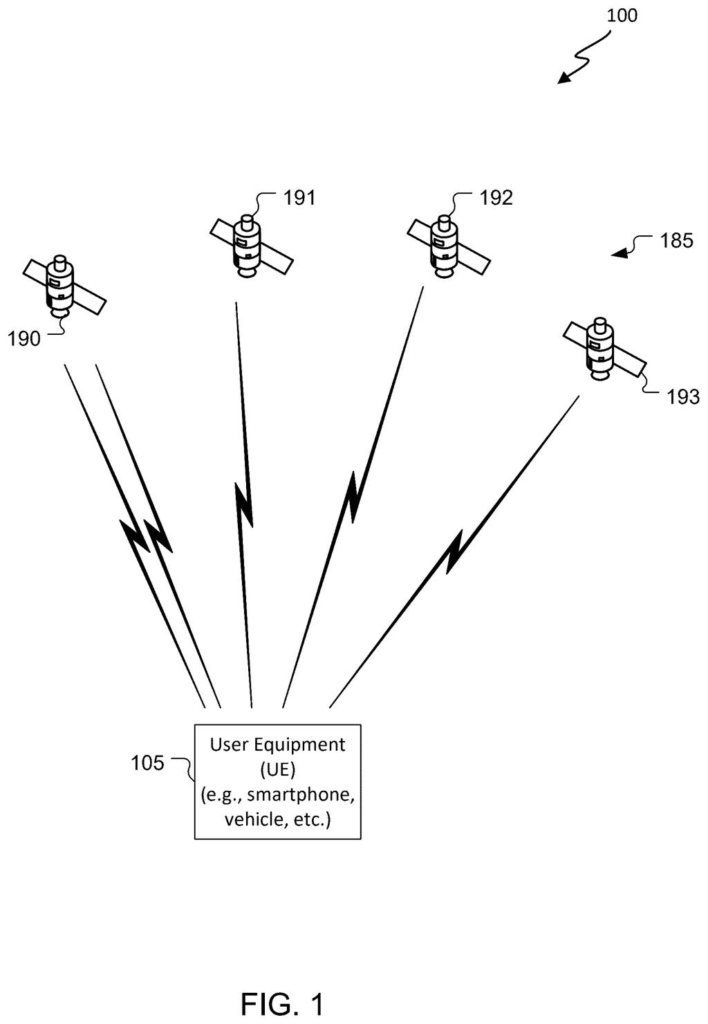
- Collect raw measurements from multiple GPS (or GNSS) satellites
- Calculate residuals for each satellite signal
- Compute corrected residuals by analyzing relationships between signals, both across all satellites visible right now and compared to signals from recent previous fixes
The key innovation is in that third step. Rather than treating each satellite's error in isolation, the system looks at cross-satellite relationships (how one signal's error pattern compares to another's) and temporal relationships (how today's errors compare to errors from a moment ago). This is where the patent's title phrase "geometric representation and temporal modeling" comes from: geometry captures the spatial relationships between satellites, and temporal modeling captures how those relationships change over time.
The corrected residuals feed back into the final position calculation, producing a location estimate that has filtered out a significant portion of the systematic errors baked into raw GNSS data.
What this means for GPS accuracy in phones and cars
GPS chips are already in essentially every phone, car, drone, and wearable Qualcomm supplies silicon for. A software or firmware improvement to how those chips interpret satellite data could improve location accuracy across a huge installed base without new hardware. For urban navigation, where signal reflections off buildings are a persistent problem, even modest accuracy gains matter.
For autonomous vehicles and precision applications, where centimeter-level accuracy is the goal, the temporal modeling angle is particularly interesting. By building a short-term memory of how satellite errors have been behaving, the system can anticipate and preempt errors rather than just reacting to them. That's a meaningful shift in how on-device GPS processing works.
This is solid, unglamorous engineering work on a problem that genuinely affects everyone who uses a phone for navigation. GPS error correction is a crowded field, and Qualcomm isn't the only company working on it, but a chip-level implementation that handles both geometric and temporal error modeling on-device is a real capability to have in a product stack. Worth watching for how it shows up in future Snapdragon location specs.
There are more where this came from
We read every patent application Big Tech publishes and send you the ones worth knowing. Plain English, free, every week.
The drawings
15 drawing sheets from US 2026/0219395 A1 · click any drawing to enlarge


Want this weekly breakdown for a company we don't cover? Patentlyze Pro →