
Patent: New Display Lens Design Splits Light Across Curved Surfaces for Clearer Images
Getting light from a tiny projector into your eye, through a thin piece of glass, without blurring or color fringing is one of the hardest problems in AR hardware. Google's latest patent tries a new approach: use multiple "on-ramps" to feed light into the lens at carefully calculated angles.
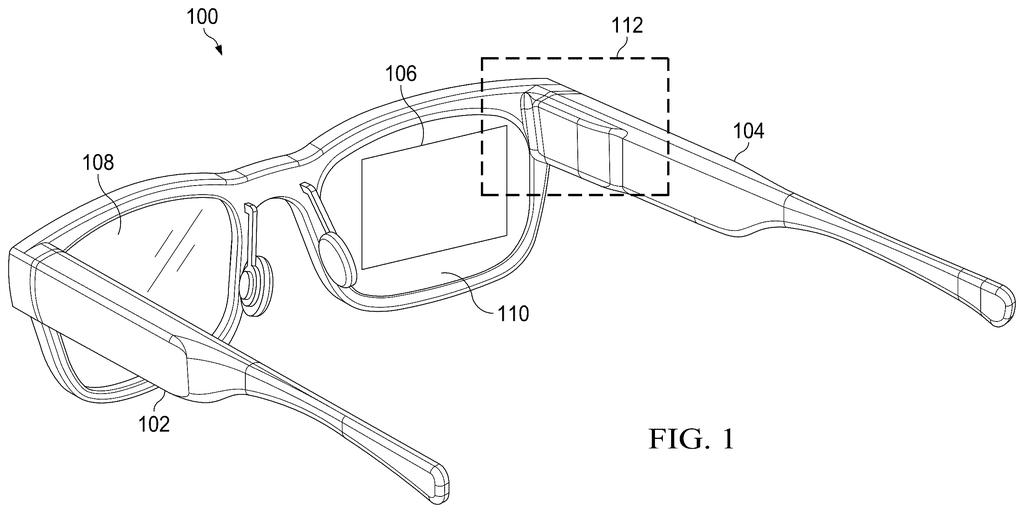
What Google's multi-entry AR lens design actually does
Imagine trying to shine a flashlight through a curved fish tank and hit a precise spot on the other side without any weird bending or color splitting. That's roughly the challenge AR glasses face every time they try to show you a digital image overlaid on the real world. The lens (called a waveguide) has to carry light from a tiny projector on the frame all the way to your eye, and the thinner and more curved the lens, the harder that is.
Google's patent describes a waveguide lens that has multiple light entry points, called incouplers, placed at very specific angles matched to the internal structure of the glass. Right around each entry and exit point the lens is flat, which keeps the light behaving predictably. The curved sections sit in between, letting the whole lens wrap around your face like normal glasses.
The payoff is that you can inject the same image from more than one spot on the lens, which means better coverage and potentially fewer dark zones in what you see, all without introducing the distortion that normally comes with bending a waveguide.
How the angled incouplers keep light distortion-free
A waveguide is a thin slab of optical glass (or plastic) that acts like a light pipe. A tiny projector shoots an image in from one edge, the light bounces internally across the lens, and a series of microscopic gratings (think of them as extremely fine etched grooves) redirects it out toward your eye at the exit point.
The core problem: bending that slab to fit the curve of a face normally disrupts the grating angles, causing what engineers call k-space closure failure (meaning the light waves no longer add up correctly, so you get unwanted refraction, color smearing, or ghost images).
Google's patent solves this with a hybrid lens geometry:
- Flat zones immediately around each incoupler (entry point) and outcoupler (exit point), so the critical light-injection and light-exit regions stay geometrically stable.
- Curved zones in the spans between those flat regions, letting the lens follow the natural arc of a glasses frame.
- Multiple incouplers positioned at separation angles that match the grating angle built into the waveguide, so adding extra entry points does not break the optical math.
By controlling those angles precisely, the system can feed display light into the waveguide from more than one location simultaneously, increasing the effective display area without needing a larger or thicker lens.
What this means for the next generation of AR glasses
The biggest complaints about consumer AR glasses, from Google Glass to more recent attempts, have been a tiny field of view and lenses that look obviously thick or chunky. This patent directly attacks both problems. Multiple incouplers mean the image can cover a wider portion of the lens; the flat-around-couplers, curved-in-between geometry means the lens can still look like ordinary eyewear rather than a sci-fi prop.
Google has been publicly working on AR glasses hardware again, and optical waveguide quality is the central bottleneck separating prototype demos from something you would actually wear all day. A design that lets engineers add entry points without fighting distortion is a meaningful step in that direction.
This is real, unglamorous optical engineering, not a concept sketch. The specific attention to grating angles and k-space closure suggests this comes from people who have actually built waveguide prototypes and hit the distortion wall. Whether it ships in a consumer product is another question, but as a technical filing it is more credible than most AR optics patents.
There are more where this came from
We read every patent application Big Tech publishes and send you the ones worth knowing. Plain English, free, every week.
The drawings
17 drawing sheets from US 2026/0219505 A1 · click any drawing to enlarge


Want this weekly breakdown for a company we don't cover? Patentlyze Pro →
Be the first to weigh in