
Amazon Patent Teaches Robotaxis How to Navigate Around Double-Parked Cars
Double-parked delivery trucks are one of the messiest problems in urban driving. Zoox is filing patents to make sure its self-driving cars can handle them without breaking a sweat or causing a head-on.
How Zoox handles the double-parking problem
Imagine you're driving down a city street and a delivery van is stopped in your lane, halfway into the oncoming traffic side. You have to inch out, check for oncoming cars, and squeeze past. It's stressful even for experienced drivers.
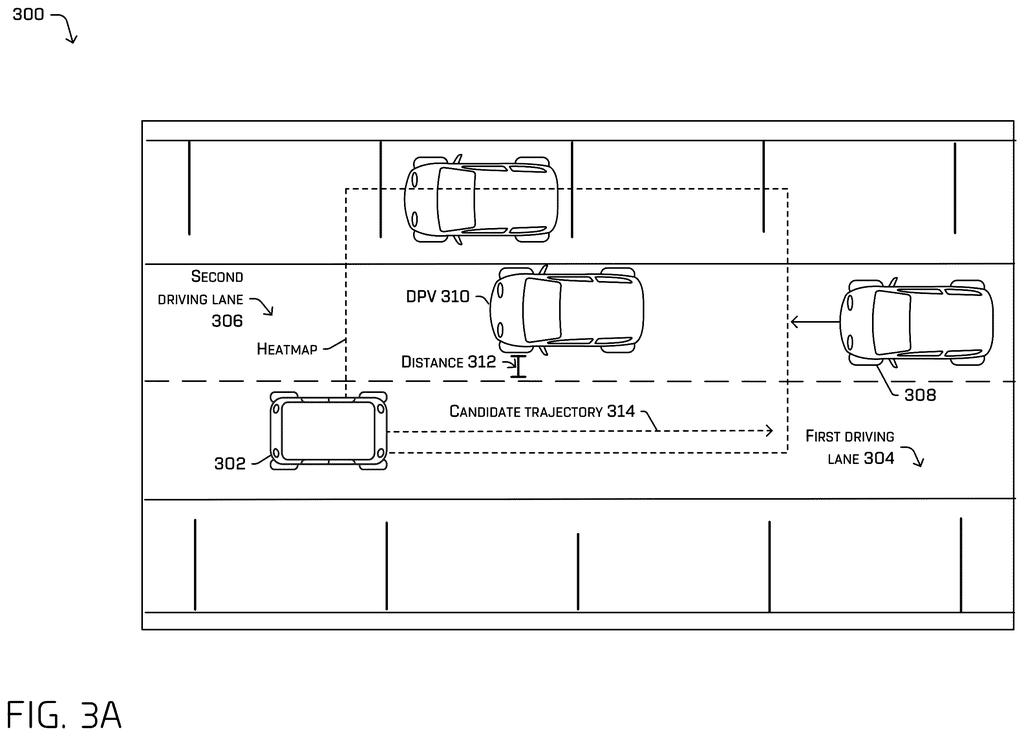
Zoox's patent describes a system that does this kind of calculation automatically. When the car's sensors spot a double-parked vehicle, the car's software draws an invisible "risk zone" around it, then figures out how much of your car would overlap that zone for each possible way it could steer past. The more overlap, the higher the penalty score for that path.
The car then picks the route with the lowest penalty, which is usually the one that gets past the obstacle while spending the least time in the oncoming lane. It's the same logic a careful human driver uses, just encoded in math instead of instinct.
… determining that the object is a stationary vehicle in a laterally adjacent driving lane; determining, based at least in part on the object being the stationary vehicle, a heatmap associated with a first region of the environment that encompasses the object; …
Translation: The system spots a stopped car next to it and creates a risk map around it.
How the heatmap scores each possible path
The system starts with data from the vehicle's sensors (cameras, lidar, radar) and identifies when a stationary vehicle is sitting in a lane next to the one the self-driving car is traveling in, meaning a double-parked car blocking the path ahead.
Once that's confirmed, the software generates a heatmap (a spatial grid where different zones carry different risk weights) centered on the stopped vehicle. Think of it like a heat map on a weather forecast: the area directly beside and in front of the parked car is "hot" (high risk), while open road further away is cooler.
For each candidate driving path the car might take, the system projects where the car would be at each future moment along that path. It then calculates the overlap between the car's projected footprint and the heatmap's risk zones. A path that swings wide into oncoming traffic registers high overlap in a dangerous zone; a tighter line registers less.
The system converts that overlap into a numerical cost, then selects the path with the lowest total cost to use as the actual control trajectory. The vehicle's steering and speed are then adjusted to follow that path.
The vehicle may analyze the sensor data to determine that a DPV is located within a laterally adjacent, oncoming traffic driving lane. The vehicle may generate a heatmap based on the attributes of the DPV and use the heatmap to determine the cost of following one or more candidate actions.
Translation: It identifies double-parked cars and weighs the safety costs of different driving choices.
What this means for robotaxi reliability in cities
Double-parked vehicles are one of the most common reasons human drivers make improvised, slightly risky moves in urban areas. For a robotaxi operating in cities like San Francisco or New York, failing to handle this situation gracefully means either stopping indefinitely or making an unsafe maneuver. Either outcome is bad for the business.
This patent suggests Zoox is building explicit, structured logic for a class of problem that many self-driving systems have historically struggled to handle consistently. If the approach works in practice, it could reduce the number of times a Zoox vehicle needs a remote human to intervene, which is one of the key metrics the industry tracks as a sign of real-world readiness.
This is unglamorous but genuinely important work. The ability to handle a double-parked car isn't a flashy AI trick, it's the kind of bread-and-butter urban driving competence that separates a robotaxi you'd actually trust from one that freezes in confusion. Zoox patenting a structured cost-based approach here signals they're thinking carefully about edge cases, not just highway cruising.
There are more where this came from
We read every patent application Big Tech publishes and send you the ones worth knowing. Plain English, free, every week.
The drawings
7 drawing sheets from US 2026/0225607 A1 · click any drawing to enlarge


Want this weekly breakdown for a company we don't cover? Patentlyze Pro →
Be the first to weigh in