
Zoox Patents a System That Fills Virtual Roads With AI-Generated Traffic
Training a self-driving car takes millions of scenarios, and real-world data alone can't cover every dangerous edge case. Zoox is patenting a way to let an AI dream up the traffic for you.
How Zoox builds fake traffic jams for robot car training
Imagine you're teaching someone to drive, but instead of taking them out on real roads, you build a detailed simulation. The tricky part is filling that simulation with convincing other cars, cyclists, and pedestrians placed exactly where they'd realistically be. That's expensive and time-consuming to do by hand.
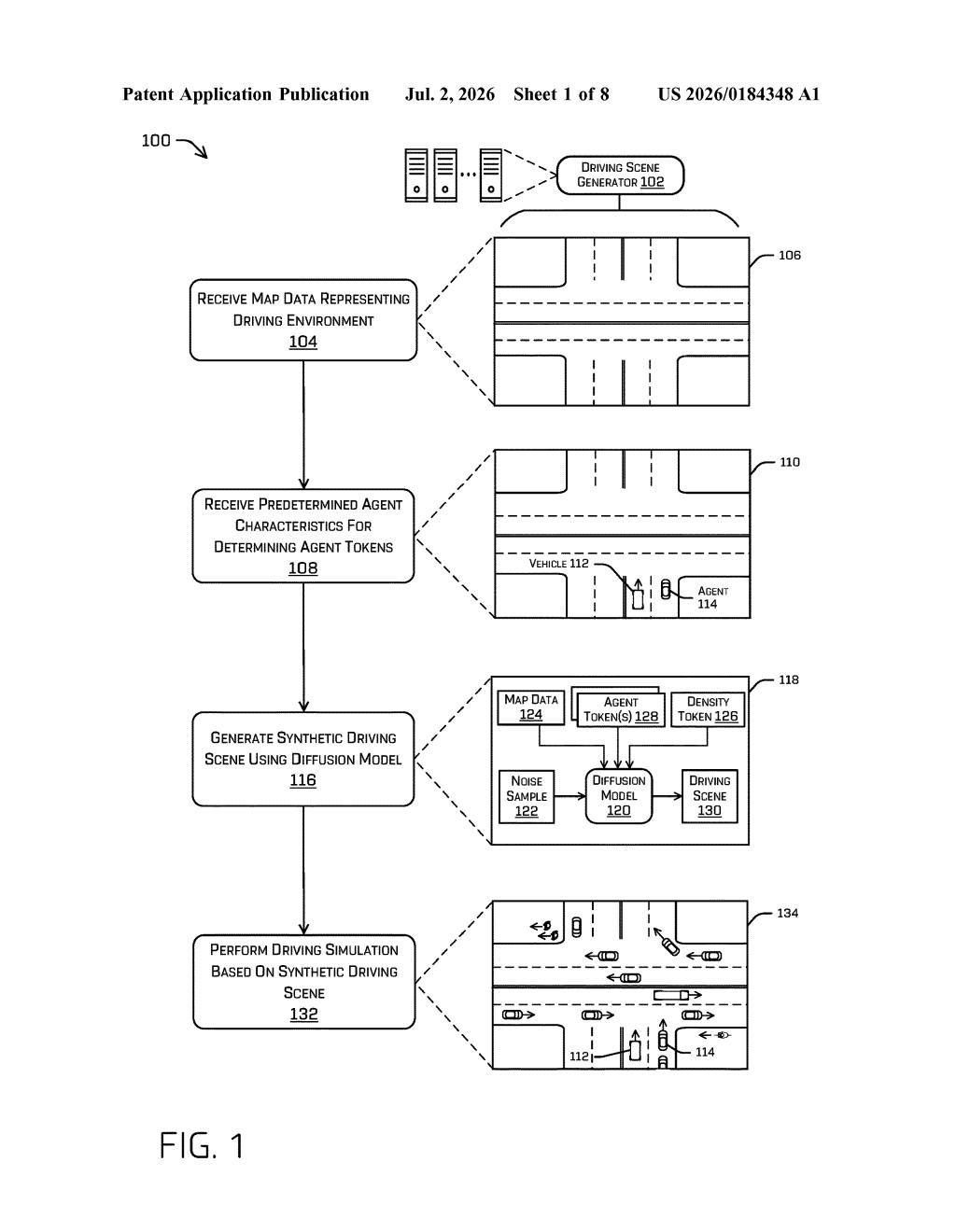
Zoox's patent describes a system that automates this process. You give it a map of a driving environment, tell it which specific vehicles or pedestrians you want present, and specify how busy you want the scene to be. The AI then populates the rest of the scene with additional realistic agents, placing them in positions that make sense given the road layout and the characters you already specified.
The underlying technology is a diffusion model, the same type of AI that powers image generators like DALL-E or Midjourney. Instead of generating pictures, this one generates traffic scenes. The goal is to help Zoox run large-scale, realistic driving simulations without needing a human animator to hand-place every car.
How the diffusion model places and populates each driving scene
The system works in three main inputs: a map of the driving environment, one or more agent tokens (data packages describing specific vehicles or pedestrians the engineer wants in the scene), and a density token (a setting that controls how crowded the resulting scene should be).
All three inputs are fed into a diffusion model, a type of AI that learns to generate structured outputs by practicing the reverse of adding noise. Think of it like teaching the model to "un-scramble" a picture of random static back into a coherent driving scene, having learned what coherent driving scenes look like from millions of real-world examples.
The model's output is a complete synthetic driving scene that includes:
- The specific agents the engineer requested, placed appropriately
- Additional background agents (cars, cyclists, pedestrians) scaled to the requested density
- Realistic spatial relationships between all agents, respecting lane markings, intersections, and other map features
That generated scene is then handed off directly to a driving simulation, where Zoox's autonomous vehicle software can be tested against it. Because engineers can specify particular agents up front, they can target hard-to-find scenarios like a pedestrian stepping out near a specific intersection, without waiting for that event to appear in recorded real-world data.
What this means for autonomous vehicle safety testing
Autonomous vehicle companies live and die by simulation. Regulators and internal safety teams want proof that a self-driving system has handled millions of edge cases before it ever meets a real pedestrian. The bottleneck has always been generating enough varied and realistic scenarios at scale, not just random traffic, but traffic that behaves the way real traffic does.
A diffusion-based scene generator could let Zoox spin up thousands of plausible variations of a specific tricky scenario in the time it would take a team to hand-craft a few dozen. That matters for safety validation, and it also matters competitively: companies that can simulate more, test faster.
This is unglamorous but genuinely important infrastructure work. Simulation quality is one of the real bottlenecks in autonomous vehicle development, and using diffusion models to generate contextually correct traffic rather than scripted or random traffic is a meaningful step forward. Zoox is a small player owned by Amazon, and patents like this suggest they're building serious technical depth in simulation, which is exactly where you'd want an edge.
There are more where this came from
We read every patent application Big Tech publishes and send you the ones worth knowing. Plain English, free, every week.
Want this weekly breakdown for a company we don't cover? Patentlyze Pro →
Be the first to weigh in