
Xilinx Patents a Chip That Throttles Itself Based on the Math It's Doing
Government export rules cap how fast a chip can compute, but not all math is the same speed. Xilinx wants its chips to know the difference so they don't slow down more than the law actually requires.
What Xilinx's datatype-aware speed limiter actually does
Imagine a speed limit sign that says '60 mph,' but your car has two different modes: one where 60 mph takes you 60 miles in an hour, and another where the same speedometer reading only gets you 40. A blanket speed cap would be too restrictive in one case and just right in the other. That's the problem Xilinx is solving here.
Governments, including the US, restrict how many calculations per second a chip can perform before it requires an export license. Those limits are written as a single number, but a chip can actually run different kinds of math at very different rates depending on the datatype being used. A datatype is basically the size and format of the numbers the chip is crunching. Smaller numbers (like INT4) can be processed much faster than larger ones (like INT8).
This patent describes a chip that checks which type of math it's doing before deciding how much to slow itself down. Instead of always throttling to the most conservative limit, it applies just enough braking to stay within the legal cap for that specific operation. The result is a chip that stays fully compliant without leaving performance on the table unnecessarily.
receive from the core a signal indicating a datatype used when performing the instruction, and in response to determining that the core exceeds the maximum operational rate based on the datatype, insert at least one stall cycle into the core to make the IC compliant with the maximum operational rate.
Translation: The chip checks the type of math being done and pauses the processor if it goes past the legal limit.
How the throttling logic reads datatypes and inserts stall cycles
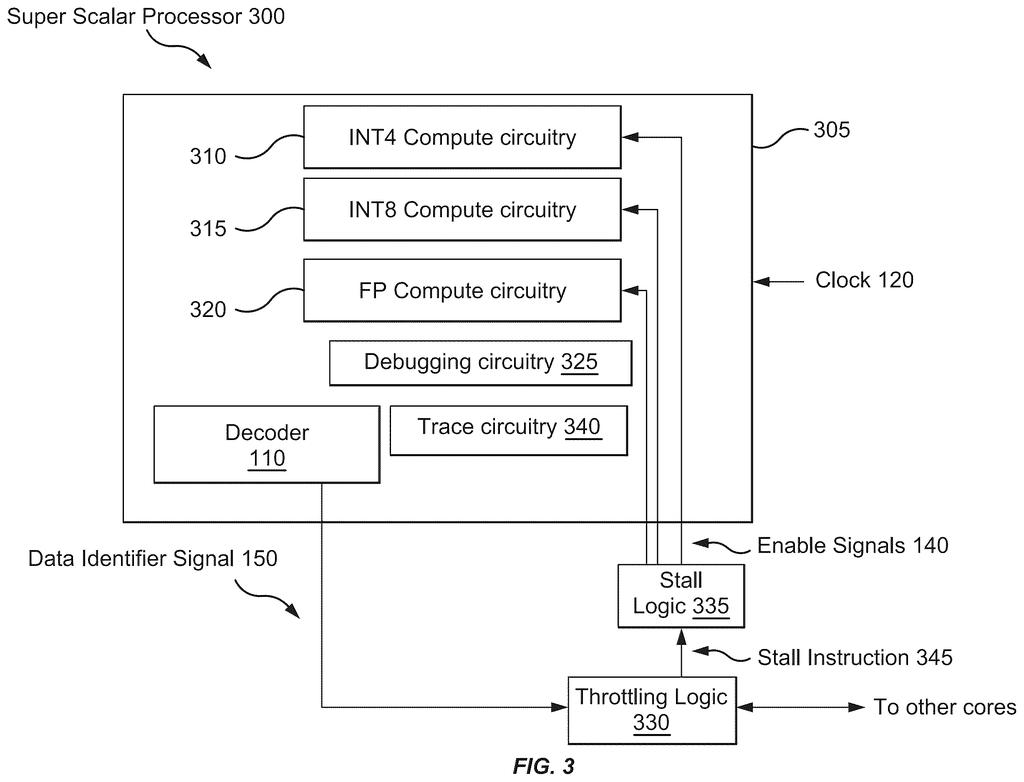
The patent describes an integrated circuit (IC) with built-in throttling logic that adjusts the chip's speed on a per-operation basis depending on the datatype of the instruction being executed.
The key components are:
- A fuse that permanently encodes the chip's maximum allowed operational rate (measured in TOPS, or Tera Operations Per Second). Think of a fuse here as a hardware-level configuration that can't be changed in software, making it tamper-resistant for compliance purposes.
- A core that runs instructions, which reports back to the throttling logic to indicate what datatype it's working with.
- Throttling logic that watches the core's activity and, if the chip is running faster than the legal cap allows for that specific datatype, inserts stall cycles (deliberate pauses in processing) to bring it back into compliance.
The critical insight is that the same chip might legally be allowed to run at 200 TOPS when processing INT4 data but only 100 TOPS for INT8. A naive throttling system would cap everything at the lower number to be safe. This design applies the correct cap per datatype, so the chip gets to run at full legal speed whenever possible instead of always being held to the most restrictive limit.
Government regulations or export control may indicate the maximum number of operations that can be performed in the IC.
Translation: Trade laws can restrict how many calculations a processor is allowed to do.
What this means for AI chip export controls
AI chips are directly in the crosshairs of US export controls, with regulations specifying performance thresholds that determine whether a chip can be sold to certain countries without a license. Those thresholds are typically written in total compute power, but chips like Xilinx's FPGAs (programmable chips widely used in AI acceleration) can behave very differently depending on how they're configured. A chip that always throttles to the lowest possible ceiling is leaving real performance unused.
This patent is essentially a compliance engineering solution: it lets Xilinx design chips that hit the performance ceiling precisely rather than conservatively. For buyers, that means getting as much compute as the law permits. For Xilinx (now owned by AMD), it's a way to stay competitive in restricted markets without running afoul of regulators.
This is a genuinely practical patent, not a moonshot. Export controls on AI chips are tightening, and the gap between 'legally allowed performance' and 'what a naive throttle actually delivers' is real money for chip buyers. Xilinx solving that gap in hardware, with a tamper-resistant fuse, is the kind of quiet engineering work that ends up mattering a lot in regulated markets.
There are more where this came from
We read every patent application Big Tech publishes and send you the ones worth knowing. Plain English, free, every week.
The drawings
4 drawing sheets from US 2026/0228004 A1 · click any drawing to enlarge


Want this weekly breakdown for a company we don't cover? Patentlyze Pro →
Be the first to weigh in