
Disney Patents a System That Keeps Projected Images Locked to a Moving Robot's Skin
Imagine a robot character whose face and body display animated visuals that shift and flow perfectly as the robot moves, bends, and changes shape. Disney is patenting the system to make that happen in real time.
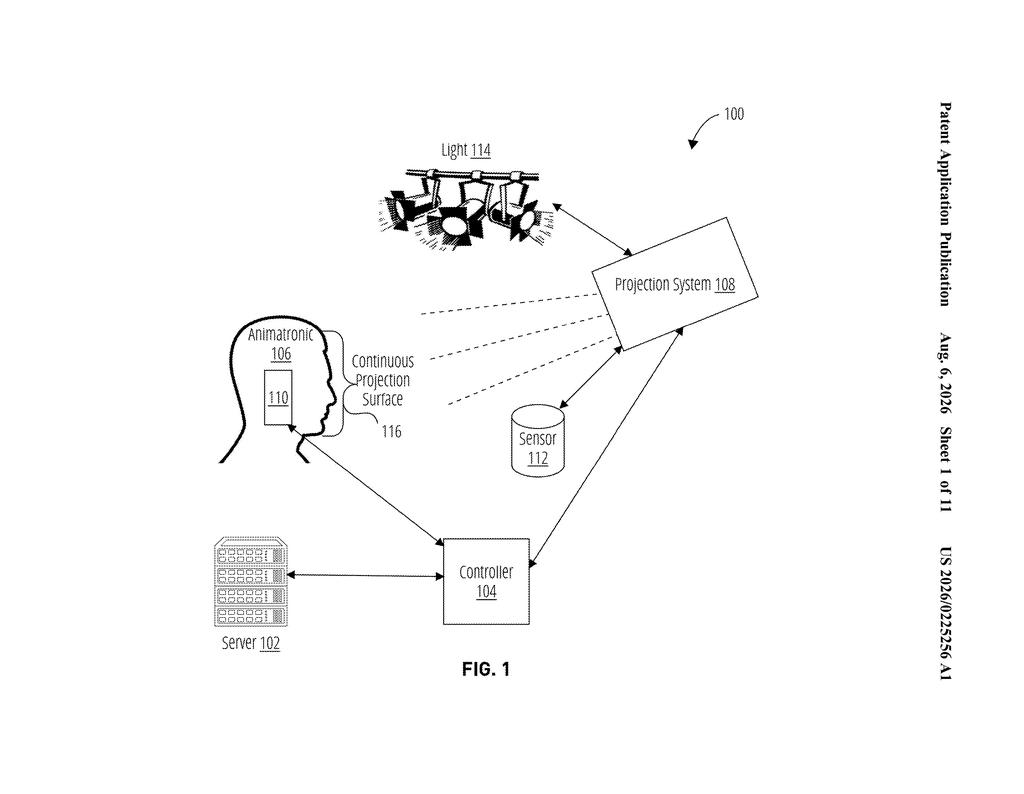
What Disney's moving-robot projection system actually does
Think about a theme park animatronic figure, the kind that waves its arms or turns its head. Now imagine instead of a painted fiberglass face, the entire body is a living screen, showing animated textures, glowing eyes, or shifting colors. The problem is that projecting onto something that moves and changes shape is hard. If the robot shifts even slightly, the projected image lands in the wrong spot and everything looks off.
Disney's patent describes a solution that treats the robot's outer surface as a single continuous screen. When a motor inside the robot changes the shape of part of that surface, the projection system knows about it and adjusts the image on the fly so the visuals always land exactly where they should.
The result: a robotic figure that can morph its physical form while the projected imagery moves with it, like a digital costume that never slips. This is aimed at Disney's own park characters and stage figures, not a product you'd take home.
… an actuator coupled to the structure and configured to change a topography of a portion of the continuous projection surface; and a projector positioned relative to the continuous projection surface and configured to project content onto the continuous projection surface.
Translation: A mechanical motor shifts the robot surface shape while a projector shines images directly onto it.
How the projector tracks a robot's changing surface shape
The patent describes a robotic system built around three core parts working together:
- A continuous projection surface: a single unbroken flexible or articulated skin stretched over the robot's frame, acting as the screen.
- An actuator (a motor or mechanical driver) connected to the structure beneath, which physically pushes or pulls part of that surface to change its shape, like a cheek that puffs out or a chest that expands.
- A projector positioned outside the robot that beams content onto the surface.
The key technical challenge is topography tracking: as the surface changes shape, the geometry of where projected pixels land shifts too. A flat image mapped onto a curved surface looks distorted. Disney's system is designed to detect or anticipate those shape changes and warp the projected content to compensate in real time, keeping the visuals looking correct from the audience's viewing angle.
The patent frames this as a "hybrid" approach, meaning it combines physical movement (the actual mechanical deformation of the surface) with digital correction (adjusting the projected image to match). Neither side alone solves the problem; both have to coordinate together.
… actuate a mechanical movement of the projection surface to change a topographical shape of the projection surface, and project a content specific to the change of the topographical shape.
Translation: The robot moves its skin to change its shape, instantly updating the projected image to match.
What this means for Disney's theme park animatronics
For Disney, animatronic figures are a major storytelling tool, and the gap between what painted robots can express and what a fully animated on-screen character looks like has always been visible. A system like this could let a park character display emotional nuance through projected facial textures and lighting that respond in sync with physical movement, closing some of that gap without requiring audiences to wear headsets or look through screens.
More broadly, this is part of a longer trend of theme park companies treating physical robots as display surfaces rather than purely mechanical sculptures. If the projection stays locked to a moving, shape-shifting figure convincingly, you get something that looks alive in a way that neither a static figure nor a flat screen can match.
This is a genuinely interesting Disney patent because it sits at the intersection of robotics and display technology in a way that's specific to the company's core business. The challenge of keeping a projected image calibrated to a physically deforming surface in real time is not trivial, and solving it well would be a visible upgrade for anyone who has stood next to a theme park animatronic and noticed how lifeless the painted faces look up close.
There are more where this came from
We read every patent application Big Tech publishes and send you the ones worth knowing. Plain English, free, every week.
The drawings
11 drawing sheets from US 2026/0225256 A1 · click any drawing to enlarge


Want this weekly breakdown for a company we don't cover? Patentlyze Pro →
Be the first to weigh in