
Adobe Patents a Tool That Turns 3D Models Into AI-Generated Images With a Text Description
Adobe is patenting a way to combine a 3D modeling window and a text prompt box in a single interface, so you can pose an object, describe what you want it to look like, and get an AI-generated image that matches both at once.
How Adobe's 3D-plus-text image generator works
Imagine you're designing a product shot. You have a 3D model of a sneaker, and you want to see it sitting on a wooden shelf, lit like a magazine ad, in a peach colorway. Normally you'd either render it in expensive 3D software or try to describe it from scratch to an AI image generator and hope for the best.
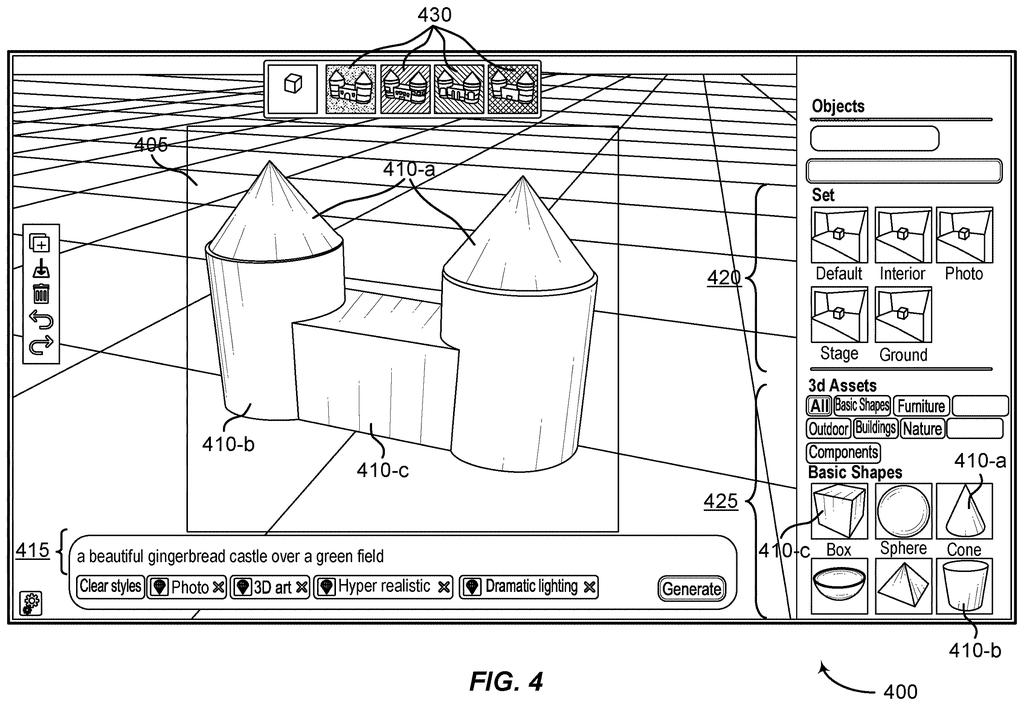
Adobe's patent describes a single screen that handles both steps together. On one side, you adjust the 3D model: rotate it, change its pose, or move it around. On the other side, you type a plain-English description of the scene and the look you want. The system then generates an image that respects both the shape you set up and the style you described.
The key idea is that the system reads the 3D geometry of your model to understand depth and form, then uses your text description to apply textures, lighting, and atmosphere on top. You stay in control of the structure, and the AI fills in the visual style.
… receiving, via a text UI element of the combined interface, a text prompt describing a scene including the object and a texture for the object; and displaying, via a preview element of the combined interface, an output image in response to receiving the text prompt …
Translation: The software takes a text description and generates a preview image based on what you typed.
How depth maps bridge the 3D model and the AI image
The patent describes a combined interface with four distinct panels working together:
- A 3D modeling panel that displays a 3D object you can rotate and edit in real time
- A 3D editing panel where you input changes to that model (move a limb, adjust proportions, change orientation)
- A text prompt panel where you type a description of the scene and the surface appearance you want
- A preview panel that shows the AI-generated output image, updating as you change either the model or the text
The underlying process starts by generating a depth map from the 3D model. A depth map is essentially a grayscale image that records how far each part of the object is from the camera, giving the AI a clear picture of the object's shape and volume without needing full rendering.
An image generation model (an AI trained to produce photorealistic or stylized images) then takes that depth map alongside the text prompt and produces an output image. The depth map acts as a structural guide, so the AI can't ignore the shape you set, while the text drives the color, texture, material, and environmental details.
The result is an image where structure comes from your 3D model and style comes from your words, with both updating interactively as you make changes.
An image processing system is configured to receive a three-dimensional (3D) model and a text prompt that describes a scene corresponding to the 3D model. The system may then generate a depth map of the 3D model and generate an output image based on the depth map and the text prompt.
Translation: The system combines a 3D shape and a text prompt to create a new image.
What this means for designers using AI image tools
For designers and artists, the frustrating gap between 3D modeling tools and AI image generators has always been control. AI image generators are fast but unpredictable about shape; 3D renders are precise but slow and require expertise to make look good. Adobe's approach tries to close that gap by making the 3D model a hard constraint the AI has to respect.
If this shows up in something like Adobe Firefly or a future version of Dimension, it could let someone with basic 3D skills produce production-quality images without a full rendering pipeline. That's a meaningful shift for small studios, freelancers, and product teams who need convincing visuals fast.
This is a logical next step for Adobe Firefly, and it solves a real problem that anyone who has fought with AI image generators over object placement will recognize immediately. The depth-map approach is not a new idea in research circles, but putting it inside a live, interactive combined interface is where Adobe could actually make it practical. Worth watching.
There are more where this came from
We read every patent application Big Tech publishes and send you the ones worth knowing. Plain English, free, every week.
The drawings
10 drawing sheets from US 2026/0228970 A1 · click any drawing to enlarge


Want this weekly breakdown for a company we don't cover? Patentlyze Pro →
Be the first to weigh in