
A Robot Hand Patent Finally Gets the Thumb Right
Getting a robot to grip things the way a human hand does is harder than it sounds, and the thumb is almost entirely responsible for that difficulty. Sony's latest patent takes a careful look at exactly how a robotic thumb should rotate.
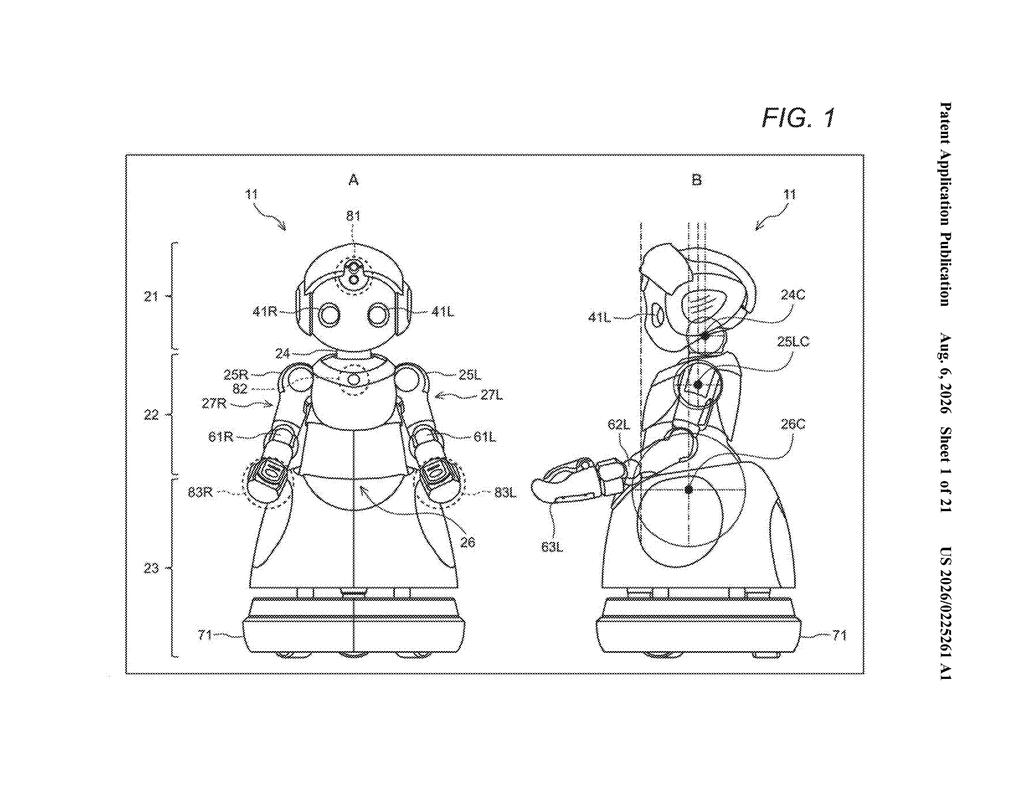
What Sony's robot thumb mechanism actually does
Think about how you pick up a coffee cup. Your four fingers curl around it, but your thumb swings in from a completely different angle to lock everything in place. That crossing motion is what makes the human hand so useful, and it's also what makes robot hands so hard to build.
Sony has filed a patent for a robot hand design that breaks the problem down into three separate rotation points. Two of them handle the curling of the fingers, and a third handles the thumb's distinctive sideways swing. The key detail is that all three pivot points sit on the same flat plane when the hand is fully open, which gives the whole mechanism a clean, predictable starting position.
This is the kind of foundational mechanical design that would show up inside a robot intended to handle real-world objects, whether that's a warehouse picking robot, a home assistant, or a research platform.
… a third rotation shaft that is parallel to the first direction or inclined in an oblique direction with respect to the first direction about a third direction perpendicular to the first direction and the second direction and that rotates the thumb portion in a second rotation direction with respect to the main portion …
Translation: This specialized joint controls how the robotic thumb swivels and opposes the rest of the hand.
How three rotation shafts recreate a human grip
The patent describes a robot hand built around three named rotation shafts, each responsible for a different part of the hand's movement.
- First rotation shaft: runs perpendicular to the length of the hand and controls the curling (flexion) of the four-finger section.
- Second rotation shaft: runs parallel to the first and adds a second bending point to the same four-finger section, allowing a more natural, multi-knuckle curl.
- Third rotation shaft: runs along the length of the hand (or at a slight diagonal) and rotates the thumb portion sideways relative to the rest of the hand. This is the motion called opposition in anatomy, and it's what lets you pinch.
The defining claim of the patent is the geometric relationship between these three shafts. When the hand is in its fully extended (open) position, all three shafts lie on the same flat plane. That co-planar arrangement is a deliberate design choice: it gives the mechanism a clean, well-defined neutral state that simplifies the math needed to control the hand and reduces the chance of the joints binding against each other during movement.
… a first rotation shaft that is parallel to a second direction perpendicular to a first direction in which the main portion extends and that flexes and extends the main portion in a first rotation direction …
Translation: These rotating axes dictate how the main body of the mechanical hand bends and straightens out.
What this means for Sony's robotics ambitions
Robot hands that can grip diverse objects reliably are one of the harder unsolved problems in practical robotics. Most commercial grippers either have a fixed claw shape or require expensive, complex mechanisms to approximate human dexterity. A clean mechanical architecture, like the one Sony is patenting here, is the kind of thing that can make a robot hand manufacturable at scale rather than just demonstrable in a lab.
Sony has been expanding its robotics research for several years, and this patent sits at the hardware foundation level. If the company is building toward a general-purpose humanoid or a more capable research robot, a well-engineered hand mechanism is one of the first things that needs to be locked down.
This is a focused mechanical engineering patent, not a flashy AI filing, but that's actually a good sign. Solid robot hand design is a prerequisite for almost everything else in humanoid robotics, and Sony thinking carefully about thumb geometry suggests the company is doing the unglamorous groundwork that real robot products require.
There are more where this came from
We read every patent application Big Tech publishes and send you the ones worth knowing. Plain English, free, every week.
The drawings
21 drawing sheets from US 2026/0225261 A1 · click any drawing to enlarge


Want this weekly breakdown for a company we don't cover? Patentlyze Pro →
Be the first to weigh in