
Drone Patent Reuses Blurry Misaligned Frames to Fix 3D Distance Measurement
When a drone's stereo cameras drift out of alignment mid-flight, the fix usually happens later on the ground using different footage, which means the correction and the problem never quite match up. Sony's new patent closes that gap by saving the exact frame where the problem was spotted and using it again to apply the fix.
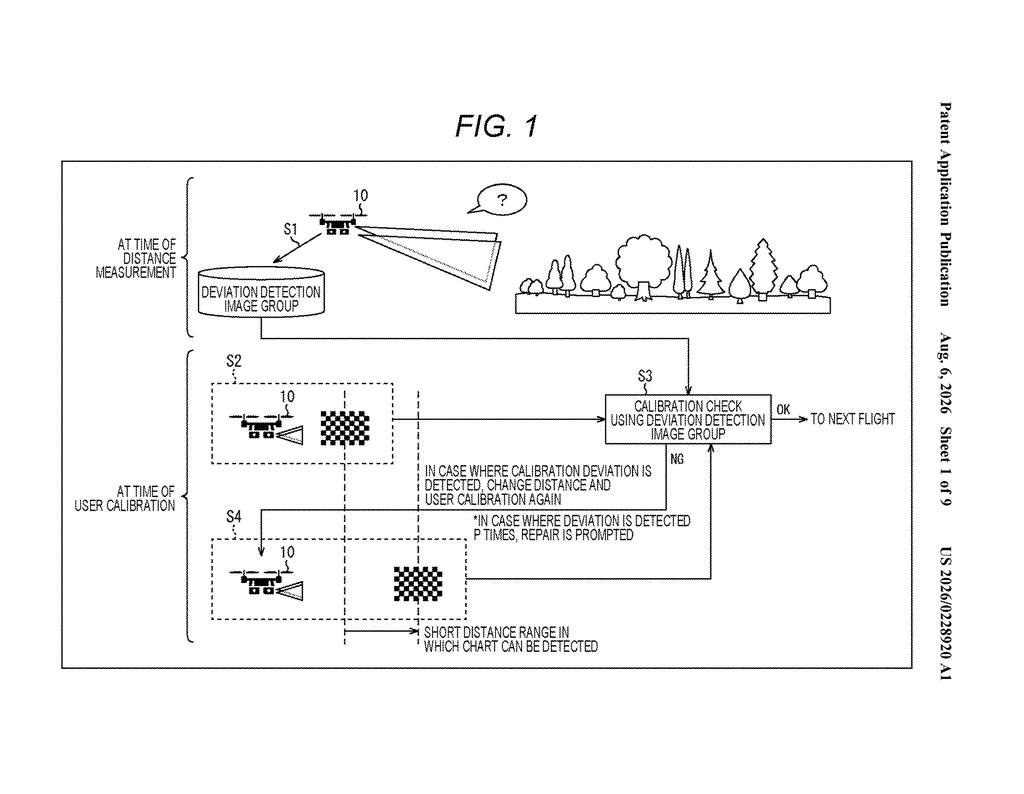
How Sony's drone cameras catch and fix their own blind spots
Imagine your car's side mirrors slowly shift out of position while you're driving. You notice the problem at a specific moment, but when you go to adjust them later, you're working from memory, not from what you actually saw. The fix might be close, but it won't be perfect.
Drones with stereo cameras (two lenses working together to judge depth and distance, similar to how your two eyes give you 3D vision) run into the same issue. Their cameras can drift out of alignment while flying, and when the drone checks for that drift, it flags the problem but doesn't always use the same image to fix it. Sony's patent saves the exact image where the alignment problem was detected and feeds it back into the correction process.
The result is that the calibration check and the actual fix are working from identical visual information, so the correction is much more consistent.
… an image saving unit that saves a deviation detection image in which a calibration deviation is detected in a first calibration check of the stereo camera executed during movement of the mobile body …
Translation: A system records the exact blurry or misaligned camera frames captured while the drone is flying.
How the saved deviation image feeds the second calibration check
The system works in two stages using what the patent calls a first calibration check and a second calibration check.
- During flight, the stereo camera continuously runs a first calibration check that watches for alignment drift between its two lenses. When drift is detected in a given frame, that frame is flagged as a deviation detection image and saved by an image saving unit.
- Later (either after landing or when the drone has a processing window), a calibration check unit loads that saved frame and runs the second calibration check against it, this time applying the corrected calibration parameters calculated during the full calibration pass.
- Because both the detection and the verification step use the same image, the system can confirm the fix actually resolves the exact problem it saw, rather than testing the correction against a different scene that may have different lighting, texture, or geometry.
The core problem the patent solves is called a mismatch: historically, the image used to detect a calibration error and the image used to verify the fix were different, so you could never be fully sure the correction worked. Stereo calibration is critical for depth perception (the camera's ability to judge how far away objects are), which underpins obstacle avoidance and autonomous navigation.
… a mobile body, a calibration method, and a program capable of eliminating mismatch between user calibration and calibration check …
Translation: The software ensures the drone's manual setup matches its internal automated checks.
What this means for drone vision and autonomous navigation
For drones, accurate depth perception isn't a nice-to-have feature, it's the foundation of obstacle avoidance and reliable autonomous flight. A stereo camera that drifts out of alignment might tell the drone an obstacle is two meters away when it's actually one. Sony's approach makes the calibration verification loop tighter and more trustworthy by eliminating the guesswork in whether a fix actually worked.
The patent specifically names drones as the target use case, but the same logic applies to any moving vehicle with stereo cameras, including robots and self-driving systems. As autonomous platforms become more common, the ability to self-verify sensor health in flight (rather than requiring a manual ground check) becomes an important piece of reliability infrastructure.
This is a focused engineering fix for a real problem in autonomous drone calibration. It won't generate headlines like a flashy new camera feature would, but accurate depth sensing is exactly where drone failures happen, so getting calibration verification right is genuinely important work. Sony's drone camera business gives this filing a clear home rather than making it a curiosity.
There are more where this came from
We read every patent application Big Tech publishes and send you the ones worth knowing. Plain English, free, every week.
The drawings
9 drawing sheets from US 2026/0228920 A1 · click any drawing to enlarge


Want this weekly breakdown for a company we don't cover? Patentlyze Pro →
Be the first to weigh in