
Sony Patents a Camera Lens That Repels Barnacles and Still Focuses Sharply
Cameras mounted on ships, drones, and utility poles share a common enemy: barnacles, algae, and other creatures that slowly grow over the lens and ruin the shot. Sony's new patent tries to solve that with a single optical element that does double duty.
What Sony's anti-growth camera lens actually does
Imagine a camera bolted to the hull of a ship or the top of a coastal utility pole. Over weeks and months, tiny organisms like barnacles and algae attach themselves to the lens, clouding the image. You can't exactly climb down to clean it every Tuesday.
Sony's patent describes a lens element made from a material that naturally repels those organisms, the way a non-stick pan repels oil. But the tricky part is that the same surface still has to let light through cleanly and focus it correctly onto the camera sensor.
To solve that, Sony drills a precise pattern of tiny holes into the element. The holes aren't all the same size or spacing; the pattern varies depending on where you are on the lens, so light bends and spreads in just the right way across the whole image. The result is meant to be a camera that stays clean longer and keeps producing sharp images.
How the micro-holes control light despite the repellent surface
The patent describes an optical element (think of it as a specialized lens layer) that sits on the light path between a subject and the camera's image sensor. The element is made from a repellent material for sessile organisms, meaning creatures that attach and stay put, like barnacles, mussels, or biofilm.
The clever engineering is in the pattern of fine holes drilled through the element. Rather than a uniform grid, the holes are arranged so their density and spacing change depending on where they sit on the cross-section of the lens. This variation controls ray diffusion characteristics (how light spreads as it passes through each region), which lets the element act as a functional optical component rather than just a protective cover.
- Outer zones of the lens can have different hole patterns than the center, compensating for how light hits a lens at different angles across the frame.
- The repellent surface property means organisms can't get a grip, reducing maintenance needs for cameras in hard-to-reach locations.
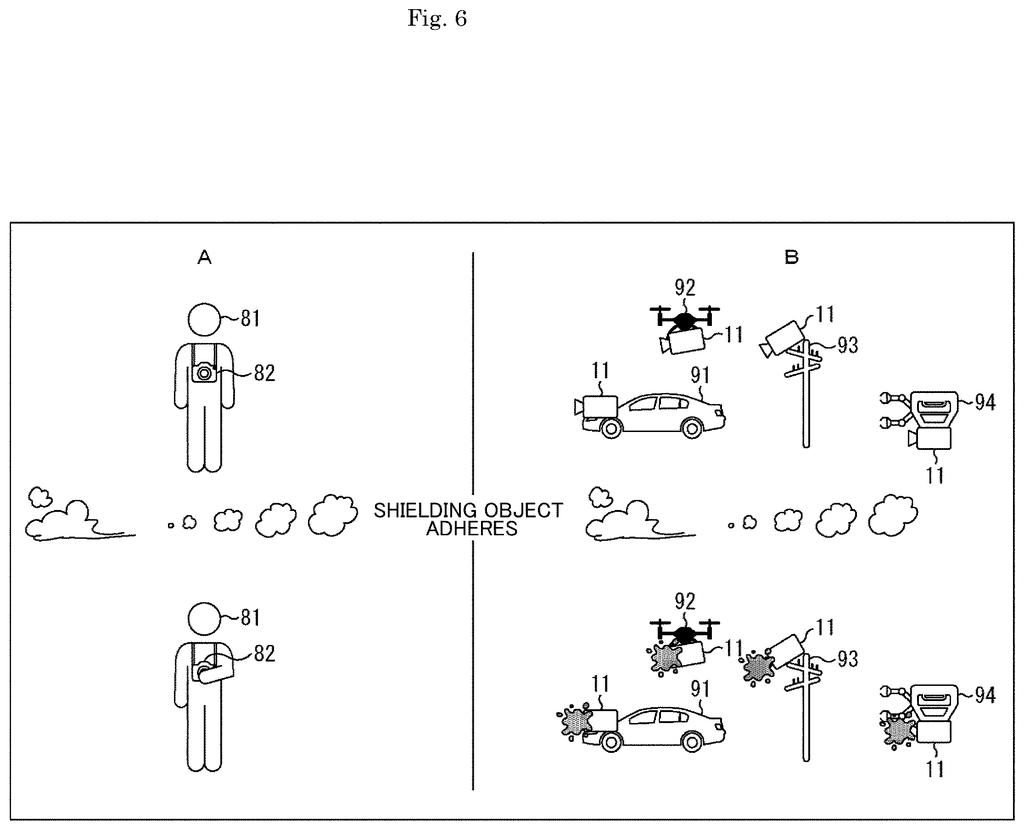
- The patent specifically calls out cameras installed on vehicles, drones, electric poles, and ships as target applications.
Sony also mentions that an image-processing device can take the raw output from this lens and convert it into a fully restored, sharp image of the subject, suggesting the optical quirks introduced by the hole pattern can be corrected in software.
What this means for outdoor and marine camera systems
For consumer cameras or studio gear, this patent is not relevant. But for infrastructure cameras, the ones watching harbors, monitoring offshore wind farms, or riding on autonomous vessels, cleaning schedules are expensive and sometimes impossible. A lens that resists biological fouling for months longer than a standard glass element could meaningfully reduce operating costs and downtime.
The combination of the repellent surface with a tunable light-diffusion pattern is the interesting wrinkle here. It suggests Sony isn't treating this as a simple protective coating bolted in front of a normal lens; the element is designed to be part of the optical system itself, with any image distortion it introduces corrected downstream in software.
This is a niche but genuinely practical patent. Sony is clearly thinking about the industrial and marine camera market, where hardware durability beats pixel count every time. The idea of encoding optical correction directly into an anti-fouling element rather than adding a separate protective cover is clean engineering. Don't expect to see this in a mirrorless camera; do expect it in a buoy or a port-surveillance system.
There are more where this came from
We read every patent application Big Tech publishes and send you the ones worth knowing. Plain English, free, every week.
The drawings
23 drawing sheets from US 2026/0219493 A1 · click any drawing to enlarge


Want this weekly breakdown for a company we don't cover? Patentlyze Pro →
Be the first to weigh in