
Salesforce Patent: AI Asks Questions Before Building Your Custom Automated Work Assistant
Building a custom AI agent today usually requires technical staff and a lot of manual setup. Salesforce's new patent describes a system where an AI simply asks you what you need, then builds the agent for you.
What Salesforce's AI agent builder actually does
Imagine calling a contractor and, before they start work, they ask you a series of questions about your house, your budget, and your timeline. Based on your answers, they ask a few more targeted follow-up questions before drawing up a plan. Salesforce's patent describes an AI that works the same way.
You tell the system you want an AI agent, perhaps one that handles customer complaints or summarizes sales calls. The system asks you a first round of questions about what the agent should do. Then, depending on what you said, the AI decides whether it needs to ask more questions before it can build anything. That second round is tailored to fill in the gaps your first answers left open.
Once both rounds are done, the system uses all your answers to generate a ready-to-use AI agent. The goal is to let non-technical users build AI tools without needing a developer to translate what they want into something a computer can act on.
receiving a request for generation, by an LLM, of an LLM agent asset for a client; providing, based at least in part on the request, a first plurality of inquiries associated with one or more parameters of the LLM agent asset; receiving a first plurality of responses to the first plurality of inquiries; …
Translation: The system gets a request and asks the user an initial round of questions to define the custom tool.
How the LLM decides what follow-up questions to ask
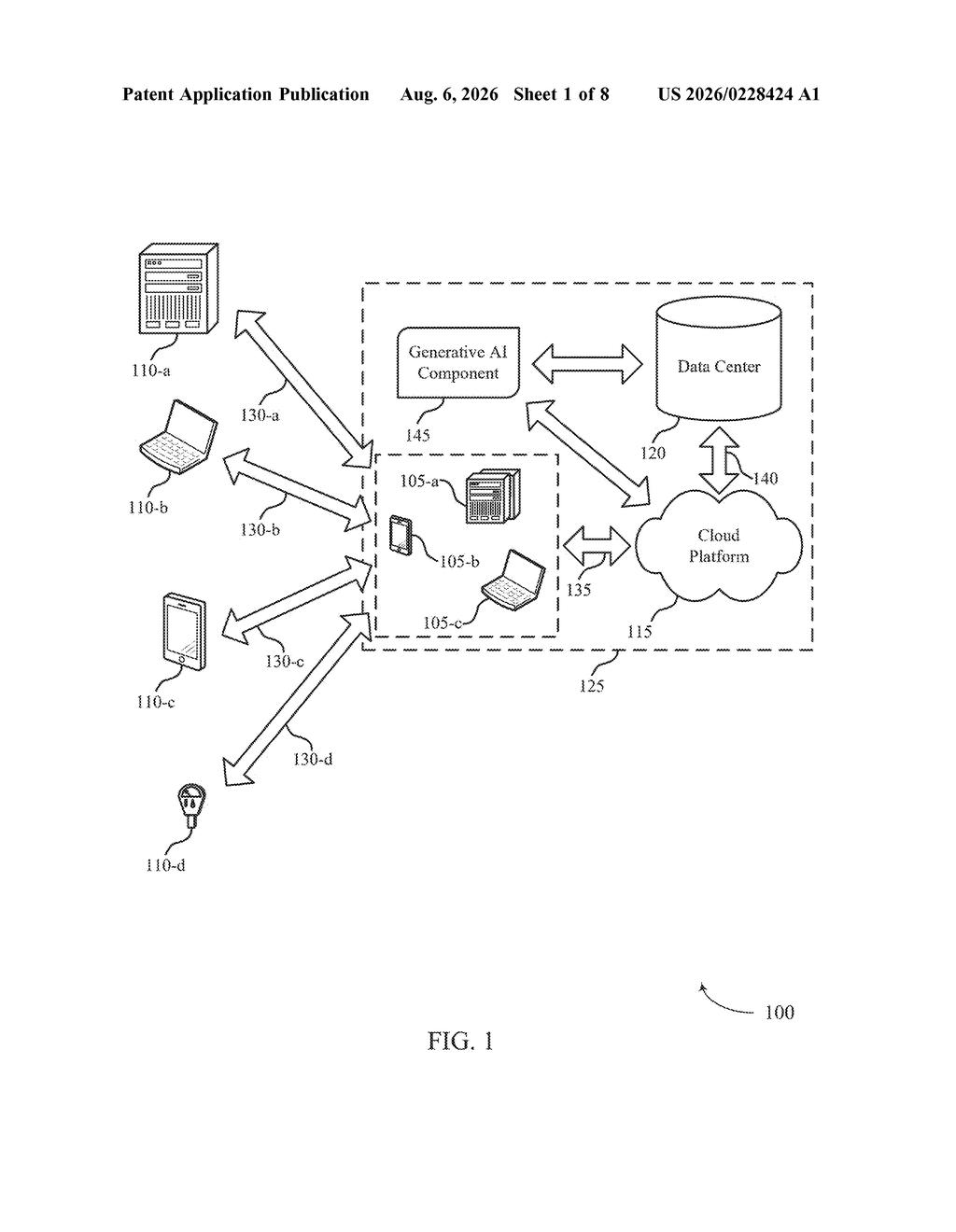
The patent describes a multi-round question-and-answer pipeline that sits between a user and an AI agent-building system.
Round one is a standard intake: the system sends the user a first batch of questions tied to the parameters an AI agent needs, things like its purpose, the data it can access, and how it should behave. The user answers in plain language.
The LLM then acts as a judge. It reads the first-round answers and decides whether those answers are complete enough to generate an agent, or whether gaps remain. This is the key step: the model is evaluating its own inputs rather than just processing them.
If the LLM determines more information is needed, it generates a second round of questions that are specifically derived from what the first answers revealed or left unclear. The user answers again.
Finally, the system combines the original request, the first-round answers, and the second-round answers to generate the LLM agent asset, the actual configured AI agent the user asked for. The patent covers the end-to-end pipeline: intake, adaptive follow-up, and generation, all driven by the same LLM handling the final output.
The system may determine, via the LLM and based on the first plurality of responses, whether a second plurality of inquiries is to be provided to the client. The system may provide the second plurality of inquiries to the client that may be based on the first plurality of responses and the determination.
Translation: Based on those answers, the AI decides if it needs to ask a follow-up round of questions.
What this means for businesses building on Salesforce
Salesforce's core business is selling software to companies that don't have large engineering teams. If businesses can describe what they want an AI agent to do in plain English and get a working agent back, that removes a significant barrier to adopting AI tools inside Salesforce's platforms like Agentforce.
The interesting piece here is the adaptive follow-up layer. Most form-based configuration tools ask every user the same questions. By letting the LLM decide which follow-up questions matter for a specific user's situation, the system can produce more accurate agents with less wasted back-and-forth. For Salesforce, that's a meaningful differentiator in a market where every major platform is racing to make AI agent creation as frictionless as possible.
This is a sensible, practical patent rather than a flashy one. Salesforce is essentially automating the discovery phase that a consultant or solutions engineer would normally handle, and doing it with the same AI that will power the final product. It fits neatly into the Agentforce strategy and is the kind of thing that ships in an enterprise product update rather than a big announcement.
There are more where this came from
We read every patent application Big Tech publishes and send you the ones worth knowing. Plain English, free, every week.
The drawings
8 drawing sheets from US 2026/0228424 A1 · click any drawing to enlarge


Want this weekly breakdown for a company we don't cover? Patentlyze Pro →
Be the first to weigh in