
Sony Patent Routes Split AI Training Through Direct Device Radio Links
Sony is patenting a way to train AI models cooperatively across multiple devices, letting them hand off pieces of the work to each other over direct device-to-device radio connections, no server required.
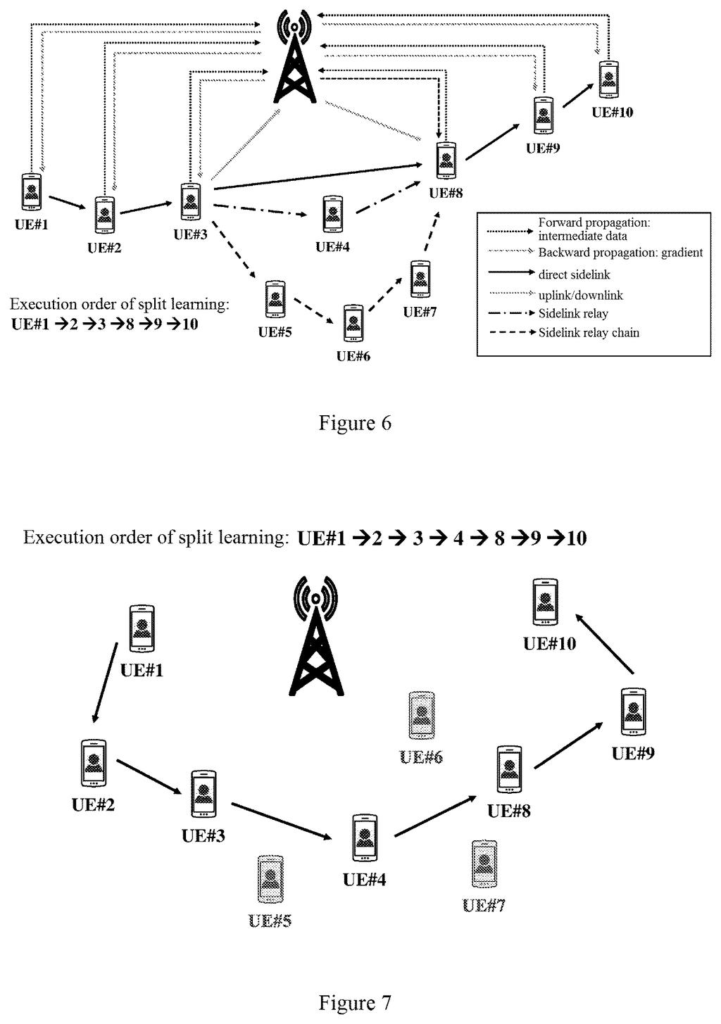
How Sony's split learning uses your neighbors' devices
Imagine you want to teach an AI model something, but your phone alone isn't powerful enough to do all the training. Normally you'd send data to a remote server. Sony's patent describes a different approach: split the training job across several nearby devices, each doing a portion of the work.
The clever part is how the system decides which devices participate and in what order. Instead of making those decisions blindly, it checks the quality of the direct radio links between devices (similar to how your phone connects directly to a nearby device over Bluetooth or Wi-Fi Direct, bypassing a cell tower). If the connection between two devices is poor, the system routes around it.
The result is a self-organizing training network among a group of users, where the workload and the communication paths are constantly matched to actual radio conditions.
How sidelink channel quality drives the training split
The patent centers on split learning, a technique where a neural network model is cut into segments, with different devices running different layers of the model. Device A processes the first few layers, hands off intermediate results to Device B, which runs the next layers, and so on. Only partial, compressed data moves between devices, not raw training data.
What Sony adds is a controller that makes the split adaptive based on sidelink channel state. A sidelink (in 5G terminology) is a direct radio link between two user devices, not routed through a base station. The system monitors how good those direct connections are at any moment.
Based on that channel quality information, the system decides:
- Which devices join the training session at all
- The order in which they pass model data to each other
- Which specific radio link each device uses to send its model segment to the next device in the chain
The output is split information, essentially a set of instructions distributed to each participating device telling it exactly what role to play. If a link degrades mid-session, the system can reorganize the participants or paths accordingly.
What this means for on-device AI without a cloud server
On-device AI training is becoming important for privacy (keeping raw data local) and for scenarios where cloud connectivity is limited or expensive. But most current approaches either train entirely on one device (slow, power-hungry) or rely on a central server (which reintroduces the privacy and connectivity problems). Sony's approach tries to get the best of both by distributing the work across a local group of devices.
For you as a user, this is the kind of infrastructure patent that could eventually show up inside Sony's phones, earbuds, or gaming hardware, enabling AI features that improve over time without sending your personal data anywhere. It's also relevant to industrial or IoT settings where many edge devices need to collaborate on a shared model.
This is a real engineering contribution to a genuinely active research area: making federated and split learning practical over wireless links. Sony is doing the unsexy work of handling radio-layer realities (links change, degrade, drop) that academic split-learning papers tend to gloss over. Worth watching, though the gap between a promising systems patent and a shipping product remains wide.
There are more where this came from
We read every patent application Big Tech publishes and send you the ones worth knowing. Plain English, free, every week.
The drawings
18 drawing sheets from US 2026/0228481 A1 · click any drawing to enlarge


Want this weekly breakdown for a company we don't cover? Patentlyze Pro →
Be the first to weigh in