
Salesforce Patents a System That Automatically Ranks AI Models for Business Tasks
Picking the right AI model for a business task is currently a guessing game. Salesforce wants to automate the whole evaluation process, from generating the test questions to ranking the results, inside a single dashboard.
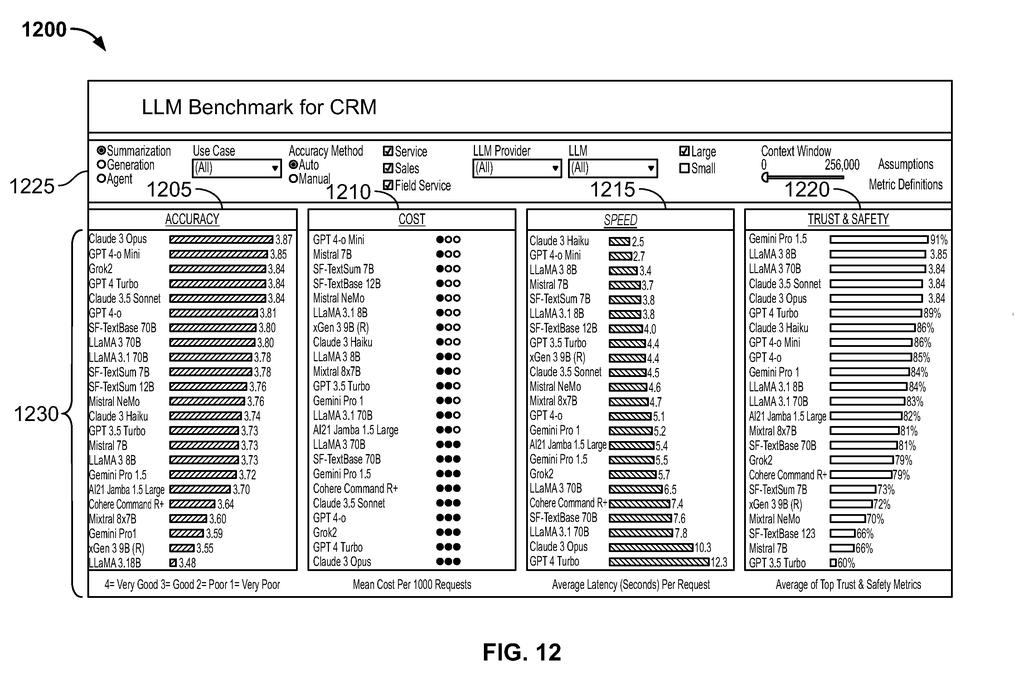
What Salesforce's AI model ranking tool actually does
Imagine your company wants to use an AI assistant to summarize customer support tickets. There are dozens of AI models out there, and nobody has time to test each one on your actual data. Salesforce is patenting a system that does that testing for you, automatically.
You feed the system your real business data, tell it what task you need help with (summarizing emails, drafting sales replies, answering customer questions), and it builds a custom test for a shortlist of AI models. It runs those tests, scores the results, and then shows you a ranked list in a clean interface you can sort and filter.
The point is to take the guesswork out of choosing an AI tool for customer relationship tasks. Instead of trusting a vendor's marketing claims, you'd see how each model actually performs on your specific work.
… identifying, using an algorithm, a set of one or more LLMs that are applicable to the at least one use case based on the at least one data set; configuring at least one benchmark associated with the set of one or more LLMs to evaluate individual LLMs of the set of one or more LLMs; …
Translation: The system uses an algorithm to pick relevant AI models and sets up tests to measure their performance.
How the benchmark scores and orders language models
The system centers on what the patent calls a grounded prompt, which is a test question or instruction built directly from your real data rather than a generic example. This matters because a generic benchmark might not reflect how an AI performs on your company's actual customer emails or sales records.
Here is how the pipeline works:
- You provide a dataset tied to a specific CRM task (like categorizing support tickets).
- The system automatically identifies which AI models are worth testing for that task.
- It generates grounded prompts from your data and uses them to produce sample responses from each model.
- Each model is scored using a configured benchmark, and the results appear in a GUI where you can sort and reorder by different criteria.
The selectable elements in the interface are tied directly to benchmark metrics, so clicking a column header does more than just sort a table. It reframes the ranking according to whichever performance dimension you care about most, such as accuracy, response length, or task-specific quality.
… displaying in a Graphical User Interface (GUI) a listing of the LLMs in accordance with an evaluation based on the benchmark, further, ordering a set of LLMs in the GUI based on a selection of a selectable element configured in the GUI …
Translation: It shows the ranked AI models on a screen so users can sort them based on how well they passed the tests.
What this means for companies buying AI tools
For any business evaluating AI tools, the current state of affairs is messy. Published benchmarks are usually run on generic academic datasets that have little to do with real sales or support workflows. This patent describes a system that closes that gap by anchoring tests to actual business data, which could make model selection far more reliable.
Salesforce's broader play here is positioning itself as the infrastructure layer for enterprise AI decisions, not just an AI vendor. If companies rely on Salesforce's platform to choose and compare AI models, that is significant lock-in. It also fits neatly into Salesforce's existing Einstein AI ecosystem, where the logical next step would be routing the highest-ranked model directly into a live CRM workflow.
This is a practical, unglamorous piece of infrastructure, and that's exactly why it's worth paying attention to. Businesses are genuinely struggling to evaluate AI models for specific tasks, and a system that automates testing on real data solves a real pain point. It's less about the AI doing anything new and more about Salesforce controlling the process by which companies decide which AI to use, which is a clever place to sit.
There are more where this came from
We read every patent application Big Tech publishes and send you the ones worth knowing. Plain English, free, every week.
The drawings
14 drawing sheets from US 2026/0228750 A1 · click any drawing to enlarge


Want this weekly breakdown for a company we don't cover? Patentlyze Pro →
Be the first to weigh in