
Google Patents an AI Audio Editor That Takes Precise Instructions as Numbers
Google is patenting a way to give an AI audio editor precise, numeric instructions for editing sound, going well beyond simple commands like 'remove the background noise' to something far more surgical.
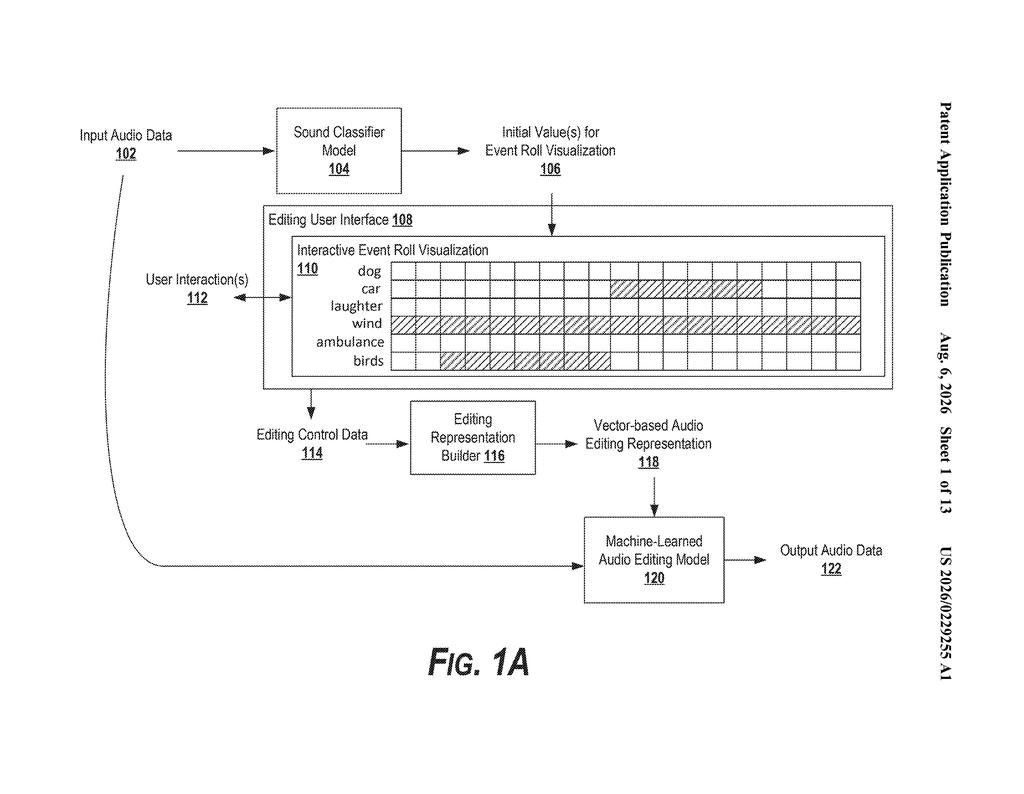
What Google's AI audio editing system actually does
Imagine you're editing a podcast and you want to remove a car horn that shows up at exactly 14 seconds, boost the host's voice slightly, and add a short musical sting right after. Today, doing all of that in the right order with the right intensity usually takes a professional audio engineer and several software tools.
Google's patent describes an AI system that can handle all of those edits at once, guided by a set of numeric instructions that tell it exactly what to change, where, and how much. Instead of typing a text prompt or clicking through menus, the system converts each desired edit into a vector (basically a row of numbers that describe the edit precisely) and feeds that alongside the original audio into a trained AI model.
The model then produces a new audio file with all the requested changes baked in. Google says the system can generate new sounds, remove unwanted ones, shift audio in time, transform its character, or simply clean it up.
… generating, by the computing system, a vector-based audio editing representation that numerically describes one or more edits to the input audio signal; …
Translation: The system turns your desired sound changes into a string of numbers.
How the vector encoding controls the AI editing model
At the core of this patent is a concept called a vector-based audio editing representation. A vector here is just a list of numbers that encodes what kind of edit you want, where in the audio it should happen, and how strong the effect should be. Think of it like GPS coordinates for an audio change: instead of saying 'somewhere around there,' you're giving the system an exact address.
Those numeric instructions are then passed, together with the original audio signal, into a machine-learned audio editing model (a neural network trained on large amounts of audio data). The model reads both inputs and produces a new audio file that reflects all the requested changes.
The patent lists several types of edits the system is designed to handle:
- Generation: adding new sounds that weren't there before
- Removal: erasing specific sounds (background noise, a cough, a wrong note)
- Transformation: changing the character of a sound (making a voice sound warmer, or a guitar sound more distorted)
- Time-shifting: moving a sound earlier or later in the timeline
- Enhancement: improving clarity or quality
By encoding edits numerically rather than relying on vague text prompts, the system can in theory apply multiple edits in a single pass with more control than prompt-based audio AI tools currently offer.
This approach allows for detailed and precise control over audio edits by encoding the edits numerically and processing the encoding with a trained model.
Translation: Turning edits into numbers lets an AI model make exact changes to the sound.
What this means for audio production and Google's tools
Audio AI tools already exist, but most rely on text prompts that can be imprecise. Saying 'remove the background noise' doesn't tell a model which noise, how aggressively to remove it, or what to do with the audio that fills the gap. A numeric encoding system sidesteps that ambiguity and opens the door to editors that professionals could actually trust with real work.
For Google, this fits neatly into its existing ecosystem. The company has been building AI audio tools through projects like MusicFX and research into audio separation. A patent like this could eventually power editing features inside Google products you already use, from YouTube Studio to Recorder on Android, giving everyday users access to the kind of precision that used to require a recording studio.
This is a genuinely interesting technical approach. Using numeric vectors instead of text prompts to drive audio edits is a practical solution to a real limitation in current AI audio tools. Whether Google ships it as a consumer feature or keeps it as infrastructure for its own production pipelines, the underlying idea is worth watching.
There are more where this came from
We read every patent application Big Tech publishes and send you the ones worth knowing. Plain English, free, every week.
The drawings
13 drawing sheets from US 2026/0229255 A1 · click any drawing to enlarge


Want this weekly breakdown for a company we don't cover? Patentlyze Pro →
Be the first to weigh in