
Apple Patent Reveals a System That Decides When to Interrupt You
Apple has filed a patent for a system that monitors what you're doing on your device and steps in with an interruption only when your behavior meets certain conditions. Think of it as a more context-aware version of the nudges Apple already sends through Screen Time.
What Apple's activity-interruption system actually does
Imagine you've been scrolling social media for 45 minutes straight. Your phone notices, checks whether that behavior crosses some threshold you or Apple has set, and then decides whether to tap you on the shoulder or stay quiet. That's the core idea here.
Apple's patent describes a computer system that watches a person's activity through input devices (a touchscreen, camera, or sensors), runs that activity against a set of criteria, and either shows an interruption prompt or deliberately does nothing. The key word is deliberately: the system is designed to hold back unless the situation actually calls for it, so you're not buried in nagging alerts.
Apple already has Screen Time and Focus modes, but this patent points to something more dynamic: a system that can summarize what you've been doing and interrupt only when it makes sense, rather than firing off fixed-schedule reminders.
… outputting, via the one or more output devices, an indication to interrupt the activity; and in accordance with a determination that the activity does not satisfy the set of one or more criteria, forgoing output of, via the one …
Translation: The system decides whether to bother you based on your current activity.
How the system detects activity and decides to intervene
The patent covers two connected ideas: interrupting user activity and summarizing it. Both rely on a computer system that receives input from sensors or input devices, evaluates what the user is doing, and then decides how to respond.
The interruption logic works like a conditional gate:
- The system detects an ongoing activity (scrolling, typing, watching video, etc.).
- It checks that activity against a set of criteria (duration, type, frequency, or some combination).
- If the criteria are met, it outputs an interruption prompt. If not, it stays silent.
The summarization side (mentioned in the abstract but elaborated in dependent claims) suggests the system can also produce a digest of recent activity, giving users a way to review what they've been doing rather than just getting stopped mid-task.
The patent is deliberately broad at the independent-claim level. It says computer system, not iPhone, and subject, not user, which leaves room for this to apply to parental controls, accessibility tools, enterprise monitoring, or even health-related activity tracking on devices like Apple Watch.
Some techniques are for interrupting user activities in accordance with some embodiments. Other techniques are for summarizing user activities in accordance with some embodiments.
Translation: The patent covers methods for breaking your focus or reviewing what you did.
What this means for screen-time and focus features
Apple already offers Screen Time limits and Focus modes, but those tools are mostly schedule-driven and static. A system that evaluates what you're actually doing in the moment before deciding whether to interrupt could make well-being features feel far less blunt. You might stop seeing reminders when you're in the middle of something genuinely productive and only get interrupted when a pattern the system recognizes as worth flagging shows up.
For parents using parental controls, or for anyone trying to manage their own attention habits, a context-aware interrupt is meaningfully different from a timer that fires regardless of context. Whether Apple builds this into a future version of Screen Time, Focus, or something new entirely is an open question, but the direction is clear.
This patent is thin on specifics at the independent-claim level, which is typical for broad platform patents Apple files to stake out territory. The interesting piece is the explicit combination of interruption and summarization, suggesting Apple is thinking about activity management as a two-part loop: catch you in the moment, then show you the bigger picture afterward. That's a more coherent design philosophy than what Screen Time currently offers.
There are more where this came from
We read every patent application Big Tech publishes and send you the ones worth knowing. Plain English, free, every week.
The drawings
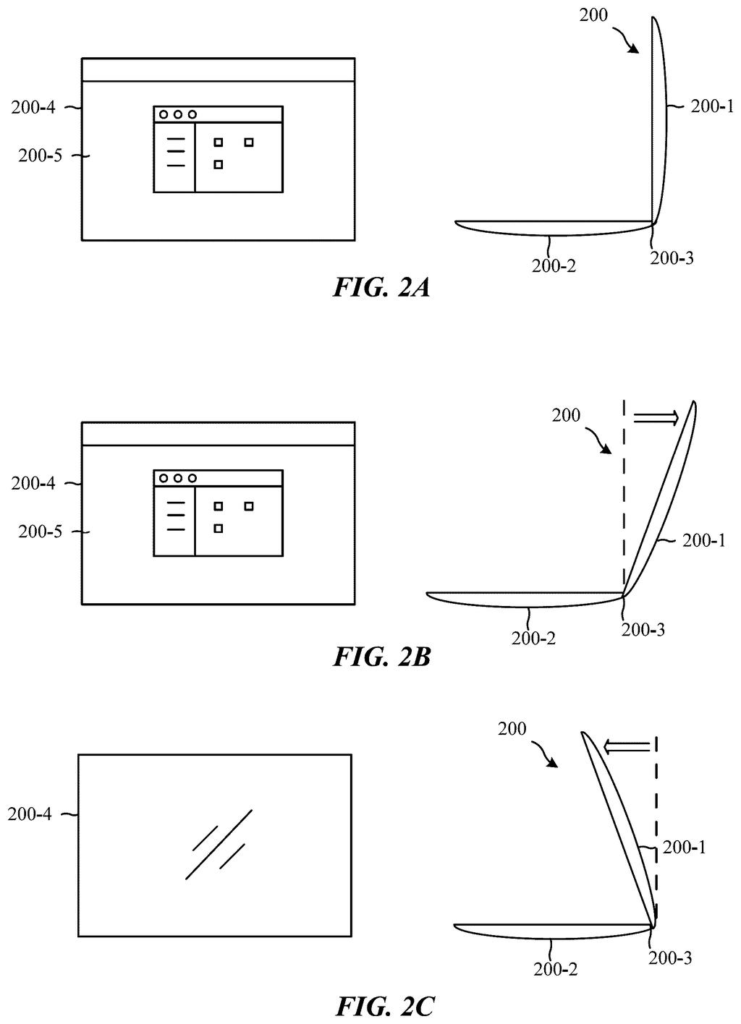
18 drawing sheets from US 2026/0227846 A1 · click any drawing to enlarge


Want this weekly breakdown for a company we don't cover? Patentlyze Pro →
Be the first to weigh in