
Samsung Patent Tailors 3D Audio Signals to Each User's Unique Ear Shape
No two people hear the same spatial audio the same way, because no two people have the same ears. Samsung is patenting a system that figures out your personal ear geometry and uses it to place sounds exactly where they belong in 3D space.
How Samsung maps sound to your specific ears
Imagine you're watching a live concert through a VR headset, and the guitarist sounds like she's coming from directly behind you even though she's actually stage-left. That's a spatial audio calibration problem, and it happens because most audio systems use a generic model of how sound bounces off a human head and ears.
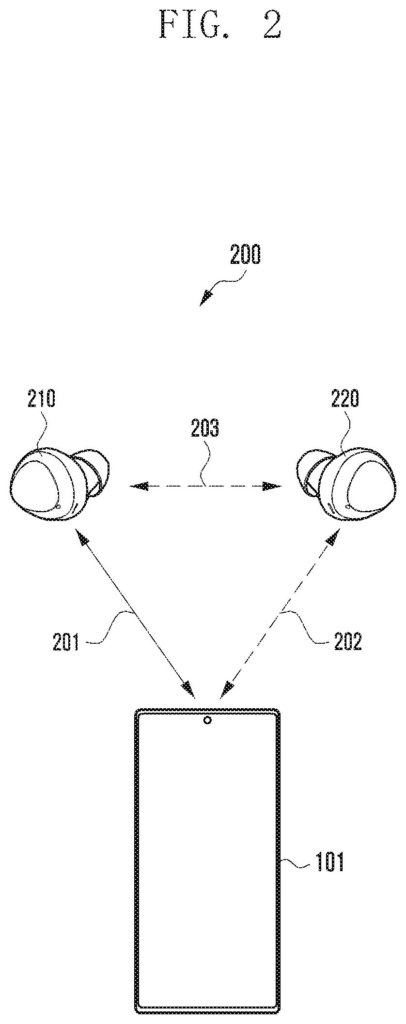
Samsung's patent describes a system that builds a personalized audio profile based on the shape of your specific ears. Multiple microphones capture audio from different directions at the same time, the system figures out where each sound is coming from, and then it processes everything through a filter tuned to your ear geometry rather than an average person's.
The processed audio and the location data for each sound are then sent to another device, like a pair of headphones or a phone, so it can play everything back with sounds appearing to come from the correct directions in 3D space. The result, in theory, is 3D audio that actually sounds right to you.
… identify user individual head-related transfer function (HRTF) information acquired based on reference HRTF information by using user information acquired from the memory …
Translation: It figures out a person's unique ear shape profile using stored data and standard templates.
How the HRTF inverse filter rebuilds spatial audio
The core of this patent is something called a Head-Related Transfer Function (HRTF), which is essentially a mathematical fingerprint of how your head, ears, and shoulders change the way sound reaches your eardrums. When you hear a sound to your left, it arrives at your left ear slightly sooner and at a different pitch than it does at your right ear. Your brain uses those tiny differences to locate the sound in space, and your ear shape affects those differences in ways that are unique to you.
Most spatial audio systems use a generic reference HRTF built from population averages. Samsung's system instead uses stored user information (likely measurements or a profile set up during device onboarding) to derive a personalized HRTF for each individual user.
The processing pipeline works roughly like this:
- Two or more microphones on external devices capture audio simultaneously from the environment.
- The system analyzes that multi-channel audio to identify where each sound originated, generating sound source location information.
- It then applies inverse filtering (a technique that removes an existing acoustic signature from audio so a new one can be applied cleanly) to the raw audio, tuned to the user's personal HRTF.
- The filtered audio and the location metadata are transmitted to a playback device, such as earbuds or a phone.
The inverse filtering step is important: it strips out the generic or environmental coloring of the audio before re-applying the user's personal spatial fingerprint.
… generate an audio signal by performing inverse filtering of the two or more pieces of audio data, based on the user individual HRTF information …
Translation: It adjusts the sound processing specifically for that individual's unique hearing profile.
What this means for Galaxy headphones and hearing aids
Generic spatial audio is noticeably wrong for many people, which is why some listeners find that 3D audio effects sound "flat" or that sounds seem to come from inside their head rather than from the room around them. A personalized HRTF system would fix that by anchoring audio to your hearing profile, making the experience much more convincing.
For Samsung, this connects directly to its Galaxy Buds lineup and its broader push into spatial audio to compete with Apple's head-tracked spatial audio on AirPods. It could also extend to accessibility tools like hearing aids or assistive listening devices, where precise sound localization has real practical value beyond entertainment.
This is a well-defined, specific patent targeting a real and documented limitation of current spatial audio systems. The personalized HRTF approach is not new in academic research, but few consumer products have implemented it properly at scale, which is exactly the kind of gap a large device maker like Samsung is positioned to close. Worth tracking if you follow Samsung's audio hardware.
There are more where this came from
We read every patent application Big Tech publishes and send you the ones worth knowing. Plain English, free, every week.
The drawings
10 drawing sheets from US 2026/0230767 A1 · click any drawing to enlarge


Want this weekly breakdown for a company we don't cover? Patentlyze Pro →
Be the first to weigh in