
Nvidia Patents a Method to Split Lighting Calculations Across Multiple Computers Without Repeating Work
Ray tracing, the technique that makes 3D graphics look photo-realistic, is enormously expensive to compute. Nvidia's new patent tackles a specific headache: when you split that work across multiple machines, how do you stop them from duplicating each other's effort?
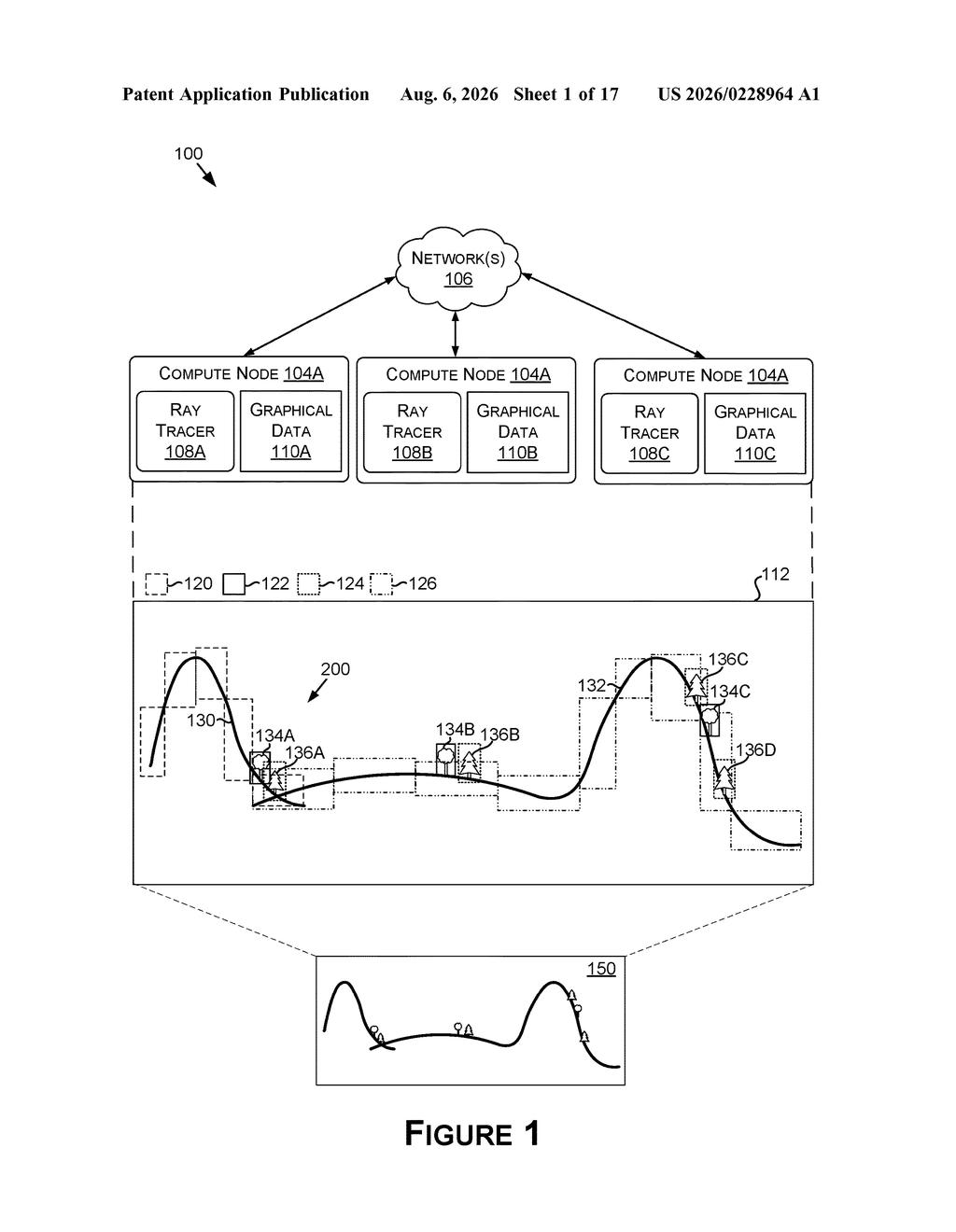
How Nvidia avoids redundant work in large-scale rendering
Imagine you're trying to render a huge 3D scene, like a movie set or a virtual city, and the scene is too large for any single computer to handle. So you split it up: computer A handles the left half, computer B handles the right half, and so on. The problem is that a simulated light ray doesn't respect those boundaries. It can bounce through areas handled by several different machines, and without coordination, those machines might end up testing the same ray against the same geometry more than once.
Nvidia's patent describes a system where each computer keeps a record of which parts of the scene have already been checked by a given ray. Before forwarding a ray to another machine, the sending computer checks whether that machine's section has already been processed. If it has, no message is sent. If it hasn't, the ray gets forwarded with a little travel log attached, so the receiving machine knows what's already been done.
The result is that no redundant work gets done, and the machines don't need to agree on a rigid scene-splitting strategy in advance. The system is flexible enough to handle different ways of carving up a scene.
… transmitting, over the one or more networks and based at least on the determination, a message corresponding to the simulated light transport ray to the second node, the message causing the second node to perform one or more second portions of the distributed light transport simulation operation using the second partition.
Translation: Computers send network messages to hand off light rays to each other for the next step of rendering.
How the node-tracking system routes rays without repeating tests
Ray tracing works by simulating how individual rays of light travel through a scene, bouncing off surfaces and accumulating color and shadow information. When the scene is distributed across a cluster of servers (each storing a different slice of the scene geometry), every ray needs to visit all the slices it intersects. The challenge is keeping track of which slices a ray has already visited.
The patent describes a traversal tracking system where each compute node maintains information about which other nodes have already run an intersection test (a check of whether a ray hits any geometry in a given slice) for a given ray. This tracking data travels with the ray as it hops between machines.
When a node is about to forward a ray, it consults that tracking record and skips any destination that has already done its intersection test. In some versions of the system, a node can also replay the traversal logic used by prior nodes to reconstruct parts of the tracking record locally, rather than receiving it all over the network.
Key components include:
- A list of nodes that have or have not yet tested the ray
- Logic to determine the next unvisited node to forward the ray to
- An optional local replay mechanism to reduce network overhead
A compute node performing a distributed light transport simulation operation on a scene may select another compute node(s) for forwarding of a ray based on determining graphical data assigned to the other compute node(s) has already been intersection-tested using the ray.
Translation: Each computer decides whether to pass a light ray onward by checking if the receiving machine already processed that ray.
What this means for large-scale 3D rendering and simulation
Large-scale ray tracing already powers visual effects in films and architectural visualization, and it's moving into real-time applications like games and virtual production. As those workloads grow, spreading the computation across multiple machines becomes necessary. The inefficiency this patent addresses, redundant ray tests across nodes, isn't theoretical: it's a real bottleneck that gets worse the more machines you add to the cluster.
For Nvidia, whose data center GPU business now dwarfs its consumer graphics revenue, a patent like this fits squarely into cloud rendering and simulation infrastructure. It also has potential relevance to physically-based simulation in robotics and autonomous vehicle training, both areas Nvidia has invested in heavily through its Omniverse platform.
This is infrastructure-level work, not a flashy consumer feature, but it's the kind of low-level optimization that determines whether distributed ray tracing is actually practical at scale. Ingo Wald, one of the inventors, is one of the most cited researchers in real-time ray tracing, which gives this filing added credibility as serious engineering rather than a defensive placeholder.
There are more where this came from
We read every patent application Big Tech publishes and send you the ones worth knowing. Plain English, free, every week.
The drawings
17 drawing sheets from US 2026/0228964 A1 · click any drawing to enlarge


Want this weekly breakdown for a company we don't cover? Patentlyze Pro →
Be the first to weigh in