
Adobe Files Patent to Predict Web Browsing Behavior for Ad Targeting
Adobe has patented a way to feed your browsing history into a large language model, have it guess which pages you'll visit next, and then use that guess to decide what content or offers to show you before you even click.
How Adobe's page-prediction AI targets content to you
A shopper lands on a retail website, clicks through a few product pages, and then pauses. Without any further action from them, the site decides what to show next.
That's the scenario Adobe is engineering with this filing. The system watches your page-by-page navigation during a session, converts those pages into a kind of shorthand the AI can read, and then asks the AI: what page is this person likely to visit next? From that prediction, a second layer of models takes over, estimating things like how often you'll come back, whether you're likely to buy something, or which audience group you belong to.
The practical result is that a website can pick the content or offer to put in front of you based on where it thinks your session is heading, not just where it's been. Adobe makes the software that powers many large commercial websites, so this kind of prediction engine could influence what a lot of people see online.
… generating, utilizing a large language model with the set of user navigation session tokens, a predicted page sequence for an additional user navigation session; utilizing the predicted page sequence with a user activity prediction model to generate a predicted user activity for the user …
Translation: The system feeds browsing history into an AI model to forecast the pages a person will visit next.
How the LLM turns browse history into a predicted page sequence
The patent describes a pipeline with three main stages.
- Tokenization: A page sequence from your browsing session is broken into tokens (think of tokens as short labels that the AI can process, the same way a language model reads words). Each token represents a page or a page descriptor.
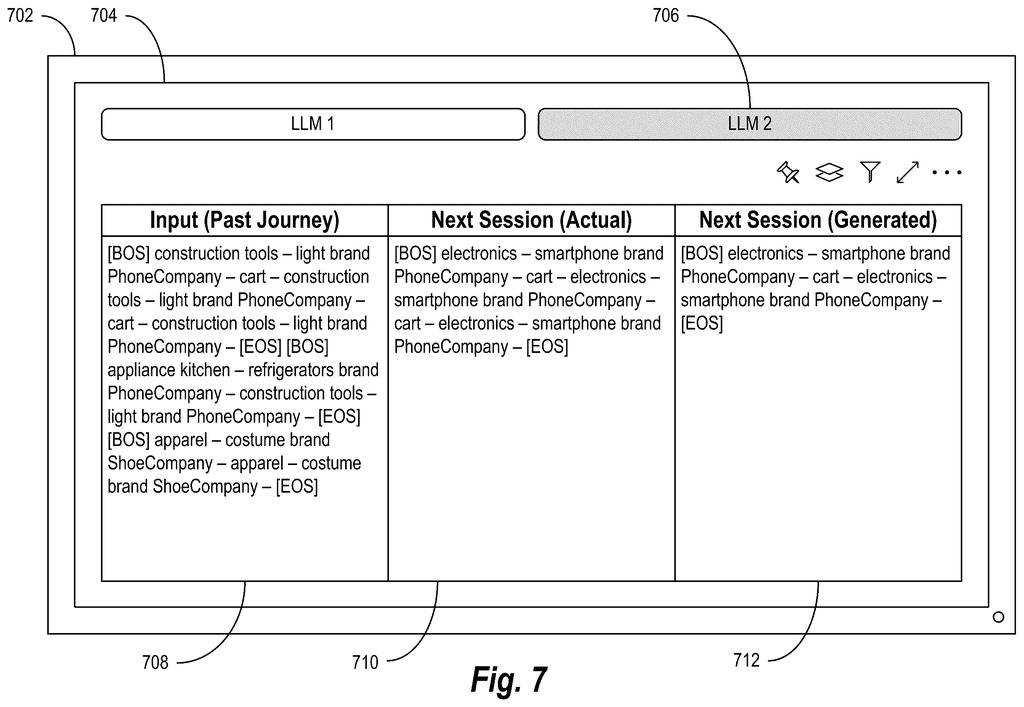
- Sequence prediction: A large language model (an AI of the same family as ChatGPT, trained on text) takes those tokens and predicts what your next browsing session might look like, outputting a probable sequence of pages.
- Downstream prediction models: That predicted sequence is then passed to separate, specialized models that answer specific business questions: Will this user convert to a paying customer? How frequently will they return? Which product segment do they fall into?
One notable technical detail is how the model is trained. Adobe describes using a page-order-agnostic contrastive loss, meaning the training signal rewards the model for getting the right pages in a predicted sequence even if their order differs slightly, rather than requiring an exact match. This makes the model more forgiving of real-world browsing, which is rarely perfectly linear.
The final output is an action: the system selects digital content to deliver to the user's device based on all of the above. That content could be a product recommendation, a promotional offer, or a different page layout entirely.
… train a large language model to predict page sequences using a page order agnostic and contrastive measure of loss from training input-output page sequence pairs …
Translation: The AI learns to anticipate web traffic patterns by comparing different sequences of visited pages.
What this means for personalization on Adobe-powered sites
For anyone who shops, reads news, or uses a subscription service built on Adobe Experience Cloud software, this is the machinery that could decide which offer pops up or which article gets recommended without you doing anything more than clicking around. The difference from older recommendation systems is that Adobe is betting on predicted future behavior rather than just your past history, which in theory produces more timely and accurate targeting.
The technique also bundles several prediction tasks (conversion likelihood, visit frequency, audience segment) into one shared foundation model rather than building and maintaining separate systems for each, which is an efficiency argument that should matter to the enterprise clients paying for Adobe's analytics stack. For readers tracking how AI is reshaping ad tech and web personalization, this filing sits alongside a broader wave of behavior-prediction patents covered in plain-English patent summaries that show how deeply language models are moving into domains far outside chat.
The concrete payoff here is timing. Older personalization systems react to what you already did; this one bets on what you're about to do and tries to get the right content in front of you before the moment passes. For a user, that's the difference between a relevant offer appearing mid-session versus a retargeting ad following you around a week later. Whether the prediction is actually accurate enough to matter depends entirely on training data quality, and that detail is absent from the filing. But the architecture is coherent, and the bundling of multiple prediction tasks under one language model is a real operational improvement over the fragmented systems most enterprise marketing platforms run today.
There are more where this came from
We read every patent application Big Tech publishes and send you the ones worth knowing. Plain English, free, every week.
The drawings
15 drawing sheets from US 2026/0238702 A1 · click any drawing to enlarge


Want this weekly breakdown for a company we don't cover? Patentlyze Pro →
Be the first to weigh in