
Google Patents a System That Teaches AI to Search Across Text, Images, and Video at Once
Google has filed a patent for a system that converts text, images, and video into a common numerical format, letting AI compare and retrieve them as if they were the same type of data. That means you could search with a photo and get back a video clip that matches its meaning.
How Google's cross-media AI search actually works
You're searching a company's media library for footage of a product launch, but all you have is a written description and a single still photo. Normally, a search engine would struggle because the photo and the text are different formats entirely.
What Google's patent describes is a system that converts all of those formats, text, photos, and video, into the same kind of numerical fingerprint. Once everything is in that shared format, the AI can find relationships between them: a sentence can point to a matching video clip, or a photo can surface similar images even if no one ever typed a caption for them.
This has practical uses for things like product recommendations, finding duplicate records across a database, and building search tools that work across mixed media. It's infrastructure-level work, designed to plug into Google's cloud data warehouse products rather than a consumer app you'd open on your phone.
… the data embeddings configure the semantic space to include relationships between the input text and the one or more of input image data and input video data.
Translation: The system maps text, images, and video into a shared digital space so the computer understands how they relate to each other.
How the engine maps text, images, and video into one space
The core idea here is called multimodal embedding. An embedding is a way of representing a piece of data, a word, a photo, a video frame, as a long list of numbers that encodes its meaning. The trick is that two things with similar meanings end up with similar numbers, even if one is text and the other is an image.
Google's patent describes a generation engine that:
- Accepts input in multiple formats at once: text, images, and video
- Selects the appropriate machine learning models for each format
- Converts all of them into embeddings that share a single semantic space (meaning: a coordinate system where closeness equals similarity in meaning)
Once everything lives in that shared space, a query written in plain English can return a video clip that matches its meaning, even though no human ever manually linked them. This is sometimes called cross-modality retrieval.
The patent also specifies that these embeddings can be used to train downstream ML models for tasks like classification (sorting things into categories), regression (predicting a value), or clustering (grouping similar items). And the output is designed to feed directly into serverless cloud data warehouses, which means it's built to work at scale without a team managing the underlying servers.
This supports a variety of application tasks such cross-modality retrieval (e.g., text-to-image search), entity resolution and deduplication, and user recommendations, as well as other tasks.
Translation: This technology helps search engines find images using text and helps databases identify duplicate files or suggest content.
What this means for Google's cloud AI search tools
For anyone using Google's cloud tools to manage large libraries of mixed media, product photos, support videos, user-generated content, this kind of system could make search dramatically more useful without requiring manual tagging of every file. The payoff is the absence of a frustrating failure: spending ten minutes writing precise keyword queries and still not finding the video you know exists.
The embedding approach also matters for deduplication and entity resolution, two unglamorous but expensive problems. If you have a database where the same customer appears under slightly different names, or the same product photo is stored in three formats, a shared semantic space can catch those matches automatically. Google's cloud AI tools, including BigQuery and Vertex AI, are the obvious home for this technology, and new Big Tech patents in the AI infrastructure space consistently show Google pushing embedding capabilities deeper into its data warehouse stack.
Most people will never interact with this system directly, but they'll feel it when a product recommendation actually makes sense or when a customer service tool surfaces the right help video on the first try. The reader-facing payoff is the removal of the broken-search experience that plagues any product dealing with mixed media at scale. Google is essentially trying to make 'the search box' agnostic to what format your content lives in, and that's a worthwhile engineering goal even if the patent reads like plumbing.
There are more where this came from
We read every patent application Big Tech publishes and send you the ones worth knowing. Plain English, free, every week.
The drawings
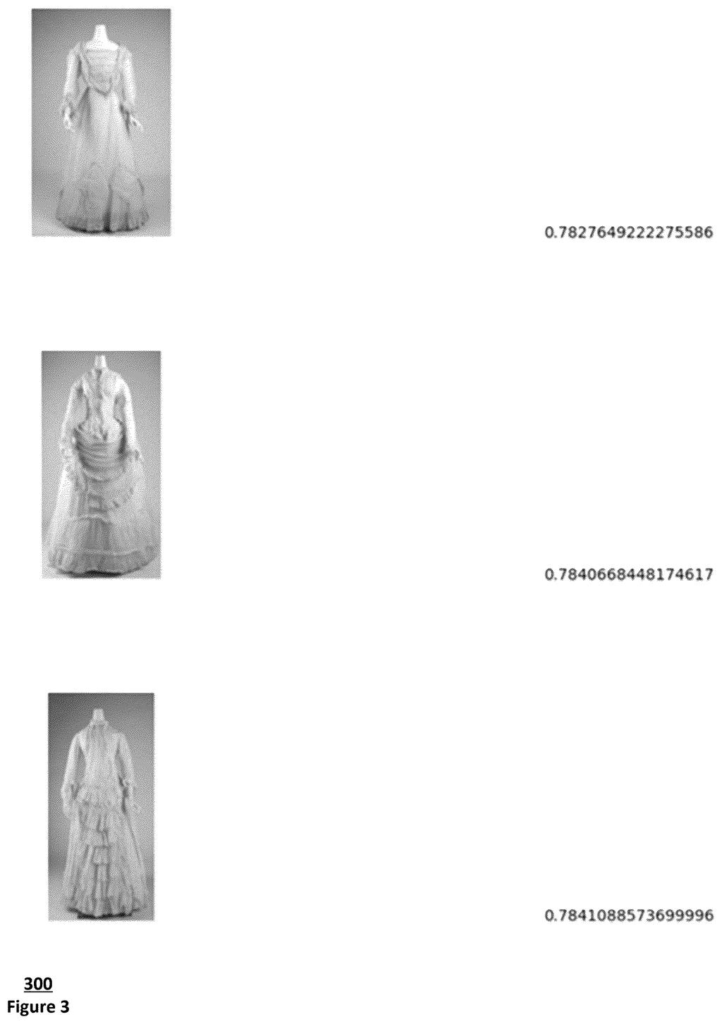
6 drawing sheets from US 2026/0236522 A1 · click any drawing to enlarge


Want this weekly breakdown for a company we don't cover? Patentlyze Pro →
Be the first to weigh in