
Disney Patents a System That Automatically Turns Up Dialogue Over Background Noise
Disney has filed a patent for a streaming audio system that measures the noise level in your room and nudges dialogue louder to keep it intelligible, without turning everything up to ear-splitting volumes.
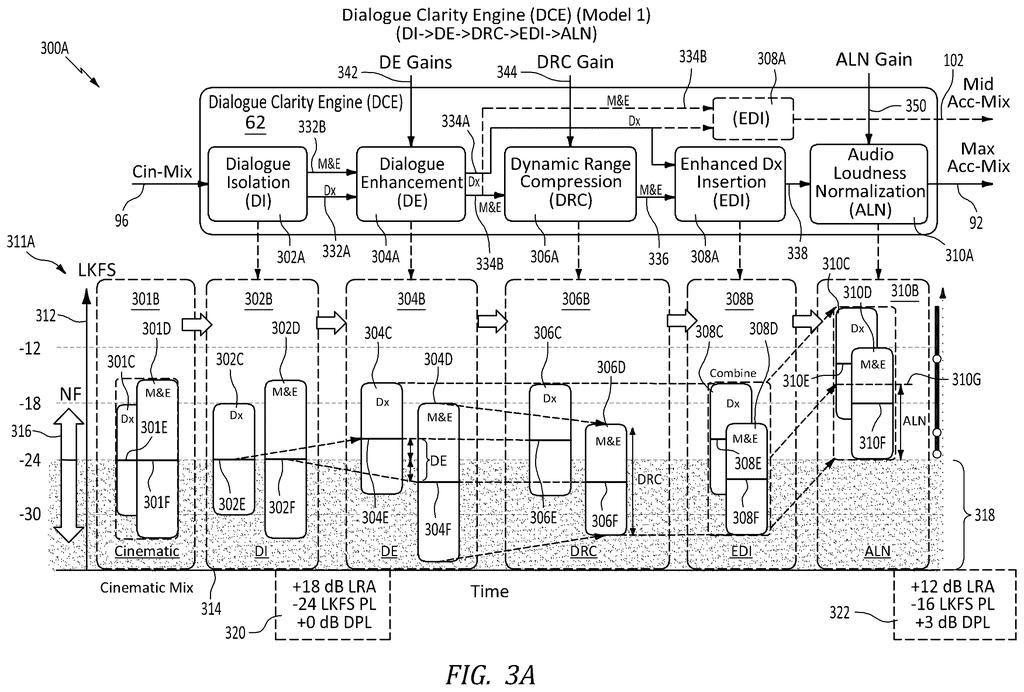
What Disney's dialogue-boosting audio mix actually does
Imagine you're watching a Disney movie in a loud living room, the dishwasher is running, kids are playing nearby, and the actors' voices keep getting swallowed by the film's sweeping score. You turn the volume up to catch the dialogue, and then an explosion in the movie nearly blows you out of your chair.
Disney's patent describes a way to fix that. Instead of one audio track, the system works with two: the original cinematic mix exactly as the studio intended, and a second version where dialogue has been carefully separated and boosted so it stays clear even in noisy environments. Your TV or streaming app then blends these two tracks together, finding a middle point that suits your actual listening conditions.
You can adjust the blend yourself with a simple slider, or the system can do it automatically by measuring how loud your room is. There's also an optional equalizer aimed at people with specific hearing impairments, letting the audio adapt to individual needs rather than a one-size-fits-all setting.
… combining the CinMix and MaxAccMix to create the personalized AccMix audio mix which is power preserving and has an loudness of the dialogue audio that allows a user to hear and understand the dialogue audio when played on the user playing device in a listening environment having the actual noise floor (NF) level …
Translation: The system blends the original movie audio with a boosted version to ensure you can hear speech over background noise.
How the cross-fade renderer blends two audio tracks
The patent describes a three-layer approach to audio delivery:
- CinMix (Cinematic Mix): The original studio audio track, with all the dynamics, music, and sound effects as the director intended. This is the starting point.
- MaxAccMix (Maximum Accessible Mix): A separately produced version of the same content where dialogue loudness and non-dialogue loudness are both kept within a carefully defined range, loud enough to sit above any reasonable background noise but capped below a loudness ceiling so it never becomes uncomfortable. This track is created by the content provider ahead of time.
- AccMix (Accessible Mix): The personalized blend delivered to the listener. It is a power-preserving combination of the two tracks above, meaning the total energy of the audio signal stays consistent as the blend shifts, so there are no jarring volume jumps. The blend value slides anywhere between the pure CinMix and the pure MaxAccMix.
The blending is handled by what the patent calls a cross-fade renderer (think of it like a mixing board fader that lives inside your playback device). It can be moved manually by the user or automatically driven by a measured noise floor (the ambient sound level in the room, captured by a microphone on the device). When the room gets louder, the renderer pushes the blend closer to the MaxAccMix. When it quiets down, it drifts back toward the original cinematic version.
Optionally, a personalized equalizer layer can be applied on top of the blend to compensate for specific hearing impairments, such as high-frequency loss. Content creators can also use the same cross-fade renderer internally to verify that their MaxAccMix meets quality standards before it is distributed.
… the combining being provided by a cross-fade renderer adjusted manually by the user/listener or automatically adjusted based on a measured noise floor, and optionally providing a personalized equalizer for hearing impairments.
Translation: You can adjust the dialogue volume yourself, or the app can do it automatically by listening to the noise in your room.
What this means for viewers with hearing difficulties
For the roughly 15 percent of adults who have some degree of hearing difficulty, dialogue clarity in streaming content is a daily frustration. Existing options like closed captions help but don't address the underlying audio experience. A system that adapts the mix in real time based on the room environment is a genuinely different approach: it meets people where they are instead of asking them to choose between a standard mix and a fully boosted accessibility mode with no middle ground.
The design also keeps control in the hands of both the studio and the viewer. Disney retains the original cinematic mix as the baseline, meaning the artistic intent is preserved when conditions allow. The interesting tech patents covering personalized audio accessibility show this as part of a broader push by content companies to bake accessibility into the streaming infrastructure itself, rather than treating it as an afterthought bolted on after production.
The design's central cost is the burden it places on content producers: every piece of content needs a separately authored MaxAccMix track, which is extra work and extra data to store and deliver. Disney is betting that this upfront production overhead is worth it because the blending logic on the playback side stays clean and power-preserving. That trade reads as reasonable for a company with the back-catalog volume to develop standardized authoring pipelines, but it could be a meaningful barrier for smaller licensees or independent creators who distribute through Disney platforms. The automatic noise-floor detection is the part most likely to frustrate in practice, since microphone-based room sensing on consumer TVs and phones is notoriously inconsistent.
There are more where this came from
We read every patent application Big Tech publishes and send you the ones worth knowing. Plain English, free, every week.
The drawings
34 drawing sheets from US 2026/0236215 A1 · click any drawing to enlarge


Want this weekly breakdown for a company we don't cover? Patentlyze Pro →
Be the first to weigh in