
Google Patents a Keyboard That Fits Multiple Letters on Each Key
Google has filed a patent for a keyboard that shrinks the alphabet down to as few as two keys, using predictive word suggestions to fill in the gaps. It's an old idea applied to new hardware constraints, and the details reveal exactly how Google thinks the system should work.
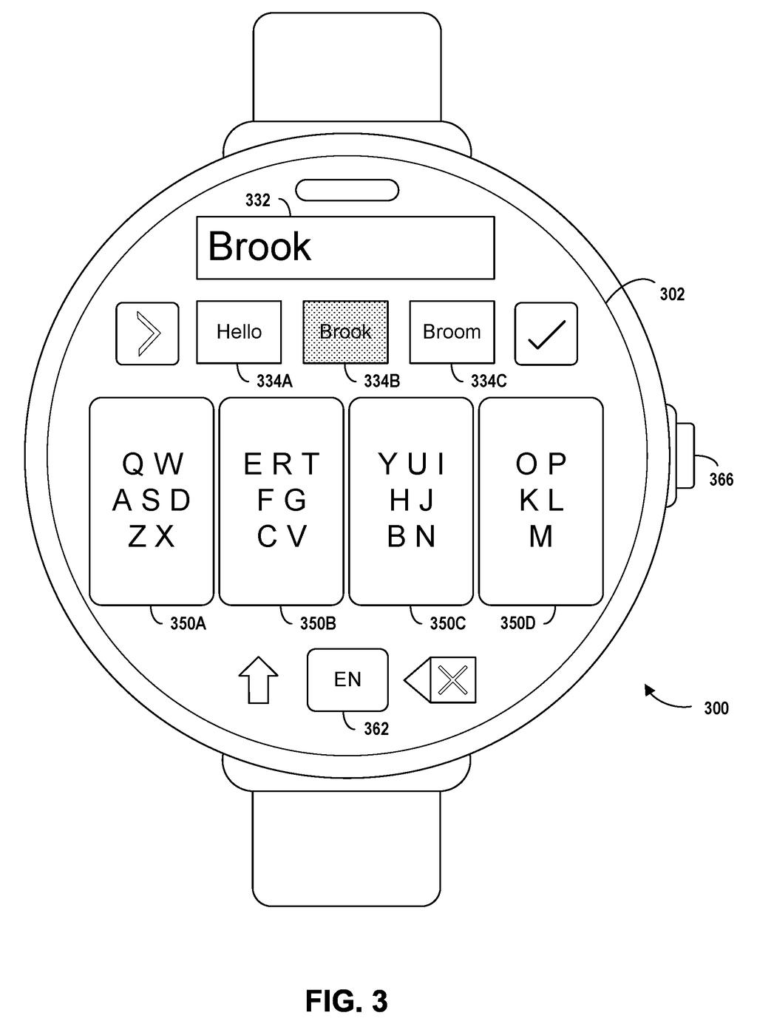
What Google's multi-character keyboard actually does for you
You're trying to type a message on a tiny screen, maybe a smartwatch or a compact phone, and the keyboard barely has room for a full row of letters. Every key is cramped, and you mistype constantly.
Google's patent describes a keyboard with as few as two keys, where each key represents several different letters at once. When you tap a key, the device makes its best guess at which letter you meant, based on the word you seem to be building. A strip of suggested words appears on screen, and you can shift focus there with a single input to pick the right one fast.
The idea is that fewer, larger keys are easier to hit accurately on a small display, and the word-prediction layer does the heavy lifting of figuring out what you actually meant. It's a trade: you give up one tap per letter in favor of one tap per word.
a graphical keyboard comprising a plurality of character keys, each character key from the plurality of character keys being associated with and including a respective plurality of characters; a text-editing region; and a word-suggestion region; …
Translation: The screen shows a keyboard where each key holds multiple letters, alongside text and suggestion areas.
How the keyboard maps keys to characters and word suggestions
The patent describes a graphical keyboard where each key on screen is linked to multiple characters, not just one. The full keyboard can have as few as two keys or as many as eight, far fewer than the standard 26-letter QWERTY layout.
When you tap a key, the system picks a specific character from that key's set, based on an internal prediction of which letter most likely fits the word you're building. That chosen character appears in a text-editing region (the box where your draft text lives). At the same time, a row of complete word suggestions appears in a word-suggestion region above the keyboard.
The patent's key detail is how you move between those two areas. A "transition input" (which could be a swipe, a button press, or another gesture) shifts the interface focus from the text box to the suggestion strip. Once focus is there, you can select a full word without hunting for individual letters.
- Keyboard: 2-8 large keys, each tied to multiple characters
- Character selection: device infers which letter you wanted
- Word suggestions: updated after every key tap
- Transition input: moves cursor focus from text area to suggestion strip
… transitioning a focus region from a location of the text-editing region to a location of the word-suggestion region.
Translation: The user can easily jump from typing text to selecting suggested words on the screen.
What this means for typing on small or wearable screens
The practical payoff shows up most on devices where screen space is genuinely scarce: smartwatches, foldable phones in their compact mode, or any interface where a full QWERTY layout is too small to use without constant errors. Bigger tap targets mean fewer misses, and leaning on word prediction means you spend less time correcting individual letters.
For everyday phone users, this probably won't replace the keyboard you already use. But for wearables or accessibility tools designed for people who struggle with small keys, a system that confidently narrows down your word from just a few taps could make text entry feel far less frustrating. Google's interest in input methods for constrained screens has been visible across several hardware categories, and this filing fits that pattern.
Google's 729th filing in our Google coverage since May continues its AI push, adding to work like the network-monitoring patent and the hands-free app control patent.
If you have ever typed on a tiny screen and found yourself stabbing at autocorrect suggestions in the wrong corner of the display, this patent addresses exactly that frustration. Google is describing a keyboard with far fewer, larger keys, where the phone does more of the word-guessing work and the suggestions are always within easy reach.
The real win is in how quickly you can move from typing to selecting a suggested word. One deliberate gesture gets you there, rather than a detour across the screen, which matters most when you are typing with one hand or glancing at a small wearable display.
Whether this ever reaches a product you can buy is an open question, but the problem it solves is genuine: small screens punish conventional keyboards, and this design rethinks the whole interaction around that reality.
There are more where this came from
We read every patent application Big Tech publishes and send you the ones worth knowing. Plain English, free, every week.
The drawings
9 drawing sheets from US 2026/0277432 A1 · click any drawing to enlarge


Want this weekly breakdown for a company we don't cover? Patentlyze Pro →