
Samsung Patents a Radar System That Cross-Checks Its Own Angle Readings
Radar sensors often guess wrong about where an object sits in 3D space because measuring angles in two directions at once is harder than it sounds. Samsung's new patent describes a method that cross-checks those two readings against a third reference antenna array to throw out the bad guesses and keep only the reliable ones.
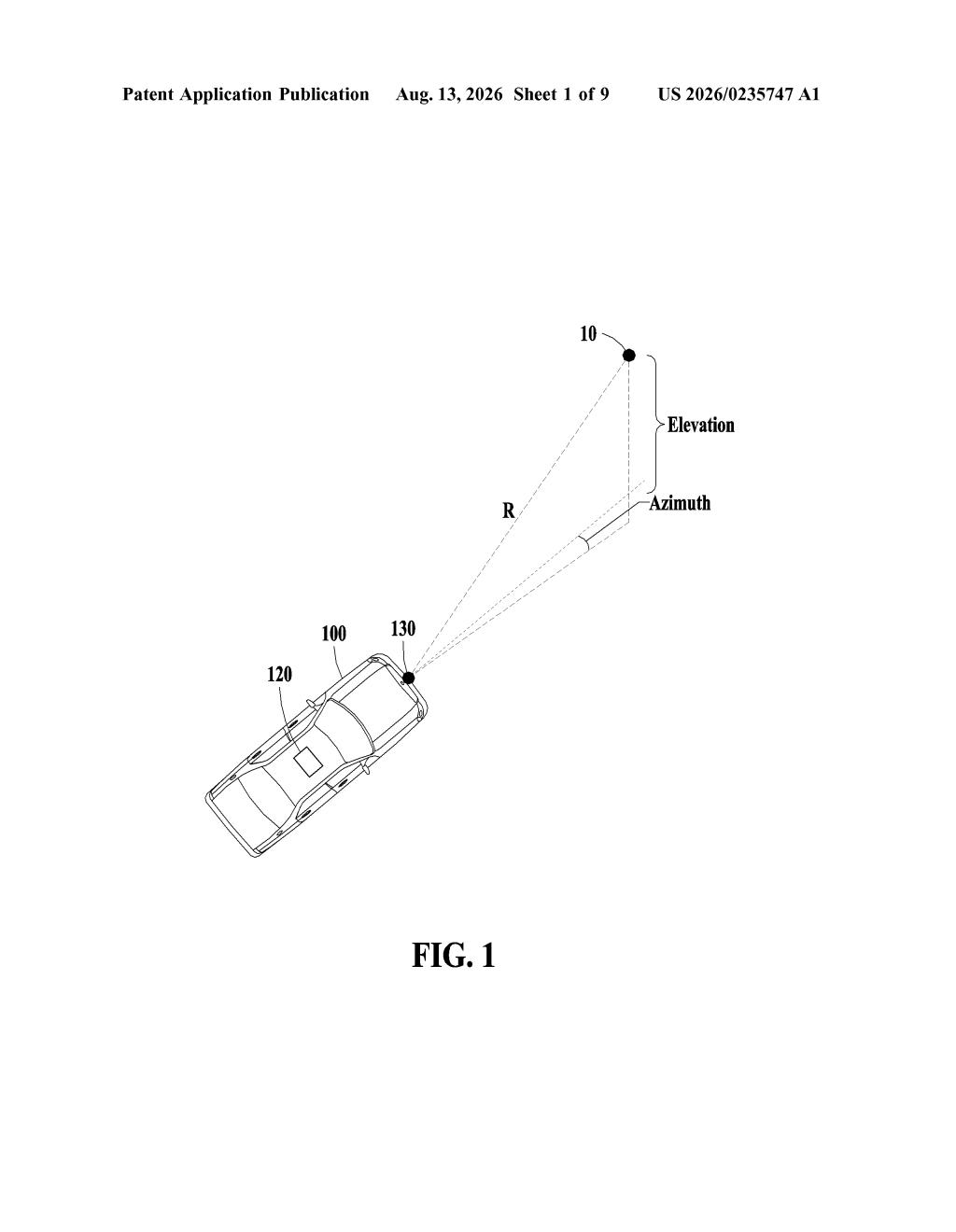
How Samsung's radar double-checks where objects actually are
Ever tried to read a map with two compasses that give slightly different headings? You know one of them is off, but you're not sure which. That's roughly the problem a radar sensor faces when it tries to pin down where something is in 3D space.
Radar measures angles to a target, but it has to do it in two separate directions, horizontal and vertical, and the answers don't always line up cleanly. Samsung's patent describes a system that takes all the possible combinations of those horizontal and vertical angle readings, then runs each pair through a third antenna arrangement to score how believable it is. Pairs with low scores get dropped. What's left is a clean, reliable picture of exactly where the target is.
The practical payoff is that a device using this radar would be much less likely to misread your hand position, or mistake noise for a real object. That kind of accuracy matters whether the sensor is inside a phone, a wearable, or a smart home device.
… generating angle pairs each comprising a corrected first angle and a corrected second angle, by performing an operation on each of combinations between the first angles and the second angles …
Translation: It pairs up the angle measurements from both dimensions to test possible combinations.
How the three-array matching system filters bad angle pairs
The patent centers on a virtual MIMO array (multi-input multi-output, meaning the device uses many antenna elements together to simulate a much larger antenna). Inside that array, Samsung carves out three sub-arrays.
- First array: arranged along one dimension (think: horizontal), it produces a set of candidate angles for a detected target.
- Second array: arranged along the perpendicular dimension (think: vertical), it produces a second set of candidate angles for the same target.
- Third array: a portion of the virtual MIMO that spans both dimensions at once, used purely as a scoring referee.
The system generates every possible pairing between the horizontal candidates and the vertical candidates. For each pair, it corrects both angles mathematically (accounting for how each sub-array's geometry distorts readings) and then asks: does this combined angle pair match what the two-dimensional third array sees? That match quality is called a matching score.
Angle pairs whose scores clear a set threshold are called target angle pairs and become the final output: multi-angle information that tells the device where the target actually sits in 3D space. Pairs that flunk the score check are discarded as likely artifacts or ambiguities.
… determining a matching score for each of the angle pairs by using a third array corresponding to a portion of the virtual MIMO array, and generating multi-angle information …
Translation: It scores how well those angle pairs match up using a separate section of antennas.
What this means for Samsung's gesture and sensing ambitions
Radar-based sensing is showing up in more consumer hardware, from in-cabin automotive monitors to the kind of hand-gesture detection that lets you control a device without touching it. The accuracy problem Samsung is solving here is a real bottleneck: when a sensor misreads an angle, it can mistake your hand for thin air, or flag empty space as an obstacle. A cross-checking system like this one would make those sensors meaningfully more reliable in everyday use.
For Samsung specifically, the filing sits alongside the company's broader push into on-device sensing across its Galaxy ecosystem, where radar chips (like the ones already used in some premium Galaxy phones for motion detection) need to improve before they can handle finer tasks. Readers who follow interesting tech patents in the radar and on-device sensing space will recognize this as part of a steady drumbeat of signal-processing improvements that have to land before gesture control or room-scale presence detection can go mainstream.
The path from this filing to a shipping feature is shorter than it might look. Samsung already has radar hardware in some Galaxy devices, so the question is software and algorithm maturity, and a signal-processing method like this one slots into existing hardware without requiring new chips. The main open question is latency: scoring every angle-pair combination adds computation, and the patent doesn't specify how that trade-off is handled at real-time frame rates. If Samsung's engineers have the math tight enough to run on-device without draining a battery, this could land in a Galaxy feature update rather than needing a new product cycle.
There are more where this came from
We read every patent application Big Tech publishes and send you the ones worth knowing. Plain English, free, every week.
The drawings
9 drawing sheets from US 2026/0235747 A1 · click any drawing to enlarge


Want this weekly breakdown for a company we don't cover? Patentlyze Pro →
Be the first to weigh in