
IBM Patents a Way for AR Headsets to Share Objects Based on Where You Look
IBM has filed a patent for a system that watches where your eyes go inside a virtual environment, decides you're genuinely interested in something, and then automatically packages and sends a copy of that object to another device when you ask for it in plain language.
What IBM's eye-tracking object-copy system actually does
A teacher stands at the front of a virtual classroom, staring at a 3D model of a molecule. Every other student is looking somewhere else. This patent is about making that moment useful for you.
IBM's idea is that AR or VR headsets should pay attention to what your eyes linger on, not just what you click or tap. If you look at a specific object long enough, the system decides you're interested, creates a tagged copy of it, and holds it ready. Then, when you ask a question out loud, like 'send me that molecule' or 'what is that part?', the system already knows what that means and sends the right object to your phone or tablet.
The result is that sharing something in a virtual space becomes as natural as pointing at it in a physical room. No menus, no long-pressing, no selecting from a list of everything in the scene.
interpreting an attention of a user relative to a specific item within a virtual environment; determine user interest for the specific item by analyzing eye movement patterns of the user; generating a copy of the specific item based on the determined user interest …
Translation: The system tracks where you are looking to figure out what you like and creates a digital duplicate of that object for you.
How the system tags and transmits the item you stared at
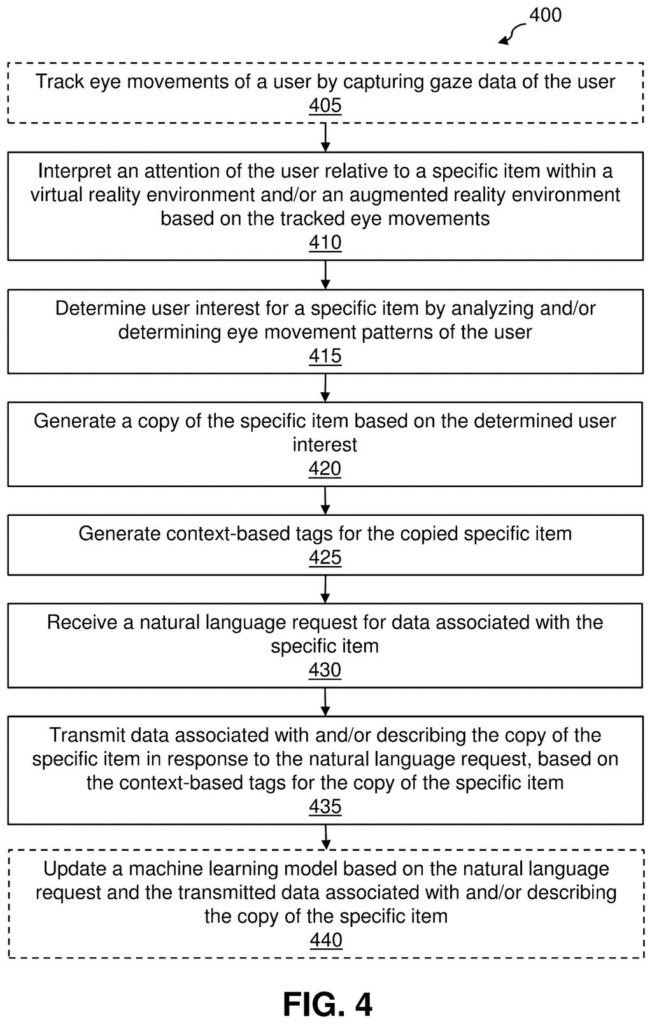
The patent describes a pipeline with four connected stages.
- Attention interpretation: The system watches the user's eye movements continuously inside a virtual environment. It looks for patterns that suggest real interest, not just a passing glance, things like fixation duration and return visits to the same object.
- Copy generation: Once interest crosses a threshold, the system creates a copy of that specific item, separate from the original scene. This copy is essentially a snapshot that can be handled independently.
- Context-based tagging: The copy gets labeled with metadata derived from the context around it in the virtual world, what it is, where it was, what surrounds it. These tags are what allow a vague natural language question to resolve to the right object later.
- Natural language retrieval and transmission: When the user asks a question in plain speech or text, the system matches the request against the tagged copies it has already prepared and sends the right one to the user's device.
The key idea is that the heavy lifting happens before the user asks. By the time you say 'send me that,' the system has already done the work of figuring out what 'that' is, because it was watching your eyes the whole time.
… receiving a natural language request for data associated with the specific item, where the data associated with the specific item is determined based on the context-based tags for the copy of the specific item; and transmitting the copy of the specific item to a user device …
Translation: You can ask the system questions about the object, and it will send the item and its information to your headset.
What this means for sharing in AR workspaces
For enterprise AR applications, where workers might be using shared virtual spaces to inspect equipment, review designs, or train on procedures, this kind of frictionless sharing could remove a real bottleneck. Stopping to navigate a menu or label an object breaks the flow of work in a physical-feeling environment. A system that handles sharing in the background, triggered by natural speech, fits more cleanly into how people actually collaborate.
The deeper shift here is using eye-tracking as an input signal for intent, not just as a tool for rendering optimization. IBM is staking out that territory in spatial computing at a time when AR hardware is still finding its footing, and that context shows up across the Big Tech patent news IBM and others are filing around spatial computing infrastructure.
The ship path for this patent is longer than the abstract makes it sound. Every stage of the pipeline depends on hardware that is still maturing: reliable, low-latency eye-tracking, AR headsets with enough ambient awareness to build a scene graph, and on-device or edge inference fast enough to tag objects in real time. The patent is pure software in its claims, which lowers the bar to filing, but the practical version needs a fully functioning AR runtime underneath it before any of this works. The shortest route to a product is probably as a feature inside an existing enterprise AR platform, once the underlying headset hardware catches up.
There are more where this came from
We read every patent application Big Tech publishes and send you the ones worth knowing. Plain English, free, every week.
The drawings
4 drawing sheets from US 2026/0237160 A1 · click any drawing to enlarge


Want this weekly breakdown for a company we don't cover? Patentlyze Pro →
Be the first to weigh in