
Sony Patents a Fix That Keeps Video Quality Settings From Going Haywire
A small numerical drift inside a video encoder can corrupt image quality, and Sony has patented a method to stop it before it starts.
What Sony's quantization clipping actually does for video
You're watching a 4K movie and one scene looks slightly washed out compared to the rest, even though your TV and internet connection are both fine. The problem might be buried inside the video file itself, in the way the encoder handled color and compression.
When a video is compressed for streaming or broadcast, the encoder uses a number called a quantization parameter to decide how much detail to throw away. Too high and the picture looks blocky; too low and the file is huge. Sony's patent fixes a specific case where that number drifts outside its safe range after the encoder applies a color adjustment step, producing unpredictable quality.
The fix is essentially a safety clamp: the encoder adjusts the number for color, then checks whether a secondary process (one that skips a math step to save time) would push that number somewhere dangerous. If it would, the encoder clips it back to the lowest safe value. Your video stays consistent without ballooning in file size.
correct a quantization parameter based on a parameter related to an adaptive color transform to obtain a corrected quantization parameter; clip, when a transform skip is applied to coefficient data of an image to be encoded, a lower limit of the corrected quantization parameter …
Translation: The system adjusts image quality settings to prevent errors when specific color and data processing modes are active.
How the encoder clips and corrects the quantization value
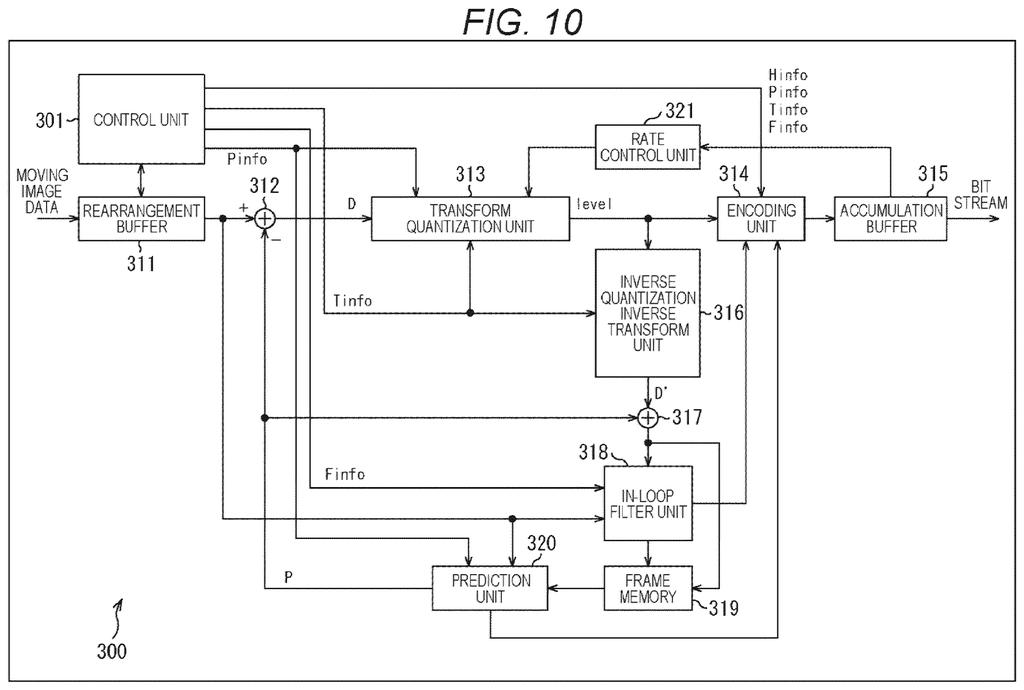
The patent describes an image processing apparatus that manages a quantization parameter (QP), the encoder's primary dial for controlling how aggressively it compresses image data. Higher QP values discard more detail; lower ones preserve it at the cost of larger files.
The problem arises when two optional encoding modes are both active:
- Adaptive Color Transform (ACT): a step that converts pixel color data into a different mathematical space to compress it more efficiently. It also offsets the QP by a fixed amount.
- Transform Skip (TS): a shortcut that skips a standard frequency-analysis step (similar to JPEG's cosine transform) for regions where that step would not help. Transform skip has its own minimum QP floor, because too low a value creates noise in skipped regions.
When ACT shifts the QP downward and transform skip is also active, the combined QP can fall below the minimum value that transform skip can safely handle. Sony's method applies a clip operation, clamping the adjusted QP so it never drops below that minimum. The clipped value is then used to quantize (compress) the actual coefficient data. This keeps both color accuracy and compression behavior inside their valid operating envelopes.
The present disclosure relates to an image processing device and method for enabling control of a value of a quantization parameter within a desired range. A quantization parameter is corrected on the basis of a parameter regarding adaptive color transform …
Translation: Sony is creating a way to keep video compression settings within a stable range to ensure consistent image quality.
What this means for video compression quality
For most viewers, quantization parameter bugs show up as subtle but nagging inconsistencies: a scene that looks slightly grainy compared to the one before it, or color that seems slightly off in fast-motion segments. These artifacts are hard to trace back to the encoder, so they tend to get blamed on the stream or the display.
This patent is a narrow but real quality-of-life fix for anyone whose video passes through a modern HEVC or VVC encoder that uses both color transform and transform-skip modes together. Sony is a major supplier of image sensor and processing technology, and compression patents like this one sit alongside the latest Big Tech patents in video coding standards that eventually reach every streaming platform and camera chipset.
Sony's value here is defensive: a fix that surfaces only when two encoding modes collide in exactly the wrong way, producing subtle visual artifacts that are maddening to diagnose. The average viewer will never know it's in place, which is precisely the point. Preventing a quality regression from slipping into shipping hardware or broadcast encoders is what this patch is for.
There are more where this came from
We read every patent application Big Tech publishes and send you the ones worth knowing. Plain English, free, every week.
The drawings
20 drawing sheets from US 2026/0238791 A1 · click any drawing to enlarge


Want this weekly breakdown for a company we don't cover? Patentlyze Pro →
Be the first to weigh in