
Sony Patents a Camera Chip That Keeps Extra Color Pixels From Breaking Your Photos
Camera sensors are experimenting with pixels beyond red, green, and blue, but those extra colors can confuse the software that turns raw sensor data into a finished photo. Sony's new patent describes a chip that keeps the two worlds from colliding.
What Sony's extra-color pixel pipeline actually does
Most camera sensors today capture light using only three colors: red, green, and blue. Every app, every photo editor, and every image pipeline on the planet expects that arrangement. When a sensor adds a fourth type of pixel, say an infrared or white pixel, the whole chain can break down.
Sony's patent describes a processor that handles both worlds at once. One path strips out those extra pixels and converts everything into the standard three-color format that existing software can read without any changes. A second path keeps all the color information intact, including the non-standard pixels, so nothing gets thrown away. Your phone or camera can then use whichever version fits the job.
The practical upshot is that a sensor with extra color channels could feed standard photo apps and specialized tools like depth sensors or medical imaging software without the chip having to choose one or the other.
a remosaic processing unit that converts an array of pixels of red, green, and blue, which are three primary colors of light in an input image into a Bayer array, the input image including the pixels of the three primary colors, and pixels of colors other than the three primary colors …
Translation: The chip takes raw data from standard and extra color pixels and rearranges them into a format cameras can actually use.
How Sony's two-path image processor handles the color split
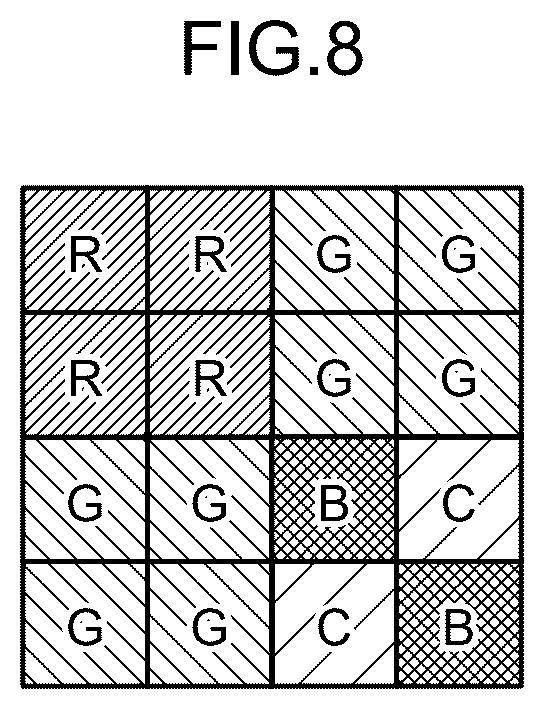
The patent centers on a sensor array that contains not just the usual red, green, and blue pixels, but also pixels of other colors. The specification does not name those extra colors explicitly, leaving the door open for infrared, white, yellow, or other experimental pixel types Sony might add to future sensors.
The device has two processing paths running in parallel:
- Remosaic path: Takes the raw mixed-color pixel array and converts it into a standard Bayer array (the classic checkerboard pattern of red, green, and blue pixels that camera software has understood for decades). The output, called the first three-primary-color image, contains only RGB data. Any information from the non-standard pixels is intentionally discarded here.
- Image processing path: Generates a second image that retains both the standard RGB color information and the extra-color data from those non-standard pixels. This version is richer but requires software that knows how to use it.
The two outputs serve different downstream consumers. The first output slots into any existing camera pipeline without modification. The second output can feed specialized algorithms, such as those used for low-light photography, depth estimation, or computational imaging tasks that benefit from the additional spectral data.
The image processing unit generates a second three-primary color image including the color information of the three primary colors and the color information other than the three primary colors from the input image.
Translation: The device creates a final image that combines standard color data with the extra color information for better results.
What this means for next-gen camera sensors
Camera sensors have been adding non-RGB pixels for years, from Sony's own stacked infrared sensors to experimental white-pixel arrays aimed at low-light performance. The consistent headache has been compatibility: the moment a sensor departs from the Bayer pattern, every piece of software downstream needs to be updated or rewritten. Sony's two-output approach is essentially a translation layer baked into the chip itself, letting hardware innovation move faster than the software ecosystem needs to catch up.
For consumers, the near-term implication is that future Sony sensors could ship with additional pixel types without requiring camera makers or app developers to overhaul their pipelines on day one. This kind of sensor-level image processing is one of the more active areas covered among new Big Tech patents in imaging and semiconductor design, and Sony's filing shows the company is thinking carefully about backward compatibility as sensors grow more complex.
The problem here is real and has slowed sensor innovation for years: hardware teams want to experiment with extra pixel types, but software compatibility locks them into the Bayer pattern. Sony's dual-output approach directly attacks that bottleneck, and the approach is proportionate to the problem because it does not ask software developers to change anything while still making richer sensor data available to those who want it. The filing is quiet infrastructure work, but infrastructure is exactly what has kept more ambitious sensor designs from reaching mass-market cameras.
There are more where this came from
We read every patent application Big Tech publishes and send you the ones worth knowing. Plain English, free, every week.
The drawings
8 drawing sheets from US 2026/0238888 A1 · click any drawing to enlarge


Want this weekly breakdown for a company we don't cover? Patentlyze Pro →
Be the first to weigh in