
Sony
Sony · Display · Filed Aug 7, 2025 · USPTO published Aug 13, 2026 · Aug 13 release
Sony Patents a Drone Arm That Locks Itself Open Automatically
Folding drone arms are a well-worn idea, but they have a quiet failure point: you have to remember to lock them before you fly. Sony's new patent removes that step entirely by making the lock automatic.
- Publication number
- US 2026/0237881 A1(US20260237881A1)
- Applicant
- Sony Group Corporation
- Filed · Published
- Aug 7, 2025 · Aug 13, 2026
- Inventors
- Soichiro OYA, Daisuke YOSHIDA, Junpei YAMAUCHI, Sayuri GOTO, Junichi SHINBORI, Noboru NAKAMURA
- Status when we published
- Waiting for an examiner
- Document
- 11 claims
- US classification
- 244/17.11
- Examiner
- ABELL, TYE W (Art Unit 3644)
- Parent application
- National Stage Entry of PCT/JP2024/004244 (filed Feb 8, 2024)(PCTJP2024004244)
What Sony's self-locking folding drone arm actually does
Ever fumbled with a folding drone arm and wondered if it was actually locked? That moment of doubt before a flight is exactly what this patent is designed to eliminate.
Sony is filing for a drone design where the arms, the parts that extend outward to hold the propellers, fold flat for storage and then snap into a locked position on their own the moment you unfold them. You don't press a button or flip a latch. The mechanism does it for you as soon as the arm reaches its open position.
The idea is simple but meaningful: a drone with arms that can accidentally fold mid-flight is a drone that falls out of the sky. By making the lock automatic, Sony is trying to take one potential failure point off the table entirely.
… an arm that extends from the body, wherein the arm is foldable from a use state to a storage state, and is automatically locked in the use state when transitioning to the use state.
Translation: The drone arm can fold down for travel and clicks into a locked position by itself when you open it up for flight.
How the arm snaps into its locked use position
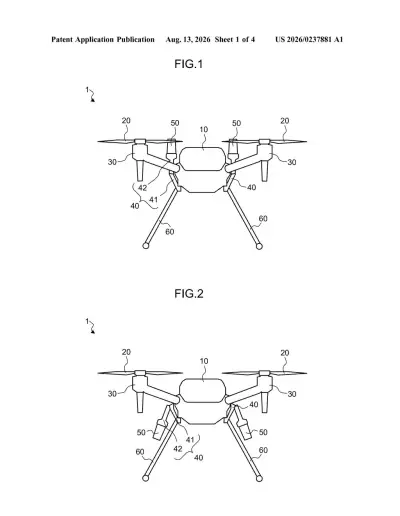
The patent covers a flight vehicle (the legal term used, but read: drone or multirotor aircraft) built around four core components: a body, rotary blades (propellers), a drive mechanism (motors), and extendable arms.
The arms are designed to fold between two defined states:
- Storage state: arms folded inward or flat against the body, reducing the drone's footprint for carrying or stowing.
- Use state: arms extended outward, holding the propellers at the correct angle and spacing for stable flight.
The key innovation is in the transition between those two states. When an arm moves from folded to extended, an automatic locking mechanism engages without any action from the user. The arm does not need to be manually latched, clicked, or checked. The patent does not specify the exact locking hardware (a spring-loaded pin, a cam, a detent, etc.), keeping the claim broad enough to cover multiple possible implementations.
The practical effect: once the arm reaches its fully open position, it is locked there. It cannot fold back accidentally during flight due to vibration, wind load, or handling.
A flight vehicle of the present disclosure includes a body, a rotary blade that floats the body, a drive mechanism that rotates the rotary blade, and an arm that extends from the body.
Translation: This patent describes a standard drone design that uses a motor to spin blades for lift and features a movable arm.
What this means for consumer and commercial drones
For anyone who has used a folding consumer drone like the DJI Mini or Air series, the manual fold-and-lock step is a familiar pre-flight ritual. Forgetting it, or not latching firmly enough, can mean a crash. An automatic lock removes that failure mode at the mechanical level rather than relying on pilot habit.
Claim 1 of this patent is written broadly: it covers any flight vehicle where a foldable arm automatically locks in the use state, regardless of how that locking is achieved. That breadth is a double-edged thing. A wide claim is harder to work around for competitors, but it also draws more scrutiny from patent examiners who will look for prior art in folding mechanisms across drones, cameras, and even furniture. Sony drone hardware filings sit alongside the latest Big Tech patents in robotics and aerial imaging, a field where mechanical reliability patents are increasingly part of the competitive foundation.
Source: US 2026/0237881 A1 at the USPTO (PDF). Full patent text and figures are in the official publication.
Get our take in your Top Stories
Liked this breakdown? Add Patentlyze as a preferred source on Google, and our plain-English take shows up more often in your Top Stories the next time Sony patent news breaks.
Add Patentlyze on Google
One click.
There are more where this came from
We read the new patents from Big Tech, carmakers and more and send you the ones worth knowing. Plain English, free, every week.
The drawings · 4 sheets
4 drawing sheets from US 2026/0237881 A1 · click any drawing to enlarge


More from Sony
All 722 Sony patents →
More in Display
All 746 Display patents →
Microsoft
Microsoft Patent Targets Dynamic Screen Dimming Precisely Where Your Eyes Look
Qualcomm
Qualcomm Patents a Display Trick That Keeps Partial Screen Updates Sharp
Samsung
Samsung Patents a Display That Corrects Its Own Brightness the Instant It Turns On
Microsoft