
Microsoft Patents a Two-Stage System for Catching Accidental Touchscreen Taps
Every touchscreen user has accidentally hit a button they didn't mean to. Microsoft's new patent describes a layered system that checks multiple signals before deciding whether to ignore a tap entirely.
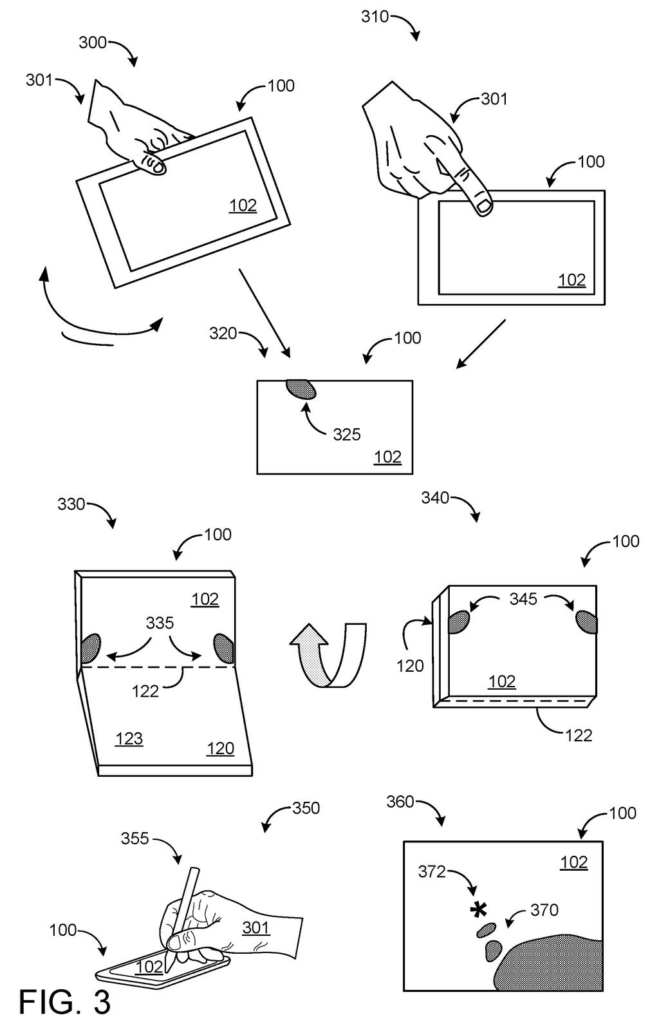
How Microsoft's accidental-touch filter actually works
Imagine you're holding your tablet in bed, and your palm grazes the screen. The device fires off an action you never intended. That accidental-touch problem is exactly what this Microsoft patent is trying to solve.
The idea is a two-step check. First, the device looks at the touch itself: the size, shape, pressure, and timing of your finger on the glass. If that analysis is fairly confident the tap was accidental, the device ignores it immediately. If it's not sure, it doesn't just give up. Instead, it pulls in readings from other sensors on the device, things like the accelerometer, gyroscope, or proximity sensor, to build a fuller picture.
Once both rounds of analysis are combined into a single confidence score, the device decides: real tap or mistake? If the score clears a second threshold, the touch is blocked. The whole process is designed to be fast enough that intentional taps still feel instant.
… responsive to the first likelihood being greater than the first confidence threshold, arresting the touch input; …
Translation: If the first check shows a strong chance of an accident, the touch is immediately blocked.
How the two-stage sensor pipeline scores each tap
The patent describes a controller that runs two sequential likelihood checks before deciding whether to act on a touch.
Stage one extracts features from the touch sensor itself: things like contact area (was it a fingertip or a palm?), pressure, duration, and position. The system computes a first probability that the tap was unintentional and compares it to a confidence threshold. If that probability is high enough on its own, the touch is immediately blocked without going further.
Stage two kicks in only when the first stage is uncertain. A second set of features is pulled from a sensor suite (one or more additional sensors, such as an accelerometer, gyroscope, or proximity sensor). These give context: was the device in motion? Was something resting on it? A second probability is calculated from that sensor data.
A dedicated aggregator component then combines both probability scores and the raw feature sets into a single aggregate likelihood. That aggregate is measured against a second, separate confidence threshold. Only if the final score clears that bar is the touch "arrested" (meaning cancelled and never passed on to the app layer).
The two-threshold design is intentional: a quick, cheap check handles obvious accidental touches fast, and the heavier multi-sensor analysis only runs when it's actually needed.
An aggregate likelihood that the recognized touch input is unintentional is then determined based on at least the first likelihood, the first set of features, and the second likelihood.
Translation: A final chance score is calculated by combining data from the initial touch and extra sensors.
What this means for touchscreen devices you already own
Accidental touch rejection is already common on modern touchscreens, but most current approaches rely on a single model or a fixed rule set. What Microsoft is patenting here is a staged, multi-sensor pipeline that can adapt its confidence requirements based on how ambiguous the situation is. That matters most for large-screen and foldable devices, where accidental palm contact is a bigger problem than on a phone.
For you as a user, the practical promise is fewer misfires when holding a tablet or stylus-driven device in odd positions, without slowing down intentional taps. The patent is filed under Microsoft Technology Licensing, so it could apply across Surface hardware, Windows touch interfaces, or licensed to other manufacturers.
This is solid, unsexy engineering work. Accidental touch rejection is a real friction point on large touchscreens, and the two-stage confidence pipeline is a genuinely thoughtful approach rather than a brute-force fix. It's not the kind of patent that announces a new product category, but it's exactly the kind of detail that separates a frustrating tablet experience from a good one.
There are more where this came from
We read every patent application Big Tech publishes and send you the ones worth knowing. Plain English, free, every week.
The drawings
6 drawing sheets from US 2026/0227875 A1 · click any drawing to enlarge


Want this weekly breakdown for a company we don't cover? Patentlyze Pro →
Be the first to weigh in