
Apple Patents Edge-Swipe Shortcuts That Pull Up AI or Notifications Based on Where You Start
One swipe, two completely different outcomes, determined purely by which part of the screen's edge your finger crosses first. Apple's latest patent filing turns the edges of a touchscreen into a context-sensitive shortcut strip.
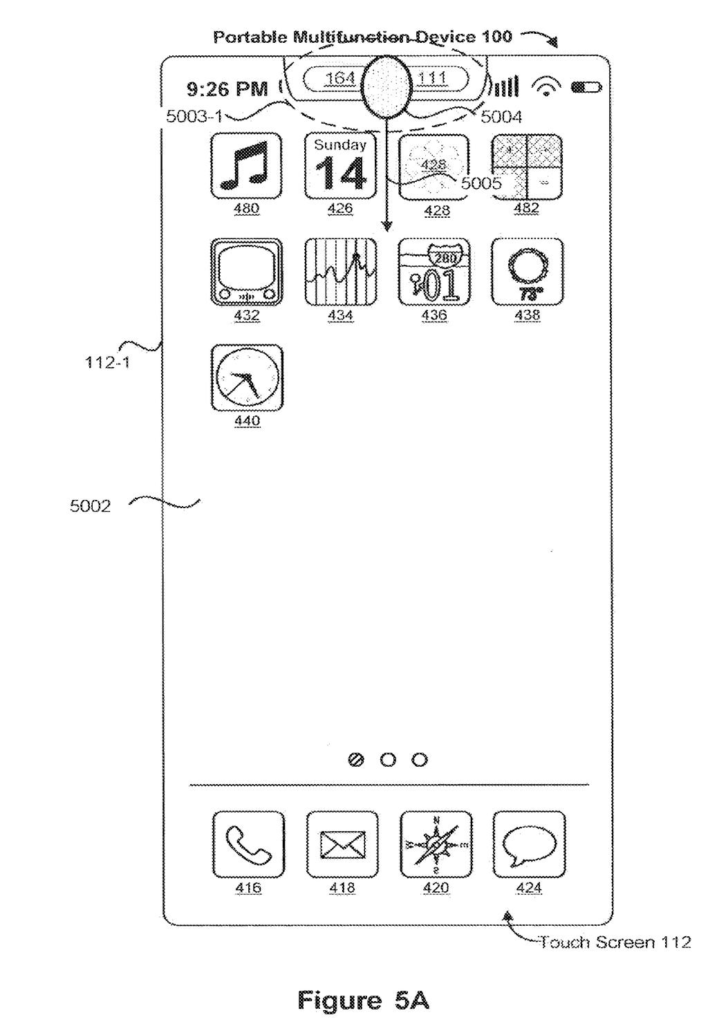
What Apple's edge-swipe gesture system actually does
Ever tried to reach a feature on your phone and wondered why you need three taps to get there? Apple's new patent is trying to make that faster by turning the edges of a touchscreen into intelligent shortcuts.
Here's how it works in plain terms: swipe inward from one part of an edge and you get an AI assistant interface where you can type or ask a question. Swipe inward from a different part of that same edge and your notifications fan out instead. Same direction, same basic motion, but where your finger starts is what decides which screen appears.
The broader patent also covers a related idea for spatial computing (think Apple Vision Pro): floating virtual objects can be repositioned only after you switch them into a special "reconfiguration mode," so you don't accidentally bump things around while working. Both ideas share the same goal, giving your gestures more precision without forcing you to memorize a complicated set of moves.
… replacing at least a portion of the first user interface with a respective user interface in the display region, wherein the respective user interface is for responding to a user-provided query …
Translation: Swiping from one specific part of the screen brings up an assistant to answer questions.
How the touch sensor reads start position to split two actions
The core invention is a gesture-routing system built around the edge of a touch-sensitive surface. When a user's finger crosses the edge of the screen in a single continuous motion, the device checks two things: which portion of the edge the finger crossed, and in what direction it moved.
- First criteria (AI query interface): if the contact crosses a first defined portion of the edge, the system replaces the current screen with a query interface, essentially an AI or search panel where you can ask questions.
- Second criteria (notifications): if the contact crosses a different, non-overlapping portion of the same edge, the system surfaces a list of previously received notifications instead.
The division is positional, not speed- or pressure-based. The same swipe direction (say, left-to-right across the bottom edge) produces a different result depending on whether your finger started in the lower-left quarter or the lower-right quarter of that edge.
The abstract also describes a separate but related mode for 3D environments (like augmented or mixed reality headsets). Virtual objects sit at fixed positions by default; a specific gesture locks them into a "reconfiguration mode" before a repositioning gesture actually moves them. This two-step requirement prevents accidental displacement during routine interactions.
… displays a first visual indication that the virtual object has transitioned into a reconfiguration mode, and further detects a second hand movement performed by the user …
Translation: The system shows a visual clue when an item is ready to be moved in 3D space.
What this means for how you call up AI on iPhone
For everyday iPhone users, this kind of gesture design is about reducing friction between you and features that currently require navigating menus. If Apple shipped this, pulling up an AI query panel or scanning your latest notifications could become a one-motion action you do without looking. That's a meaningful quality-of-life change for people who check their phones dozens of times a day.
From a strategic angle, the filing also signals that Apple is thinking carefully about how hand gestures scale across both flat touchscreens and spatial computing devices, and the newest Big Tech patents in the AR and touch-interface space show several companies racing toward this same gesture-unification problem. The two-step repositioning lock for virtual objects is particularly telling: it suggests Apple's spatial OS team is iterating on accidental-interaction problems that real Vision Pro users run into.
This patent sits very close to the shippable end of the spectrum. It requires no new sensors, no new hardware, and no OS subsystem that doesn't already exist on current iPhones. The edge-detection logic is a software decision about touch coordinates, which means the shortest route to a product is a software update. The AI-panel trigger in particular maps cleanly onto features Apple has already announced publicly. The spatial-object reconfiguration piece is slightly further out because it depends on headset adoption, but even that is software running on hardware Apple already sells.
There are more where this came from
We read every patent application Big Tech publishes and send you the ones worth knowing. Plain English, free, every week.
The drawings
66 drawing sheets from US 2026/0236161 A1 · click any drawing to enlarge


Want this weekly breakdown for a company we don't cover? Patentlyze Pro →
Be the first to weigh in