
Microsoft Patents an Engine That Sorts Computers Into Update Waves Automatically
Every time Microsoft ships a software update to millions of computers, one bad line of code could bring down an entire organization. This patent describes a system that tries to prevent exactly that by automatically deciding which computers get updated first, and in what order.
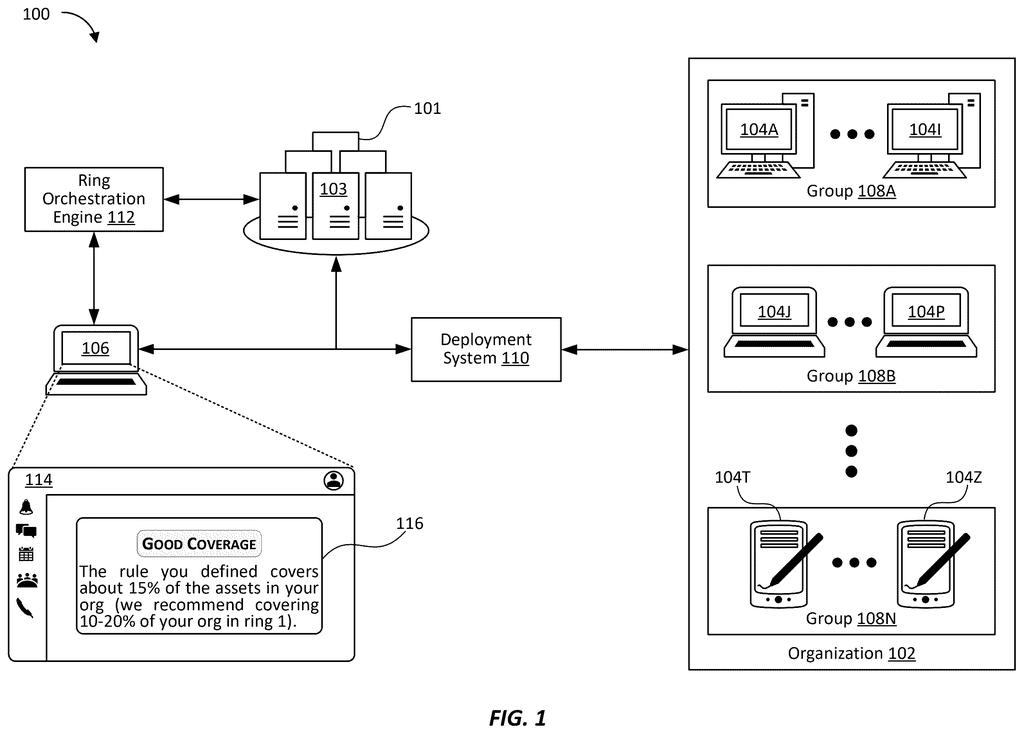
How Microsoft's ring rollout system works for your software
A software update lands at the wrong time, on the wrong machine, and suddenly half the office can't work. IT teams know this scenario well, and avoiding it is one of the quieter but expensive problems in corporate technology.
Microsoft's patent describes an automated engine that, before rolling out any new code, first takes stock of every computer or device it needs to reach. It then sorts those machines into groups based on their characteristics, such as how critical they are, what type of device they are, or how they're configured. Those groups become the basis for a staged rollout plan, where the update goes out to a small, lower-risk batch first, then wider and wider circles.
The goal is that if something goes wrong, only a small slice of machines is affected before the problem gets caught. The system handles the sorting and scheduling automatically, instead of relying on an IT administrator to do it by hand every single time.
… generate a ring deployment plan based on the asset landscape, wherein: the ring deployment plan comprises a plurality of deployment rings for incrementally deploying the new code; and the plurality of target assets are assigned to a deployment ring of the plurality of deployment rings according to the asset landscape …
Translation: It creates a schedule of rollout waves and sorts computers into them based on their traits.
How the engine profiles assets and builds deployment rings
The patent describes what Microsoft calls a ring orchestration engine, a piece of software that manages staged software deployments. When a deployment request comes in, the engine identifies every target asset (a computer, server, device, or other endpoint) that should receive the new code.
Next, the engine collects asset properties for each target. These are descriptive attributes about each machine, things like its role, configuration, location, or criticality. Using those properties, the engine classifies assets into groups and builds an asset landscape, essentially a structured map of what the full population of target machines looks like.
From that landscape, the engine generates a ring deployment plan. In software deployment, a "ring" is a wave: ring one might be a handful of test machines, ring two a slightly larger group, and so on, working outward until everyone is updated. The plan assigns each asset to a ring automatically.
- The engine receives a deployment request for new code.
- It discovers and profiles all target machines.
- It groups machines by shared properties into an asset landscape.
- It generates a ring-by-ring rollout schedule from that landscape.
- It kicks off deployment to the first ring and manages the progression.
… classifies the target assets into asset groups based on the one or more asset properties. From the classification, the ring orchestration engine determines an asset landscape for the target assets based on the plurality of asset groups …
Translation: The system groups computers by their shared characteristics to map out the network.
What this means for enterprise software update safety
Bad software updates are not a hypothetical. They have taken down hospital systems, grounded airlines, and locked employees out of their computers for days. The standard safeguard is staged rollouts, where you update a small group first and watch for problems before going further. The problem is that deciding how to stage those groups is time-consuming and inconsistent when done by hand.
An automated engine that can profile a fleet of thousands of machines and generate a sensible rollout order is a real operational win for large enterprises. Microsoft keeps filing on enterprise deployment and update infrastructure, and this fits that pattern. For you as a business technology buyer, it points toward future Windows or Azure update tools that could make large-scale software changes meaningfully less risky.
Microsoft's 501st filing in our Microsoft coverage since May adds to a pattern that includes hiding agents behind one window and mapping old codebases.
The problem this patent addresses is both real and expensive. A poorly staged software update across a large organization can cost millions in downtime, and the manual work of defining deployment rings before every rollout is exactly the kind of tedious, error-prone task that organizations often cut corners on.
The approach here is essentially automating the upfront analysis that good deployment engineers already do by hand. That's useful, but it raises an obvious question: how good is the asset profiling? The value of the whole system depends entirely on whether the engine correctly identifies which machines are risky to update early. If it misclassifies a critical production server as low-risk, staged rollout gives a false sense of safety.
This is solid infrastructure work, not a dramatic leap. Organizations running Microsoft's enterprise tools will care about it more than anyone else, and the patent's real test will be how accurately the engine reads a messy, real-world device inventory.
There are more where this came from
We read every patent application Big Tech publishes and send you the ones worth knowing. Plain English, free, every week.
The drawings
8 drawing sheets from US 2026/0299916 A1 · click any drawing to enlarge


Want this weekly breakdown for a company we don't cover? Patentlyze Pro →
Be the first to weigh in