
Adobe Patents a Way to Turn Hand-Drawn Sketches Into Editable Design Files
Designers have always started with paper, then rebuilt everything from scratch on screen. Adobe is filing patents for a system that could close that gap automatically, turning a rough sketch into a layered, editable design document.
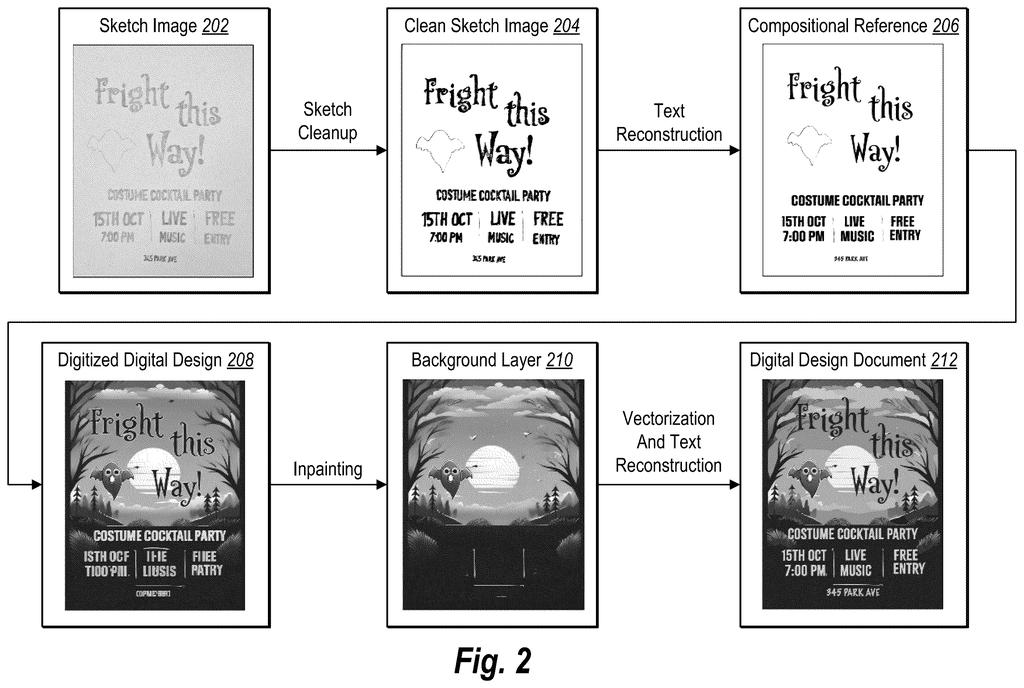
What Adobe's sketch-to-design AI actually produces
You're sketching out a poster or app screen on paper and you want to get it into Adobe's software without redrawing everything from scratch. Right now that means a lot of manual labor: tracing shapes, retyping text, rebuilding the layout pixel by pixel.
Adobe's patent describes a system where you photograph or scan your sketch and the AI takes over from there. It figures out the canvas size and proportions, cleans up uneven lighting and low contrast (the way a phone photo of a napkin sketch always looks messy), and converts your drawing into a clean black-and-white reference image. From that, machine learning models generate a full digital design that matches your layout.
The key detail is the output: not just a flat image, but a layered document where background graphics and text blocks are separate, editable elements. That means you'd actually be able to click into a headline, change the copy, or swap a color, rather than just getting a static picture of your sketch.
… generating a layered digital design document comprising a background layer based on the digitized digital design and editable text elements based on the compositional reference.
Translation: The software creates a file where the drawing is a background image and the text can be selected and changed.
How the binarization pipeline reads a rough sketch
The system works in three broad stages, each building on the last.
Stage 1: Reading the sketch. The system determines the canvas size and aspect ratio of your sketch image before doing anything else. This matters because a wide landscape sketch should become a wide document, not a square one. It sounds simple, but getting proportions right from a phone photo of a tilted sketchbook page is a real geometry problem.
Stage 2: Cleaning and binarizing. A binarization model (a type of image-processing algorithm that strips a photo down to pure black and white, dropping shadows, paper texture, and uneven light) normalizes the lighting across the image, boosts contrast so faint pencil lines show up clearly, and converts the whole thing to a binary black-and-white format. The result is what the patent calls a compositional reference: a clean map of where things sit on the page.
Stage 3: Generating the layered document. One or more machine learning models then use that compositional reference to generate a digitized digital design, essentially a polished visual interpretation of the layout. The final output is a layered design document with:
- A background layer derived from the generated design
- Editable text elements placed where the sketch showed text
The editable text layer is the part that separates this from simply running a photo through an art filter. The system is attempting to identify where text lives in a layout and make those elements independently editable in the resulting file.
The present disclosure relates to systems, non-transitory computer-readable media, and methods for generating layered digital design documents from sketches utilizing deep learning.
Translation: Adobe is patenting a way for AI to turn hand-drawn sketches into professional design files.
What this means for designers who sketch first
For working designers, the most painful part of the sketch-to-screen workflow has always been the transcription step. You draw something fast, it looks right, and then you spend an hour rebuilding it digitally. A tool that outputs editable layers, rather than a flat render, would actually be usable in a real project rather than just a novelty demo.
Adobe already has generative AI features across Photoshop and Illustrator, so the infrastructure for plugging something like this into a Creative Cloud workflow exists. The new Big Tech patents coming out of the design-software space increasingly target this exact handoff between physical ideation and digital production, and Adobe's filing fits that pattern. Whether this becomes a Firefly feature or something inside Express is an open question, but the output format described (layered, editable) maps cleanly to how those apps already work.
Most of what's described here is a software pipeline built on model types Adobe already ships in some form, which puts it closer to a productizable feature than most AI patents. The main open question is accuracy: binarization on clean sketch paper works well, but real-world sketches come in on cocktail napkins, whiteboard photos, and crumpled notebook pages. If the compositional reference stage handles messy inputs reliably, the path from patent to shipping feature is short; if it needs clean input, the use case narrows considerably.
There are more where this came from
We read every patent application Big Tech publishes and send you the ones worth knowing. Plain English, free, every week.
The drawings
18 drawing sheets from US 2026/0237116 A1 · click any drawing to enlarge


Want this weekly breakdown for a company we don't cover? Patentlyze Pro →
Be the first to weigh in