
Google Patents a System That Trains AI to Write Its Own Instructions
Getting an AI model to do a specific job usually means expensive retraining or a lot of manual trial-and-error with instructions. Google's new patent describes a system that automates that entire process by training a second AI layer to write the instructions for you.
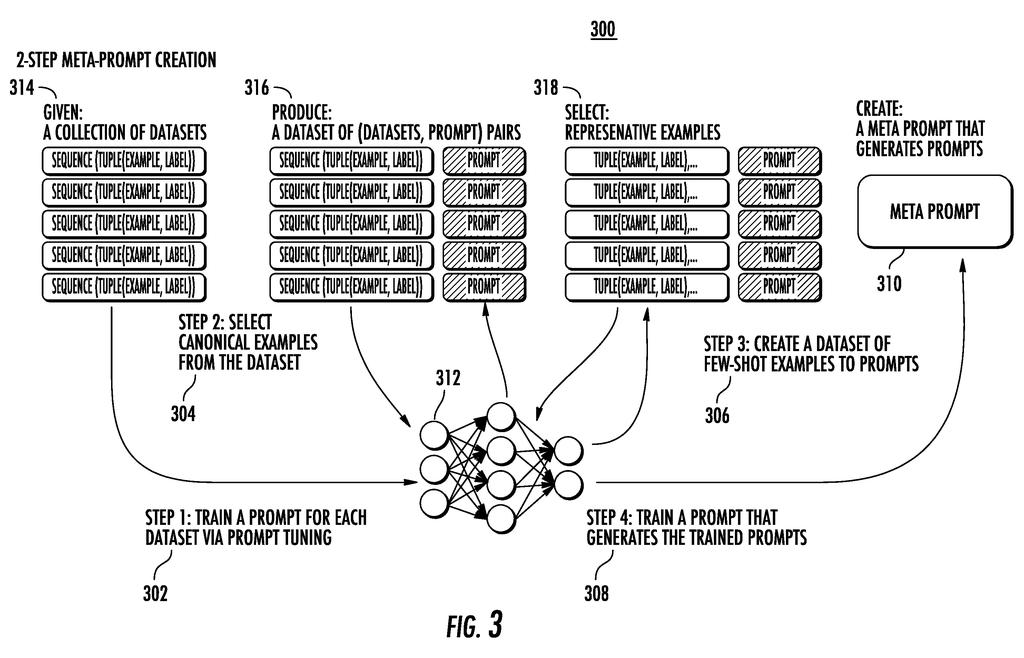
How Google's self-writing prompt system actually works
Today, adapting a general-purpose AI to a specific task, like sorting customer emails or summarizing medical notes, typically means either paying to retrain the model or spending hours hand-crafting the right instructions. Google wants to automate that frustrating middle step.
The patent describes a system built around something called a meta-prompt: a learned layer that sits between you and the AI model. Instead of you writing the instructions, the meta-prompt learns, through its own training process, how to generate the best instructions for whatever task you throw at it. Feed it your task and your data, and it figures out the right way to talk to the AI on your behalf.
The system also borrows a trick from search engines: when it needs to tune a prompt, it looks up similar prompts that have already been trained and reuses what worked. That means less computation and faster results. The whole thing is designed to plug into an API, so developers could call it from any application without touching the underlying model.
… adjusting, by the computing system, one or more meta-prompt parameters of the meta-prompt based on the prompt gradient; storing, by the computing system, the meta-prompt, wherein the meta-prompt comprises a set of learned parameters associated with the prompt generation task …
Translation: The system automatically updates its own instructions by calculating how well its previous attempts performed.
Inside the meta-prompt training and gradient loop
The patent lays out two interlocking ideas, both aimed at making prompt tuning (the process of finding the right input instructions to get a pre-trained AI to perform a specific task) cheaper and more automatic.
The first idea is the meta-prompt. Rather than tuning a prompt directly for a given task, the system trains a special set of parameters, the meta-prompt, whose entire job is to generate task-specific prompts on demand. Training works like this:
- The system feeds the meta-prompt and some training examples into a pre-trained model and gets an output.
- It compares that output to the correct answers and computes a prompt gradient (a mathematical signal indicating how wrong the output was and in which direction to adjust).
- It uses that gradient to update the meta-prompt's internal parameters, then repeats until the meta-prompt reliably produces good prompts for new tasks.
The second idea is semantic search-assisted retraining. When a new prompt needs to be tuned, the system searches a library of previously trained prompts for ones that are conceptually similar (semantic search finds meaning-level similarity, not just keyword matches). Data from those similar prompts is reused, cutting down the computation needed to start from zero.
The whole pipeline is packaged as an API (application programming interface, a standard connector that lets software talk to other software), meaning developers can call these prompt-generation and prompt-tuning functions from their own products without managing the underlying model themselves.
… systems and methods for prompt tuning can generate and utilize a meta-prompt to reduce the computational cost of generating prompts. The prompt tuning techniques can be implemented as part of a prompt tuning application programming interface (API).
Translation: This technology creates a master instruction set to help AI generate specific tasks more efficiently.
What this means for businesses building on AI APIs
For any company building AI-powered features on top of large language models, the cost of adapting a general model to a specific use case is a real bottleneck. Retraining is expensive. Manual prompt engineering is slow and often requires specialized expertise. A system that generates and refines prompts automatically, and reuses prior work via search, could meaningfully lower the barrier to deploying task-specific AI in production.
The API framing is the most commercially pointed detail here. Google is signaling that this capability is meant to be a service that other developers consume, which fits neatly into the broader Google Cloud AI product strategy. For anyone tracking how AI infrastructure patents are evolving, this filing sits alongside other interesting tech patents in the prompt-engineering and model-adaptation space that together sketch out where cloud AI tooling is heading.
The meta-prompt design is clever, but the tradeoff is real: you are now training a second model layer to generate instructions for the first, which adds its own complexity, failure modes, and appetite for quality training data. If the meta-prompt learns to generate mediocre prompts, every downstream task inherits that mediocrity, and diagnosing where things went wrong gets harder because the instructions themselves are opaque outputs of a learned system. At scale, where the alternative is armies of prompt engineers, that cost is probably worth it; for smaller deployments, maintaining a meta-prompt pipeline may cost more than it saves in manual tuning.
There are more where this came from
We read every patent application Big Tech publishes and send you the ones worth knowing. Plain English, free, every week.
The drawings
21 drawing sheets from US 2026/0236459 A1 · click any drawing to enlarge


Want this weekly breakdown for a company we don't cover? Patentlyze Pro →
Be the first to weigh in