
Google Patent Reveals AI Assistant That Drafts Complete Messages From a Single Command
Saying 'send an email to my landlord about the broken heater' shouldn't require you to dictate every word. Google is patenting a way for its assistant to draft the whole thing after hearing just that one request.
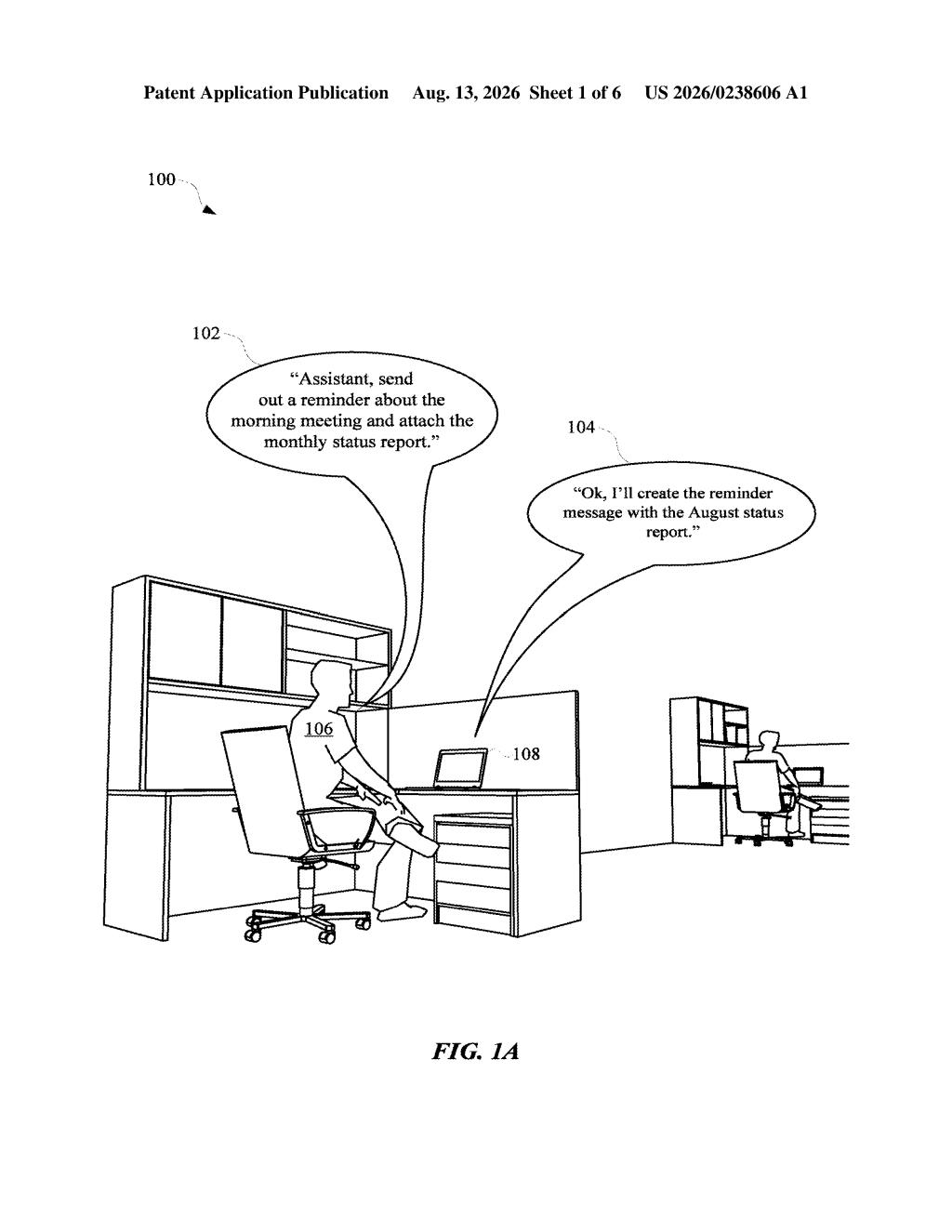
How Google's assistant turns one sentence into a finished message
Right now, asking a voice assistant to send a message usually means one of two things: either you dictate the whole thing word for word, or the assistant produces something short and generic. Google wants to change that.
This patent describes an assistant that listens to your spoken request, picks the right kind of message template for the situation, and then fills in the different sections of that template automatically. Some of those sections get filled from what you said; others get filled in by the assistant itself, drawing on context like your past messages with that person. You say the intent, and it handles the composition.
The goal is a finished, properly structured message without you having to spell out every detail. Think of it as the assistant acting more like a personal secretary who already knows your communication style than a simple speech-to-text recorder.
receiving, by an automated assistant, a spoken utterance corresponding to a request for the automated assistant to perform one or more particular actions associated with a template …
Translation: The system starts by listening to a voice command meant to trigger a specific message template.
How the assistant picks a template and fills in the blanks
The patent describes a system where a spoken request, like telling the assistant to send a specific kind of message to a specific person, triggers a multi-step composition process.
First, the assistant identifies which template applies to the request. A template here is a structured layout for a message with distinct sections: an opening, a body, a call to action, a closing, and so on. These sections can be non-contiguous, meaning they don't necessarily follow in order and can be filled in independently.
Next, the assistant figures out what content goes into each section:
- Some content comes directly from what you said in your spoken request (for example, the reason for the message).
- Other content, for sections you didn't explicitly address, is generated by the assistant based on context (like your previous messages to the same recipient).
- The system checks whether all sections are filled before it sends anything.
The assistant only performs the action (sending the message, scheduling something, etc.) once the template is determined to be complete. If enough information has been gathered to fill every required section, it proceeds. If not, it can presumably ask follow-up questions or infer the remaining content from other sources.
… content that is assigned to certain sections of the selected template can come from a variety of different sources and/or may not be explicitly specified in the request from the user to the automated assistant …
Translation: The AI can automatically fill in parts of a message without the user having to spell everything out.
What this means for hands-free messaging on Android and Google devices
For anyone who regularly uses a voice assistant while driving, cooking, or otherwise occupied, the current experience of having to dictate messages word by word is a bottleneck. This patent points toward an assistant that can handle the composition work itself, reducing the number of things you have to say out loud to get a well-formed message out the door.
The underlying approach, using past messages to inform new ones and filling gaps the user left unaddressed, also matters for how Google positions its assistant against other AI-driven communication tools. This filing sits alongside a broader wave of interesting tech patents covering AI-assisted messaging and context-aware assistants, a space that Google, Apple, and Microsoft are all actively working to own.
The practical payoff here is real and fairly specific: people who rely on voice commands to get things done will spend less time correcting or re-dictating messages that the assistant got half-right. The template-plus-inference approach is a more honest solution to that problem than just making autocomplete faster. Whether Google ships this in a form that actually trains on your past messages without raising privacy concerns is the question that will determine whether users notice it at all.
There are more where this came from
We read every patent application Big Tech publishes and send you the ones worth knowing. Plain English, free, every week.
The drawings
6 drawing sheets from US 2026/0238606 A1 · click any drawing to enlarge


Want this weekly breakdown for a company we don't cover? Patentlyze Pro →
Be the first to weigh in