
Sony Patent Reveals Consoles Automatically Generating Their Own Game Store Previews
Getting a game onto a digital storefront requires more than just the code, someone has to produce screenshots, trailers, and preview clips that meet the platform's exact requirements. Sony's new patent describes a system that handles all of that automatically, by booting up the game itself and recording what it sees.
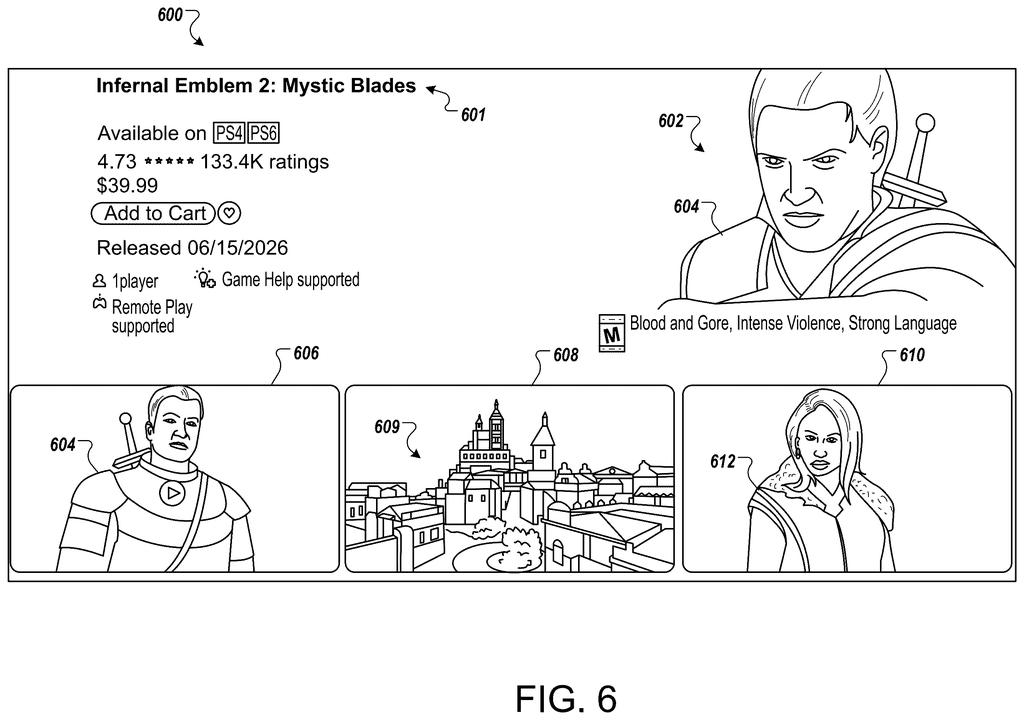
How Sony's auto-capture system builds game store pages
Every time you browse the PlayStation Store, each game tile has a carefully composed screenshot, a short video clip, or a hover preview waiting for you. Right now, producing those assets is largely a manual job: developers record footage, crop images, and submit files that meet Sony's specific size and format rules.
Sony's patent describes a way to automate that entire process. The system receives the game's install package, boots it up inside a virtual console (a software copy of a PlayStation), plays through it, and then automatically captures screenshots and video clips that meet whatever content rules Sony has set. The finished assets go straight into a storage system, ready to populate the store page.
For developers, especially smaller studios without big marketing teams, this could mean submitting a game file and getting a store-ready listing back without any extra production work.
… emulating, by the one or more processing devices, a gaming console to simulate game-play of the video game using the plurality of files, the game-play using at least a portion of the game elements represented in the plurality of files; …
Translation: The system plays the game automatically to capture footage.
Inside the emulate-then-capture pipeline
The patent lays out a pipeline with five main stages:
- Content criteria intake: The system first loads a set of rules that define what a valid digital asset looks like, things like resolution, aspect ratio, video length, or which parts of the game should appear.
- Package reception and decompression: The game arrives over a network as a compressed bundle (the same kind of file a developer would submit to a platform). The system unpacks it to get at the individual game files.
- Console emulation: Rather than running the game on real hardware, the system spins up a software emulator, a virtual PlayStation, and uses the unpacked files to simulate actual gameplay. This means no physical console is required at any point in the process.
- Asset generation: As the emulated game runs, the system captures frames and clips that satisfy the content criteria defined in step one.
- Repository storage: The finished assets are saved to a central store, tagged as preview material for that specific game.
The claim doesn't specify how the system decides which moments of gameplay to capture, whether that's time-based sampling, scene-change detection, or something AI-driven, leaving that as an open implementation detail.
… generating, from the simulated game-play, one or more digital assets that satisfy the content criteria; and storing the one or more digital assets in a repository, wherein the one or more digital assets are configured to provide preview of the video game.
Translation: It turns that automated gameplay into store previews.
What this means for PlayStation Store publishers
For game publishers, the most direct implication is time and cost. A small indie studio currently has to budget time for capturing, editing, and formatting store assets, often after the game is already finished, when everyone is exhausted. A system that automates this from the install package could shrink that tail end of the launch process considerably.
For Sony, the strategic upside is consistency and speed across the PlayStation Store's entire catalog. Thousands of games pass through that storefront each year, and any manual review or production bottleneck slows listings down. The filing sits in a growing area of Big Tech patent news around automated content pipelines, where platform owners are increasingly trying to reduce the human labor that sits between a finished product and a live store page.
The shortest path from this patent to a shipping feature is actually pretty short, which is what makes it interesting. No new hardware is required, the system runs entirely in software, using emulation that Sony already operates internally for compatibility testing and streaming services like PlayStation Now. The main engineering lift is hooking automated gameplay capture onto an existing emulation layer and feeding it a content-criteria spec. That's a real project, but it's not a years-away research bet. The most plausible first deployment is an internal tool that generates draft assets for developers to approve rather than a fully hands-off pipeline, and even that version would remove most of the grunt work.
There are more where this came from
We read every patent application Big Tech publishes and send you the ones worth knowing. Plain English, free, every week.
The drawings
8 drawing sheets from US 2026/0233104 A1 · click any drawing to enlarge


Want this weekly breakdown for a company we don't cover? Patentlyze Pro →
Be the first to weigh in