
Samsung Patents an Image Sensor That Shoots Video and Detects Motion at the Same Time
Samsung has filed a patent for an image sensor that pairs a standard color-capturing pixel with a motion-detecting pixel inside every group, letting a camera record normal images and track changes in light at the same time, without switching between modes.
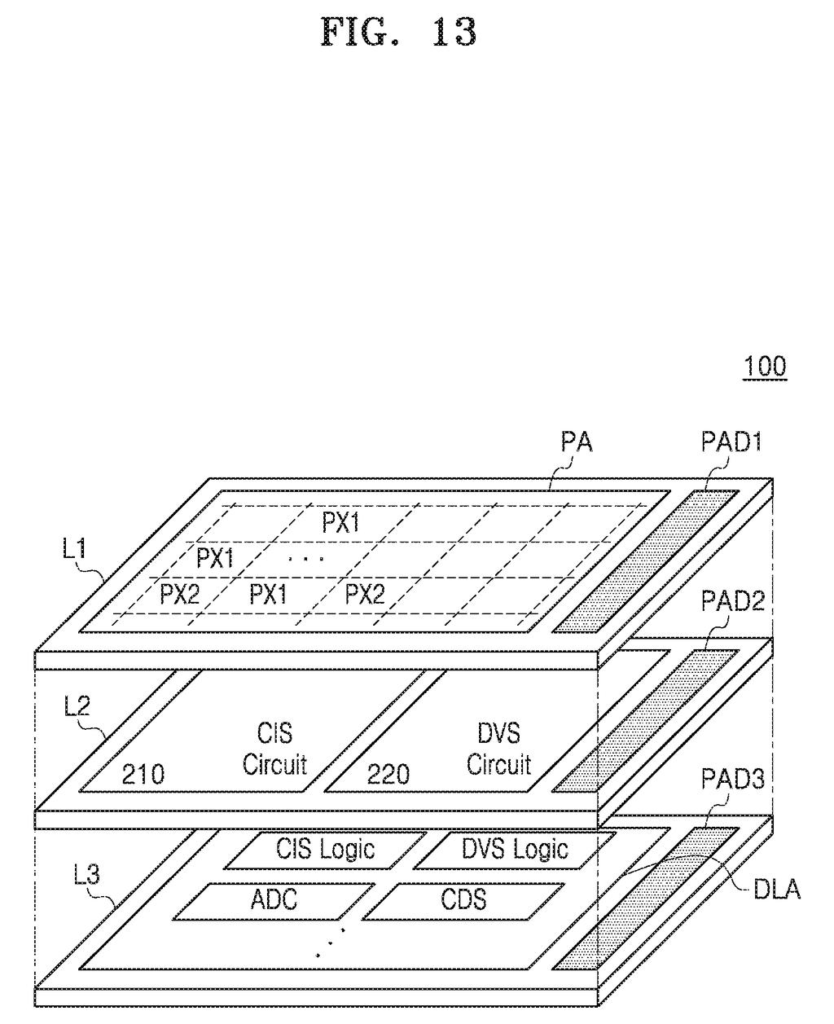
What Samsung's dual-pixel motion sensor actually does
Imagine you're filming your kid's soccer game and the camera keeps blurring the exact moment they kick the ball. Most cameras take snapshots in rapid sequence, so fast motion in between frames gets smeared or lost entirely.
Samsung's patent describes a sensor where each small cluster of pixels contains two types: one pixel captures a full color image the way current cameras do, while its neighbor watches for any change in brightness, no matter how quick. Both pixels look at the same color of light, so their data lines up cleanly.
The motion-detecting pixel feeds into a special circuit that fires off a signal the instant it notices a change, rather than waiting for the next scheduled frame. Your device gets a continuous stream of motion cues layered on top of normal video, which means fast action leaves a trail of data instead of a blur.
… a first pixel configured to generate image data and a second pixel configured to generate event data, and the first pixel and the second pixel included in a same pixel group are configured to receive an optical signal of a same color …
Translation: Neighboring pixels capture normal video and track movement using the exact same color of light.
How the DVS circuit reads motion from paired pixels
The patent covers an image sensor built around a pixel array divided into groups. Inside at least some of those groups, two distinct pixel types live side by side.
- First pixel (image pixel): works the standard way, accumulating charge from light and handing it off as conventional image data at regular intervals.
- Second pixel (event pixel): feeds a Dynamic Vision Sensor (DVS) circuit, a type of readout system borrowed from neuromorphic engineering that only fires when the light level it sees changes, not on a fixed schedule.
- Color matching: both pixels in the same group sit behind a filter for the same color (say, both see green), so the image data and the event data describe the same slice of the scene.
The DVS circuit converts the electrical charge from the event pixel into an event signal, a timestamped spike that says "something changed here, right now." This is fundamentally different from a standard frame, which says "here is what everything looked like at time T."
The practical result is two parallel streams: a conventional video feed and a high-speed motion log, both geometrically aligned because the pixel pairs share a physical location on the sensor.
… a dynamic vision sensor (DVS) circuit configured to generate an event signal, based on an electrical signal corresponding to charge generated from the second pixel …
Translation: A specialized circuit instantly detects motion by measuring tiny electrical changes in the movement pixels.
What this means for cameras that miss fast-moving moments
For anyone who has tried to photograph a hummingbird, catch a sports replay, or scan a fast-moving assembly line, the limiting factor has always been that standard cameras are blind between frames. A motion-event layer changes that: the sensor reports every meaningful flicker of movement the instant it happens, so software has much richer data to work with when it reconstructs or analyzes motion.
This kind of hybrid sensor architecture is an active area of investment across the camera and chip industry, and Samsung's approach of color-matching the two pixel types is a direct answer to a known problem where event data and image data don't align spatially. The new Big Tech patents covering image sensor design show how camera hardware competition has shifted from megapixel counts toward the quality of motion and low-light intelligence built into the silicon itself.
For a reader who cares about what their phone camera actually does in the moment it matters, this patent addresses something real: the gap between frames is where fast action disappears. Samsung's approach of embedding event pixels directly alongside color pixels, and tuning them to the same color channel, is a tidy solution to the alignment problem that has made previous hybrid sensors awkward to use in practice. The payoff would show up in sports modes, action photography, and any video feature that depends on tracking movement, places where current sensor technology frustrates people even if they can't name why.
There are more where this came from
We read every patent application Big Tech publishes and send you the ones worth knowing. Plain English, free, every week.
The drawings
15 drawing sheets from US 2026/0238894 A1 · click any drawing to enlarge


Want this weekly breakdown for a company we don't cover? Patentlyze Pro →
Be the first to weigh in