
Adobe Patents an AI Tool That Finds Matching Materials Across 3D Models
Picking the right material in a 3D scene is tedious, click-heavy work. Adobe is patenting a way to let designers tap one surface and instantly find every other surface on the model that's made of the same stuff.
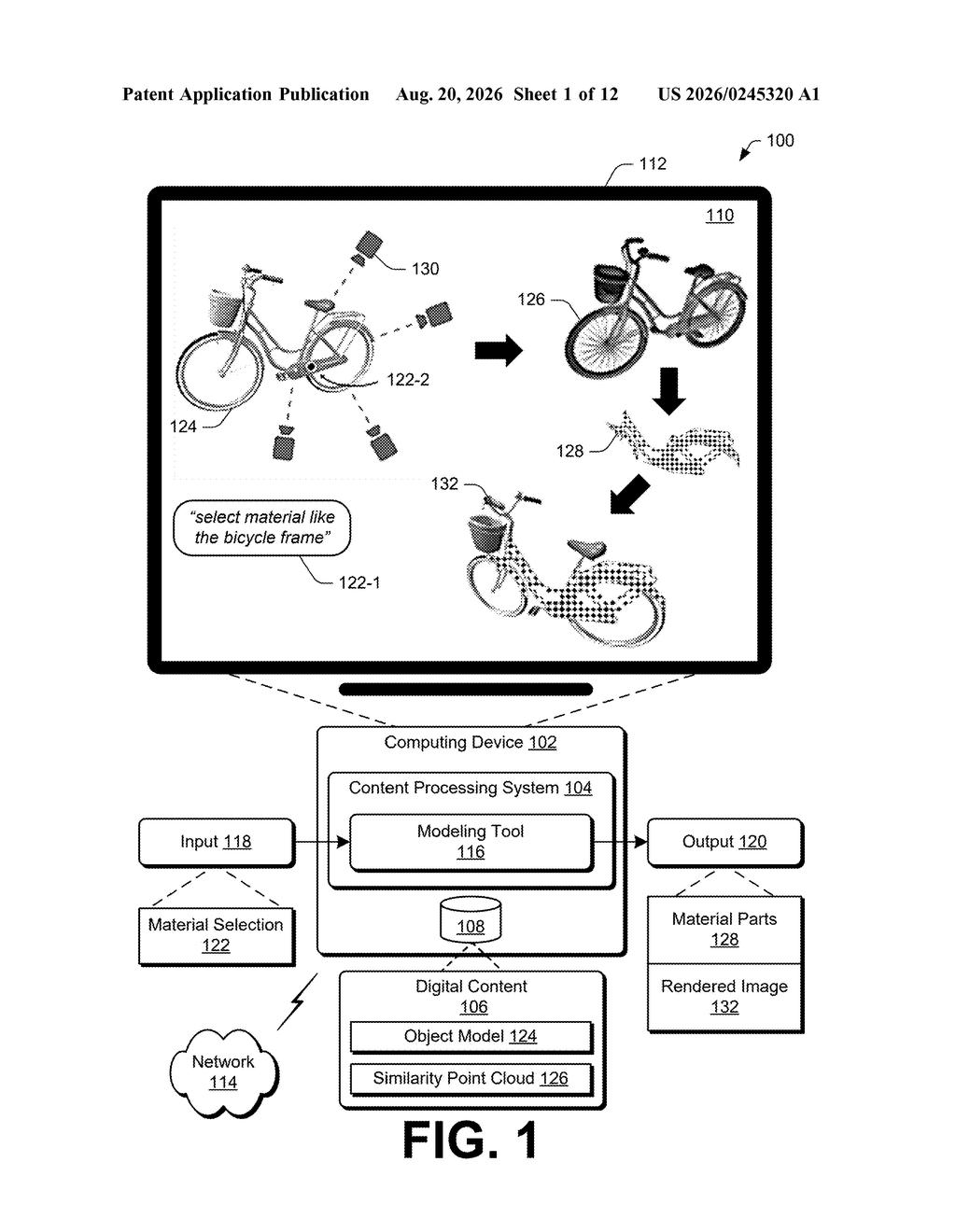
How Adobe's material-matching tool reads a 3D object
Imagine you're building a 3D model of a car and you want to repaint every plastic trim piece the same color. Right now, you'd have to hunt through the model piece by piece, identifying which surfaces share that material. It's slow, and easy to miss something.
Adobe's patent describes a system where you click on one surface, and the software automatically highlights every other surface on the model that's made of a similar material. It does this by analyzing multiple views of the object through an AI model, building an internal map of material similarities across the whole shape.
The goal is to make material editing feel less like archaeology and more like a simple selection tool, the kind designers already use for colors in photo editing. You pick one, the software finds the rest.
… inputting, by the processing device, the sample images and the material selection into a material selector model that creates a similarity point cloud enabling material similarity querying across multiple material parts of the object model …
Translation: The software analyzes images of your 3D object to map out which parts are made of the same material.
Inside Adobe's similarity point cloud for 3D surfaces
The system works in three stages. First, a 3D object model is loaded into a user interface that can preview it from multiple angles. The designer clicks on a specific surface, which the patent calls a material part, to designate a material they want to match.
Next, the software automatically captures sample images of the model from different viewpoints, focusing on the selected area. Those images, along with the selection itself, are fed into a material selector model (an AI trained to understand surface properties like texture, shininess, and roughness).
The AI then constructs a similarity point cloud (think of it as a mathematical map where materials that look alike sit close together and materials that differ sit far apart). The system queries that map to find other surfaces on the model whose material signatures land near the selected one.
Finally, the interface highlights all those matching surfaces, giving the designer a ready-made selection they can edit, re-texture, or recolor in one go. The patent also references material glint generation, suggesting the system is built to handle reflective and specular materials, not just flat colors.
The processing device is further operable to obtain a plurality of sample images showing different views of the object model and the material part designated by the material selection, input the sample images and the material selection into a material selector model …
Translation: The system takes photos of your 3D model from various angles to identify the specific texture you selected.
What this means for 3D artists and design software
3D content creation tools have long had smart selection features for 2D work (selecting pixels by color, for example), but applying that logic to 3D materials is much harder because the same surface can look different depending on the light and camera angle. Adobe's approach, using multi-view images and an AI similarity map, is a practical path to closing that gap for tools like Substance 3D or future versions of Dimension.
For working artists, a reliable material-matching selector could shave meaningful time off asset preparation, particularly in product visualization and game asset workflows where a single model might have dozens of distinct surface types. This filing sits in the broader wave of AI-assisted 3D authoring tools that Big Tech patent news has been tracking closely as companies race to automate the more repetitive parts of digital content production.
Adobe's 116th filing among patents we've tracked since May continues its push to simplify design, building on applications like talking through graphics and sketches to editable files, all in our Adobe coverage.
The core idea runs on software alone and uses AI systems Adobe already has running. That means Adobe could turn this into a real feature faster than most patents ever become products.
The one open question is whether the matching system works well when a 3D model has many overlapping surfaces and materials. The patent explains how it works but never says how accurate it is, and that gap still needs real engineering work to close.
There are more where this came from
We read every patent application Big Tech publishes and send you the ones worth knowing. Plain English, free, every week.
The drawings
12 drawing sheets from US 2026/0245320 A1 · click any drawing to enlarge


Want this weekly breakdown for a company we don't cover? Patentlyze Pro →
Be the first to weigh in