
Apple Patents a Way to Connect Accessories to Apps Without Leaking Your Identity
Every time an app connects to a Bluetooth accessory, there's a quiet privacy risk: the handshake that links device to app can expose who you are. Apple's latest patent describes a way to handle that entire process in the background, using encrypted identifiers instead of raw user data.
How Apple hides your identity when pairing accessories
Imagine you buy a pair of wireless earbuds from a third-party brand, install their companion app, and press connect. Behind the scenes, the app has to reach out and find your earbuds among every Bluetooth device broadcasting nearby. That search process, as it exists today, can leak details about you and your devices to apps that don't necessarily need them.
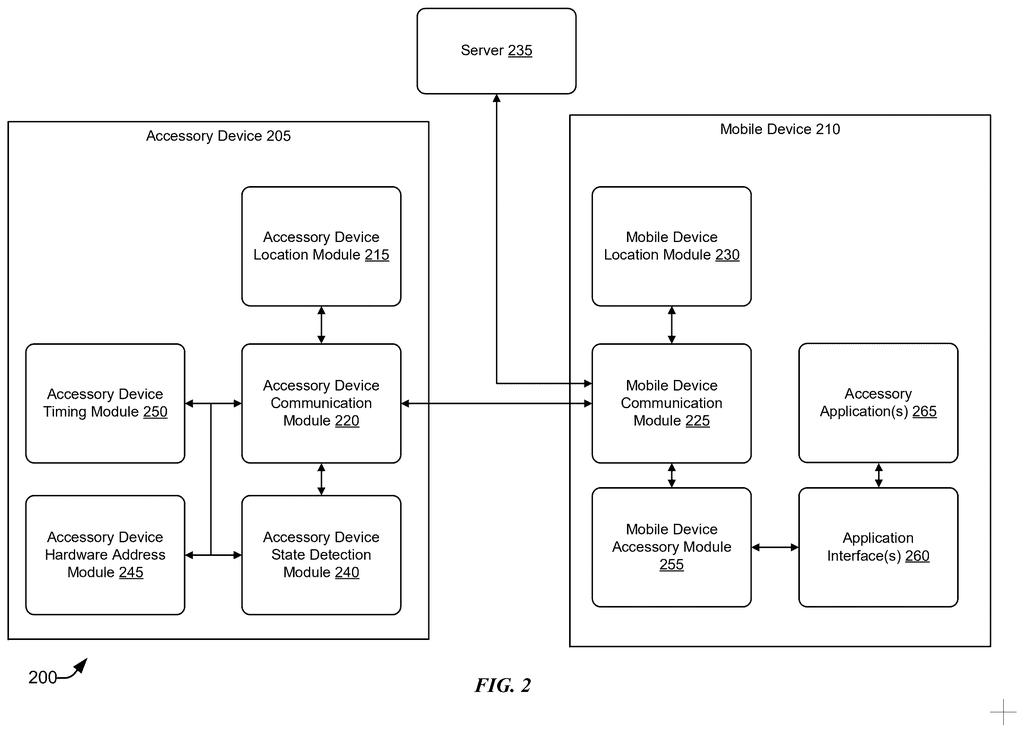
Apple's patent describes a system where your iPhone handles the connection work itself, acting as a go-between. The app tells the phone "I want to talk to this accessory," and the phone uses a private, encrypted lookup to find and connect to the right device, then passes the conversation through. The app gets access to the accessory, but never has to see (or touch) the raw identifiers that could be used to track you.
The end result is that third-party apps can still work with their companion accessories, while your phone keeps the sensitive matching details locked away from the app itself.
detecting, by a system process of a mobile device, a trigger for establishing a communication pathway with an accessory device from an application that is associated with the accessory device, the trigger including an accessory identifier …
Translation: The phone's operating system notices when an app wants to talk to a nearby gadget.
How the cryptographic mapping and advertising messages work
The patent describes a method where a system process on the iPhone (a background service controlled by Apple, not the third-party app) acts as a secure broker between an app and a Bluetooth accessory.
When an app wants to connect to its paired device, it fires off a trigger that includes an accessory identifier (a label that says "I'm looking for this specific type of device"). The system process then consults a private mapping table that links those identifiers to sets of cryptographic information (essentially, encrypted keys that prove ownership or association without revealing raw hardware addresses).
Using that cryptographic set, the system finds the right advertising message (a small packet of data that Bluetooth accessories broadcast to announce themselves). Because the advertising message is matched via encrypted keys rather than plain hardware IDs, the connection can be made without exposing stable identifiers that could be used to track the device or its owner.
- The app makes a connection request
- The system process looks up the matching cryptographic credentials
- The phone finds the correct accessory using encrypted advertising data
- A communication channel is opened, with the phone acting as gatekeeper
The app communicates through that channel, but the sensitive matching logic never leaves Apple's system process.
… accessing a mapping of accessory identifiers to sets of cryptographic information, and the techniques may include identifying a set of cryptographic information that corresponds to the accessory device …
Translation: The device looks up secret security keys linked to that specific accessory.
What this means for third-party apps and your Bluetooth privacy
Bluetooth privacy is a real and underappreciated problem. Apps that connect to accessories have historically needed access to low-level identifiers like hardware addresses, which can be used to build a profile of where you go and what devices you own. Regulations in multiple regions are tightening around exactly this kind of passive tracking, and users are increasingly aware that a "smart home" app or a fitness device companion could be doing more than just syncing your steps.
For developers building third-party accessories and apps, this patent signals that Apple may be moving toward a model where the connection plumbing is handled at the OS level, similar to how HealthKit or HomeKit abstract away sensitive data. That could restrict what app makers can see, but it also gives them a cleaner, safer API to build against. Big Tech patent news in the Bluetooth and wireless privacy space has been trending toward this kind of OS-level mediation, and Apple's filing fits squarely in that direction.
Apple's fifth filing we've tracked in our on-device AI privacy watchlist since July builds on earlier work like wallet card tapping and managing AI models across devices.
Bluetooth tracking is not a hypothetical threat: security researchers have documented cases where accessories with stable hardware identifiers were used to follow people's movements without consent. The problem is real, it affects everyday devices people already own, and it scales across millions of accessory pairings. Apple's approach here, routing connection logic through a privileged system process rather than handing raw identifiers to any app that asks, matches the scope of the problem well. It addresses the root cause (app-level access to trackable data) rather than patching symptoms, which puts it in a stronger category than most incremental privacy filings.
There are more where this came from
We read every patent application Big Tech publishes and send you the ones worth knowing. Plain English, free, every week.
The drawings
12 drawing sheets from US 2026/0247456 A1 · click any drawing to enlarge


Want this weekly breakdown for a company we don't cover? Patentlyze Pro →
Be the first to weigh in