
Google Patents a Method for Measuring Quantum Computer Accuracy Gate by Gate
Before a quantum computer can do anything useful, you need to know how badly it's getting things wrong. Google's new patent tackles that measurement problem with a rigorous statistical method for grading each logic gate's accuracy.
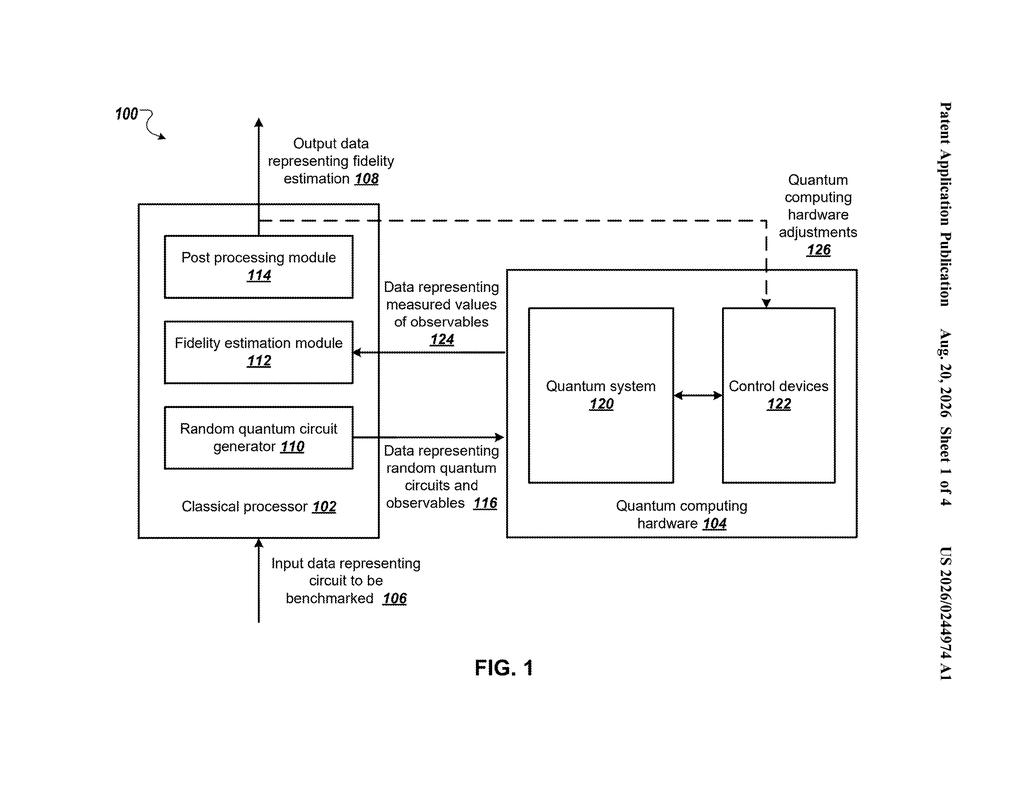
What Google's quantum gate accuracy test actually measures
You're trying to bake a cake and your oven's temperature dial is off, but you don't know by how much. Every cake comes out slightly wrong in a different way. The only way to figure out the dial's true error is to bake a lot of test cakes under controlled conditions and look at the pattern of failures. Quantum computers have exactly the same problem with their basic building blocks, called logic gates.
A quantum logic gate is a tiny operation that nudges a quantum bit (a qubit) from one state to another. In practice, every gate makes small errors, and those errors pile up fast. Google's patent describes a systematic way to measure how accurate each gate is by running many specially designed random test circuits on the real hardware, recording the results, and using statistics to back-calculate an error rate.
The number they're solving for is called fidelity: a score between 0 and 1 that tells you how closely the real hardware's output matches what a perfect, error-free machine would produce. Higher fidelity means fewer errors. Getting this number reliably is a prerequisite for building quantum computers that can actually outperform classical ones on real tasks.
… estimating a value of a polarization parameter for the set of random quantum circuits, comprising performing a least mean squares minimization based on multiple expectation values …
Translation: The system calculates the error rate by running mathematical optimizations on repeated circuit tests.
How the polarization parameter ties circuits to error rates
The patent describes a procedure for estimating the fidelity of an n-qubit quantum logic gate, where n is the number of qubits the gate acts on simultaneously. Fidelity here is a mathematical measure of how close the gate's real-world behavior is to its ideal, error-free version.
The core steps are:
- Design multiple sets of random quantum circuits, each set built around the gate you want to test. Random circuits are used because they expose errors in a statistically even way, without accidentally hiding some error types.
- For each circuit, choose a specific observable (a measurable quantity, like whether a qubit ends up as 0 or 1) that is mathematically tailored to that circuit's structure.
- Run each circuit on real quantum hardware and collect expectation values, which are basically weighted averages of the measurement outcomes over many runs of the same circuit.
- Feed those averages into a least mean squares minimization (a standard curve-fitting technique that finds the best numerical explanation for a set of noisy data points) to estimate a polarization parameter for each set of circuits.
- Combine the polarization parameter estimates across all sets to arrive at a final fidelity estimate for the gate.
The method is designed to be robust against a specific statistical trap: because quantum measurements are noisy, naive averaging can produce biased (systematically wrong) estimates. The least-squares approach across multiple randomized circuit sets helps cancel that bias out.
What this means for building reliable quantum hardware
Fidelity measurement is not a glamorous corner of quantum computing, but it is a load-bearing one. Without accurate, scalable ways to grade individual gates, engineers can't tell whether hardware improvements are real or just noise. The problem gets harder as qubit counts rise, because the number of possible error sources grows exponentially and running exhaustive tests becomes prohibitively expensive. A method that extracts reliable fidelity estimates from a manageable number of random-circuit runs is genuinely useful infrastructure for the field.
For Google, which has publicly staked a large portion of its long-term research ambitions on quantum hardware, having a rigorous benchmarking toolkit is part of the groundwork that makes everything else credible. Quantum computing patents like this one sit alongside a steady stream of new Big Tech patents on quantum hardware characterization, error correction, and control systems that collectively map where the industry's engineering effort is actually going.
Google's 588th filing among the patents we've tracked since May includes cheaper quantum chemistry simulations and smarter partial document search in our Google coverage.
Measuring how accurately a quantum computer's basic steps run sounds dry, but getting it wrong wastes months of research and real money. Sloppy measurements hide errors, send scientists hunting fake problems, and make it impossible to know how good the machine actually is. As these machines grow bigger, bad measurements cause even more chaos, so the careful new measurement approach in this patent earns its complexity.
The names behind this patent matter. Hartmut Neven has run Google's quantum computing program for years, which means this method almost certainly grew from real frustrations inside a real lab, not a whiteboard exercise.
There are more where this came from
We read every patent application Big Tech publishes and send you the ones worth knowing. Plain English, free, every week.
The drawings
4 drawing sheets from US 2026/0244974 A1 · click any drawing to enlarge


Want this weekly breakdown for a company we don't cover? Patentlyze Pro →
Be the first to weigh in