
Samsung Patents Technology That Keeps 3D Scene Measurements Sharp During Fast Motion
Phones that understand depth in video have a dirty secret: the depth information is really only calculated for individual still frames, leaving gaps whenever the camera or subject moves. Samsung's new patent uses a second type of sensor to fill those gaps in real time.
What Samsung's event-sensor depth trick actually does
Every time your phone records video of a moving object, the camera is trying to figure out how far away everything is. That depth information drives features like portrait blur, augmented reality overlays, and autofocus. The problem is that calculating depth is hard, and phones typically do it only once per full video frame, leaving the in-between moments as educated guesses.
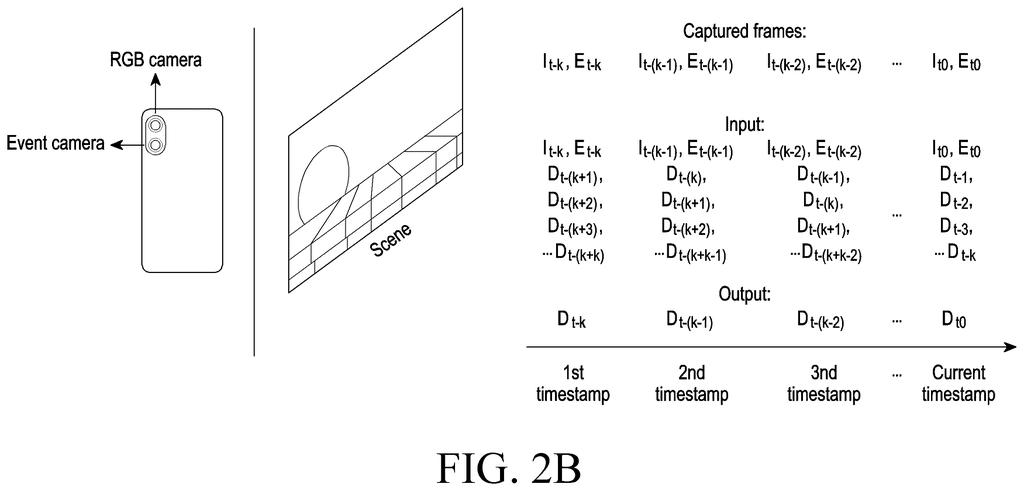
Samsung's patent describes adding an event sensor alongside the regular camera. Unlike a normal camera that captures complete pictures at set intervals, an event sensor only registers which pixels change and when, firing off thousands of tiny updates per second at almost no power cost. The patent uses that stream of pixel changes to track how depth is shifting between full camera frames, then stitches all of that information together into one accurate, continuously updated depth picture.
The result, at least in theory, is depth data that stays accurate even when you or your subject is moving quickly, without making the phone work dramatically harder.
… capturing one or more event frames over a time period between the current video frame and each of the one or more previous video frames using an event-sensor of the electronic …
Translation: It records micro-changes between regular frames using a specialized sensor.
How the event sensor aligns and fuses depth maps
The patent describes a pipeline that runs on an electronic device equipped with both a conventional camera and an event sensor (a chip that detects per-pixel brightness changes, rather than taking complete snapshots).
Here is how the process flows:
- The camera captures the current video frame and one or more recent previous frames.
- A depth map (a grid that assigns a distance value to each pixel in the image) is estimated for each of those frames using standard depth-estimation techniques.
- While the camera is between frames, the event sensor captures event frames, which are lightweight records of exactly which pixels changed brightness and by how much.
- Those event frames are used to align the older depth maps to match the current frame, compensating for any camera or scene motion that happened in the meantime.
- Finally, the aligned historical depth maps are fused (combined and averaged in a principled way) with the current depth map to produce an updated, higher-quality depth estimate.
The key insight is that event sensors produce data at much finer time resolution than conventional cameras, which typically shoot at 30 or 60 frames per second. By using that high-frequency change data to bridge the gaps, the system avoids the depth errors that accumulate when fast motion occurs between full frames.
… aligning the depth map of the one or more previous video frames with the depth map of the current video frame using a change in pixel intensities indicated by the one or more event frames …
Translation: It uses those tiny intensity changes to match up the 3D measurements across frames.
What this means for AR, autofocus, and 3D video on phones
Depth accuracy in video underpins a surprising number of features you probably already use: portrait-mode video blur, AR filters that stick to surfaces, fast and accurate autofocus, and any kind of 3D scene reconstruction. When depth data is stale or misaligned because something moved quickly, those features glitch in ways that are immediately visible, like blur halos snapping around a moving person's head or an AR object suddenly floating off a table.
Samsung has been building its own image sensor and event sensor hardware for years, so this patent fits into a plausible roadmap for future Galaxy cameras. People shooting fast-moving sports, kids, or pets would be the first to notice a real improvement, because those are exactly the situations where depth estimation falls apart today. This filing sits alongside a broader wave of new Big Tech patents targeting event-sensor video processing, a hardware category that is moving from robotics labs into consumer imaging faster than most people expected.
Samsung's 89th filing we've tracked since May joins earlier work like one on bright and dark areas and one on blocking edge blur in our camera sensor efforts.
The person who notices this patent's payoff is the one recording a birthday party or a toddler's first steps, where the subject keeps moving and the background blur keeps flickering or latching onto the wrong thing. By using event-sensor data to bridge the gap between video frames, the system keeps the depth map stable and accurate even during fast motion, so portrait-mode video behaves the way users already expect portrait-mode photos to behave. That consistency, maintained automatically and without any extra steps from the user, is what turns a feature people distrust into one they rely on.
There are more where this came from
We read every patent application Big Tech publishes and send you the ones worth knowing. Plain English, free, every week.
The drawings
12 drawing sheets from US 2026/0245227 A1 · click any drawing to enlarge


Want this weekly breakdown for a company we don't cover? Patentlyze Pro →
Be the first to weigh in