
Qualcomm Patents Tech That Lets Users Choose How Their Phone Reads Photos
Qualcomm has filed a patent for a device that lets users choose, at runtime, which image-analysis engine processes a video stream. That sounds like a small detail, but it touches a real tension in on-device AI: flexibility versus efficiency.
What Qualcomm's switchable image encoder actually does
Ever wondered why one AI camera app handles fine detail better than another, even on the same phone? The short answer is that different AI engines are built for different jobs, and most devices are locked into one.
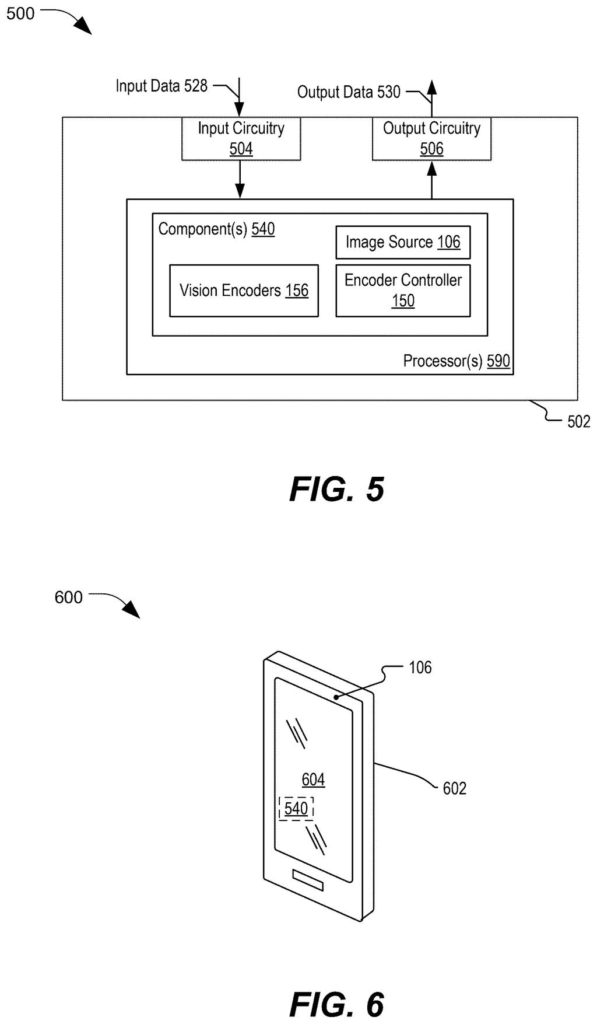
Qualcomm's patent describes a device with several image-analysis engines built in. Based on your input, the device picks the one best suited to the task and runs it on your video feed, frame by frame. Each engine produces output data that gets stored in memory for whatever comes next, whether that's identifying objects, tracking motion, or something else entirely.
The practical idea is that you, or an app acting on your behalf, get a say in how the device sees. Rather than one fixed approach baked in at the factory, the system is designed to be reconfigured depending on what you need it to do.
select, based on a user input, a hierarchical vision encoder (HVE) from a plurality of vision encoders; and use the HVE to process an image frame of a sequence of image frames to generate encoder output data.
Translation: You can pick which specific software tool your phone uses to analyze and understand the images in a video.
How the device picks and runs a hierarchical vision encoder
The patent describes a device with a processor, memory, and a collection of vision encoders to choose from. A vision encoder is essentially an AI module that takes raw image data and converts it into a structured representation that other software can work with, much like a translator turning spoken words into text.
The specific type Qualcomm focuses on is called a hierarchical vision encoder (HVE). Hierarchical means the encoder analyzes an image at multiple levels of detail at once: broad shapes at one layer, finer textures and edges at the next, and so on. This layered approach is common in modern computer vision systems because it captures both the big picture and the small details without needing separate passes.
The key mechanism is conditional selection: a user input (which could come from a person, an app, or a system setting) triggers the device to choose one encoder from the available set, then apply it to a sequence of image frames. The resulting encoder output data is stored in memory and passed downstream.
- Memory stores the outputs from whichever encoder is active
- The processor selects the encoder based on user or system input
- The chosen hierarchical vision encoder processes each frame in sequence
A device includes a memory configured to store one or more sets of encoder output data. The device also includes one or more processors coupled to the memory and configured to select, based on a user input, a hierarchical vision encoder (HVE) from a plurality of vision encoders.
Translation: The phone stores data from your photos and lets you choose the specific method it uses to interpret those visual files.
What this means for on-device AI image processing
For end users, the immediate implication is an AI camera or video system that can adapt to context rather than being permanently optimized for one scenario. A surveillance use case might favor one encoder's sensitivity to motion; a medical imaging app might prefer another's fine-grained detail. Having the selection tied to input means the same physical hardware can serve multiple purposes without a firmware update.
For Qualcomm specifically, this fits a broader push to make their chips more configurable at the software layer, which matters as device makers ask for more flexibility without giving up the power efficiency that dedicated silicon provides. Qualcomm's on-device AI chip filings have been piling up, and Patentlyze's plain-English patent summaries show a clear pattern of the company trying to give developers runtime control over what had previously been fixed hardware decisions.
This is the seventh Qualcomm filing we've tracked since July in our AI models working together watch, following one recording model disagreements and one monitoring wireless chips.
Letting users switch between image-processing modes at runtime means the device must keep multiple systems loaded and ready at all times. That idle weight costs battery and memory even when only one mode is running, and every switch adds a small delay that compounds if the user toggles frequently. The trade reads as worth it only in narrow circumstances. A shared device serving a building inspector in the morning and a medical worker in the afternoon has a genuine reason to adapt. A personal phone doing one job reliably does not, and forcing that overhead onto it is a bad bargain.
The deeper problem is that the patent describes the switching mechanism but says almost nothing about what makes each mode actually good at its specific job. Switching quickly between two mediocre options is not progress. The quality of each mode is where the real value lives, and this design leaves that question open.
Get our take in your Top Stories
Liked this breakdown? Add Patentlyze as a preferred source on Google, and our plain-English take shows up more often in your Top Stories the next time Qualcomm patent news breaks.
There are more where this came from
We read every patent application Big Tech publishes and send you the ones worth knowing. Plain English, free, every week.
The drawings
16 drawing sheets from US 2026/0253256 A1 · click any drawing to enlarge


Want this weekly breakdown for a company we don't cover? Patentlyze Pro →
Be the first to weigh in