
Apple Patents a True Optical Zoom Lens That Fits Inside a Thin Phone
Getting a real optical zoom into a phone camera is hard because zoom lenses need room to move. Apple is patenting a system that pulls it off in a housing less than 6 millimeters tall.
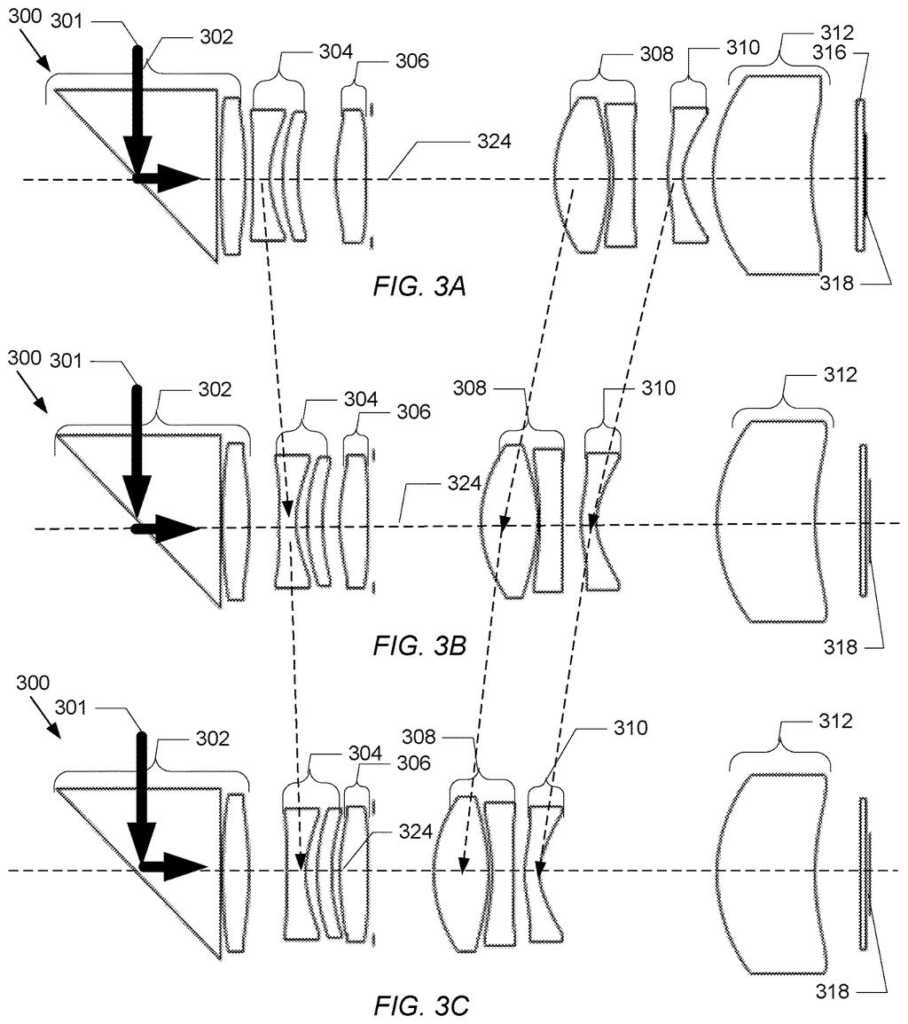
How Apple's thin zoom lens moves three parts at once
A thin phone sits flat on your desk, but inside it, a camera is trying to do something physically tricky: zoom in on a subject without just cropping the photo. Real optical zoom requires lenses to slide back and forth, and that sliding takes space most phones don't have.
Apple's patent describes a camera system with three separate groups of lenses, each one connected to its own tiny motor. When you pinch to zoom, a small controller tells each motor exactly how far to move and in which direction. The groups don't all move the same way, some go one way, some the other, and together they change the focal length while keeping the image sharp.
The whole stack of lenses is under 6 millimeters tall, which is roughly the thickness of four credit cards. The system also lets in more light than typical compact zoom lenses, with an f-number below f/3.0, meaning photos stay bright even as you zoom.
A lens system provides a zoom function (variable magnification) in a low profile camera (lens system height less than or equal to 6 mm), which may be in a cellular phone.
Translation: The camera lens provides true optical zoom while staying under six millimeters thick to fit inside a phone.
How the three-group lens system changes focal length
The patent covers a zoom lens system designed specifically for low-profile cameras, defined here as any housing 6 mm or shorter in total height. That constraint rules out most conventional zoom designs, which rely on a long barrel that physically extends outward.
The core of the approach is three independently movable lens groups, each driven by its own actuator (a small motor or electromagnet). A central controller coordinates them: when the user requests a focal length change, the controller calculates the required displacement for each group and sends individual signals. Critically, each group can move a different distance and in a different direction along the shared optical axis. That asymmetric movement is what compresses a full zoom range into a shallow physical stack.
Focusing is handled by one of the three groups rather than a separate element, which keeps the total part count low. Key specs called out in the filing:
- Total lens system height: 6 mm or less
- Maximum aperture: below f/3.0 (wider than many compact zoom lenses, meaning better low-light performance)
- Target device: explicitly mentions cellular phones
The patent names Masaharu Hosoi and Yoshikazu Shinohara as inventors, both names associated with precision optics work, and was filed in October 2025.
What this means for iPhone camera hardware
For anyone who has watched a phone camera's quality drop when you tap the 2x or 5x button, this is directly relevant. Many phones today switch between fixed-focal-length lenses rather than truly zooming, what you see as "3x zoom" is often just a different physical camera with a longer fixed lens. True optical zoom inside a single, thin unit would mean smoother transitions and better image quality at in-between zoom levels you can't get from a two-lens switcher.
Apple has already experimented with periscope-style telephoto lenses that fold the optical path sideways to gain length without adding height. This patent takes a different angle, keeping the lenses upright but carefully choreographing how they move relative to each other. Camera optics is one of the faster-moving areas in Apple's filing history, and Patentlyze tracks the full stream of plain-English patent summaries covering how Apple's optical engineering choices connect to what ends up in your pocket.
Apple's 333rd filing we've tracked in our Apple coverage since May adds to a run of headset ideas that includes per-eye image delivery and 3D content sharing controls.
The 6 mm limit is what makes this worth caring about for anyone who owns a phone. It means a real zoom, the kind that smoothly closes in on a faraway face without the sudden blurry jump you get today, could fit inside a phone no thicker than what people already carry.
The honest question is whether it survives real life. Three separate moving glass pieces have to hit their exact positions every single time, and that kind of fussy mechanical teamwork tends to fall apart after a year of drops, cold mornings, and hot cars, long after the patent lawyers have moved on.
There are more where this came from
We read every patent application Big Tech publishes and send you the ones worth knowing. Plain English, free, every week.
The drawings
6 drawing sheets from US 2026/0244001 A1 · click any drawing to enlarge


Want this weekly breakdown for a company we don't cover? Patentlyze Pro →
Be the first to weigh in