
Apple Patents Controls for Sharing and Dimming Content in 3D Spaces
Apple is working on ways to let people share what they're looking at inside a three-dimensional environment, while also giving the device tools to dim the world around a piece of content so it stands out.
What Apple's spatial content-sharing patent actually covers
Imagine you're wearing a spatial headset and you want to show someone else a photo, video, or document you're viewing in the space around you. Right now, handing that experience off to another person isn't always obvious or smooth, especially when your content is floating in a full three-dimensional room.
This patent covers three related ideas. First, the device can dim or de-emphasize the 3D world around a piece of content, so the thing you're focused on gets all the visual attention. Second, it can reshape or adjust the edges of a content window, rather than always showing a hard rectangular border. Third, it includes tools for actually sharing that content with other users who are in the same environment.
None of these ideas are shocking on their own, but together they sketch out a more considered approach to how a headset handles the moment you go from private viewing to social viewing.
… an electronic device selectively de-emphasizes a three-dimensional environment in which content is presented …
Translation: Apple's device can dim the background world to help users focus on what they are viewing.
How the device dims surroundings and reshapes content edges
The patent covers three distinct capabilities, all aimed at making content presentation feel more intentional inside a three-dimensional environment.
Selective de-emphasis of the environment: When the device decides (or the user signals) that focus should shift to a specific piece of content, the surrounding 3D space is visually suppressed. Think of it like a spotlight effect: the room fades back and the content comes forward. This matters because in a fully rendered spatial environment, competing visual elements can make it hard to direct attention.
Boundary modification: Instead of every window or panel appearing as a rigid rectangle, the device can modify the boundaries of content in the user interface. This could mean softer edges, shaped frames, or dynamically resized borders depending on context. The technical goal is giving the UI layer more expressive control over how content occupies space.
Sharing with other users: The device includes a mechanism for presenting content to other users within the same three-dimensional environment. The patent doesn't lock this to any specific sharing protocol, but it implies a coordinated handoff so multiple people can see the same content simultaneously.
All three features appear to be coordinated at the OS or system layer, not just inside individual apps.
What this means for spatial computing and shared viewing
For people who use or are curious about spatial computing headsets, this patent points to Apple thinking carefully about the social layer of the experience. Solo use cases are relatively well understood; shared viewing inside a 3D space is much harder to design well, because you have to manage focus, ownership, and visual context all at once.
The boundary-reshaping and environment-dimming ideas suggest Apple wants the OS itself to handle these transitions, rather than leaving each app to figure it out independently. That's a meaningful design decision, and it's the kind of detail that shows up in plain-English patent summaries covering spatial computing and AR before the products that use them ever get announced.
Apple's 35th filing AR glasses ideas we've tracked since May builds on work like per-eye image delivery and avatar consistency in calls.
Showing someone else what you see in a mixed reality headset is genuinely awkward today. Without a shared way to point at things floating in 3D space, two people wearing headsets quickly lose each other, or give up and just take the headsets off.
Apple's answer is to dim the room around you and reshape the edges of whatever you are both looking at. That steers attention cleanly, the way a spotlight steers attention in a dark theater.
Will that fix every problem with working together inside these environments? No. But the problem it solves, the basic confusion of shared looking, is one that stops real work right now.
There are more where this came from
We read every patent application Big Tech publishes and send you the ones worth knowing. Plain English, free, every week.
The drawings
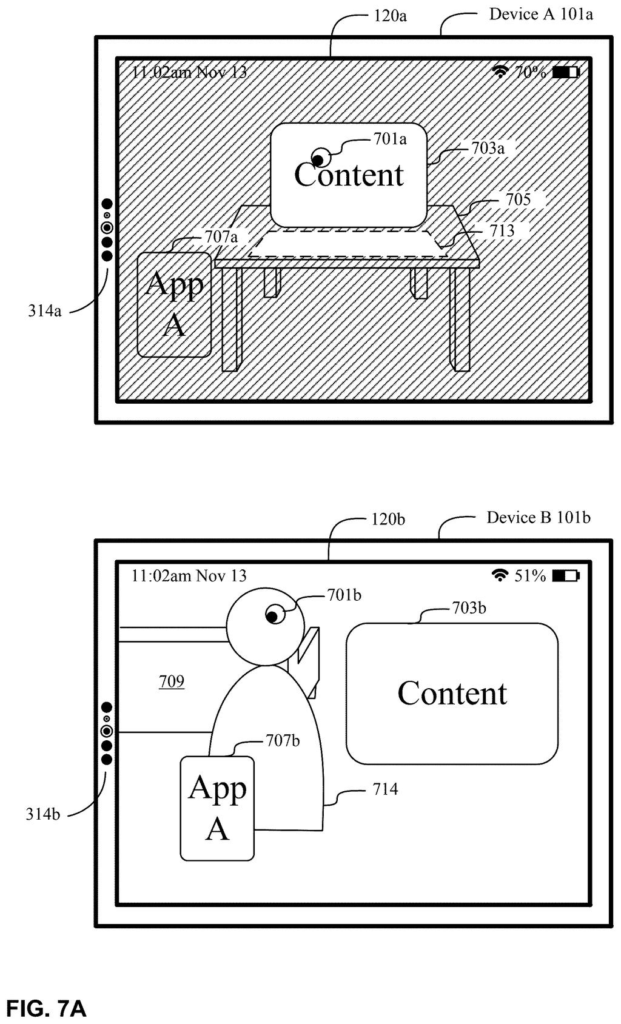
40 drawing sheets from US 2026/0244267 A1 · click any drawing to enlarge


Want this weekly breakdown for a company we don't cover? Patentlyze Pro →
Be the first to weigh in